What is ‘Home’?

Screen Shot 2019-06-09 at 10.48.32 AM

I’m on Day 2 of my Staycation so it’s exciting to drop in for today’s June entry. I know I don’t relax well; I have a difficult relationship with leisure time. As much as I crave it, I also have my heart and brain tugging at me to make great use of my time. I am one of those people who has to learn to be ok with slowing down which is not something I’ve done much of as I’ve juggled full-time work and school. Funny story, but I’ve noticed that once I became eligible to work, I juggled more than one commitment.

My pattern of activity has differed over the years. I started working part-time in high school, holding down that job for two years. I also partially committed to sports, completing two seasons of track and one season of cross county. I only made it through one semester of college before picking up a student worker position. During my Marine Corps career, I occasionally picked up college classes, paying for them with DoD tuition assistance. A return to college after separating from the Marine Corps also meant a return to part-time work. I did not find a decent paying position when we moved to Wyoming so I committed solely to my undergraduate studies until we decided to have our daughter and then I juggled parenthood and collegiate studies until my May 2012 graduation. The short “break” in excess commitments ended in 2014 when I returned to school as a graduate student while working full-time. I graduated May 2016 but I picked up another graduate program October 2017, again while working full-time.

Big sigh here. I am my own worst enemy about overcommitting myself to projects.

It’s a big part of why I’ve taken a break from my memoir writing and my blog writing. I’ve needed to rest to see how far I’ve come in my journey and to reflect on the right things, instead of the things that have been difficult. I want to present you all with my best self and to do so means slowing down. I have to be ok with not getting the draft of my memoir finished this year (or realizing I am still capable of getting it done once my degree program is finished). It’s not a paid project, yet, so I should not beat myself up for taking my time with what is to be my longest writing endeavor.

Getting back on track with today’s lesson, I am here to talk about developing a sense of home. I’ve been blessed to live in many different areas, some domestic and some places overseas. In each instance, I had a family arrangement composed of biological and non-biological relations which also includes friends. When I was overseas, I remained connected to my domestic group using snail mail, e-mails, and MySpace. 2007 was the last time I was overseas, but I still use technology to keep in touch with my domestic group, favoring Instagram and Facebook, and my overseas connections. (I’m pretty certain I also stopped using MySpace in late 2007 and started Facebook some time in 2008; I’m pretty late to using Instagram, only creating an account in 2016!).

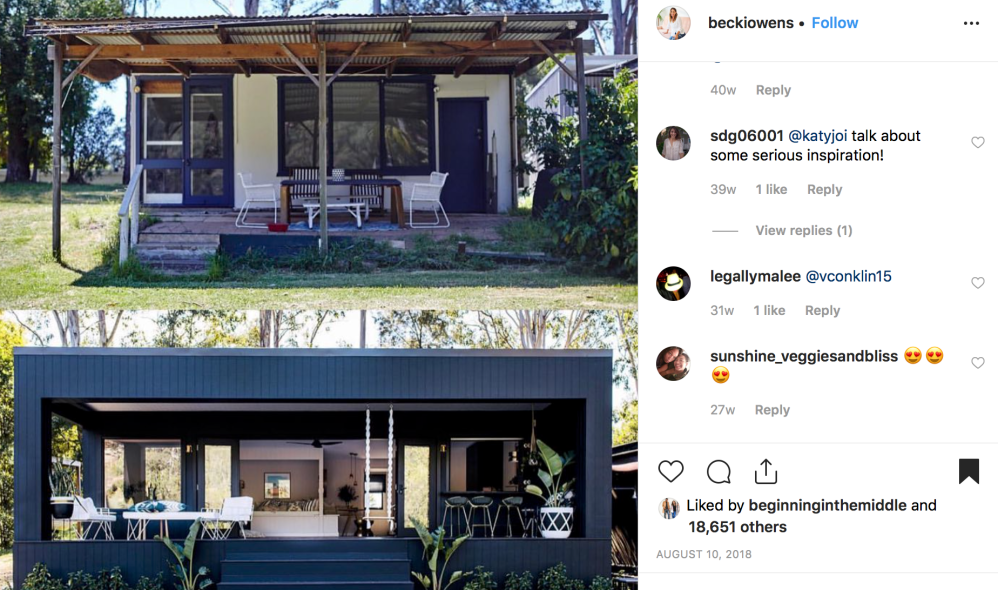
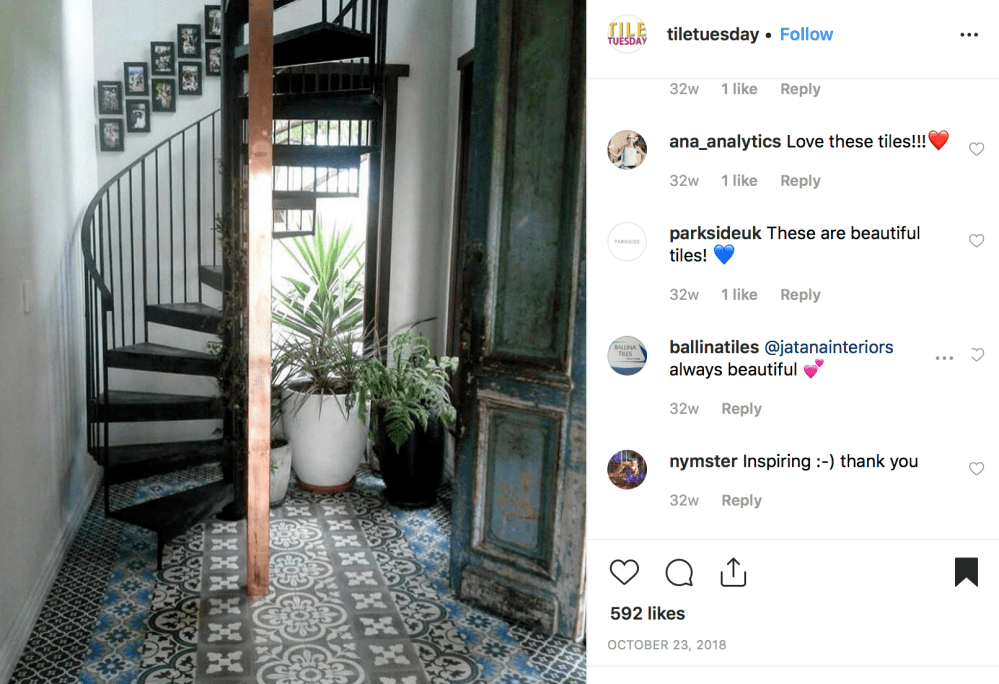
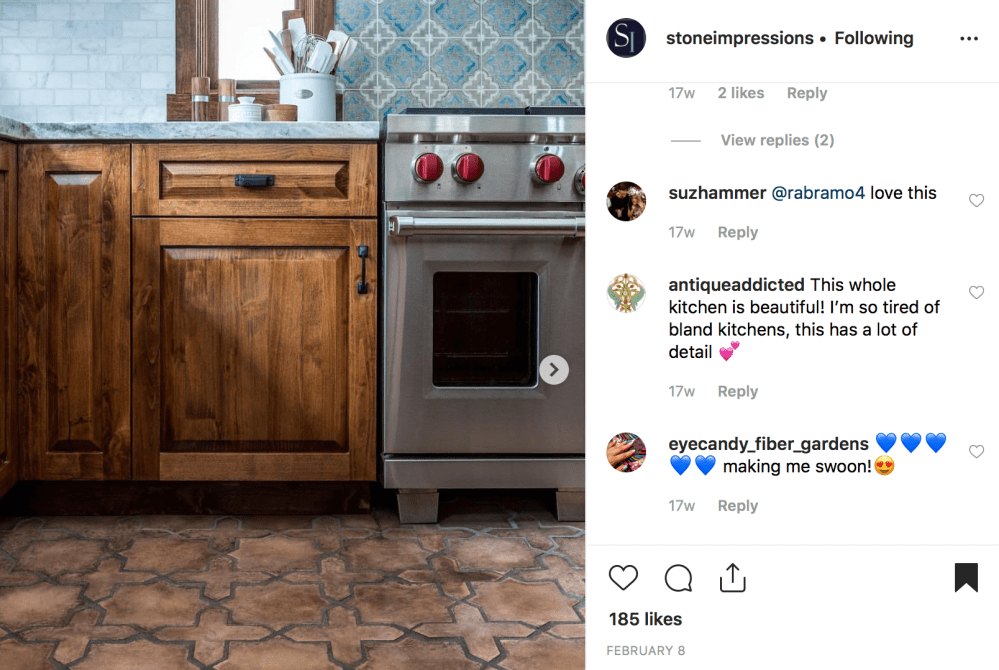
With my journeys, I’ve developed an eclectic home with my husband and daughter. It is part California and Rhode Island. Ocean blues dominate in many different areas: furniture, clothing, and towels, for example. The touches are not nautical themed, but we do have some ocean artwork in our residence. My coastal life and regional upbringing are more present in my food preferences. Meals at home have included shrimp, scallops, clams and oysters, a variety of fish, langoustine, Mexican chorizo and Gaspar’s chourico.  It’s hard to think of a pasta I don’t enjoy; I can, instead, list my preferences for you. A love of travel also influences our decor, food choices, and down the road, our tile choices for our dream home. I’ve shared a few things below I’ve found through Instagram and love.

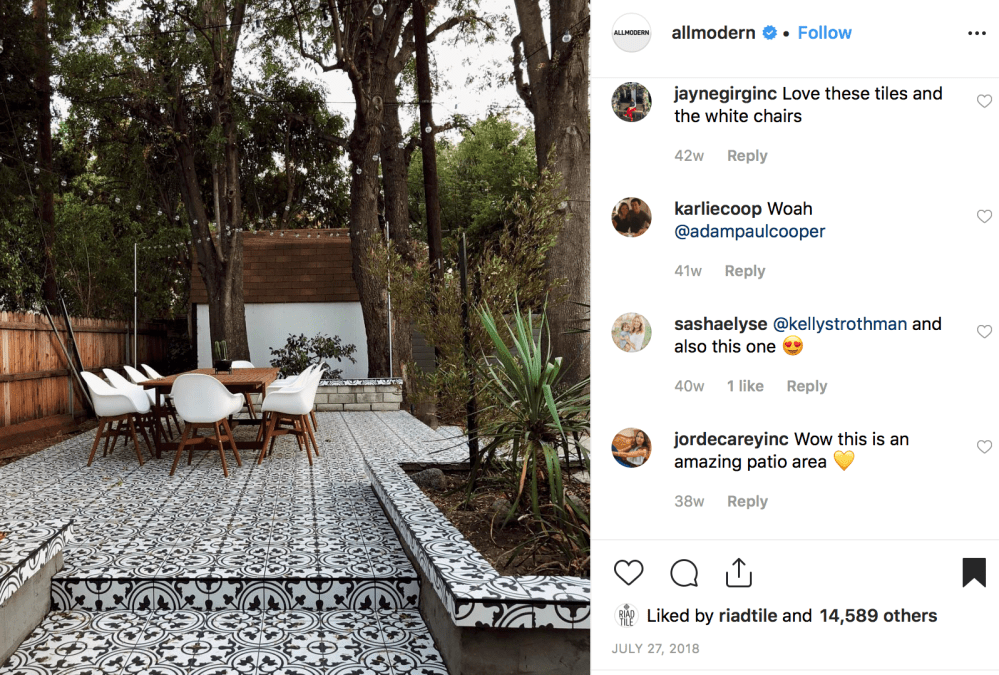
Screen Shot 2019-06-09 at 10.55.10 AMScreen Shot 2019-06-09 at 10.53.06 AMScreen Shot 2019-06-09 at 10.52.14 AMScreen Shot 2019-06-09 at 10.49.26 AMScreen Shot 2019-06-09 at 10.47.41 AMScreen Shot 2019-06-09 at 10.47.19 AM

I know this entry is quite different from many that focus on my time in the Marine Corps and my service in Iraq. Today is the anniversary of my mother’s death and I wanted to reflect on the adult I’ve become because I moved away from home, the place she grew up. Rhode Island is beautiful in many ways, but there’s always this part of me that felt it wasn’t where I was meant to stay. It is, though, a place I return to and I appreciate it greatly when I am there.

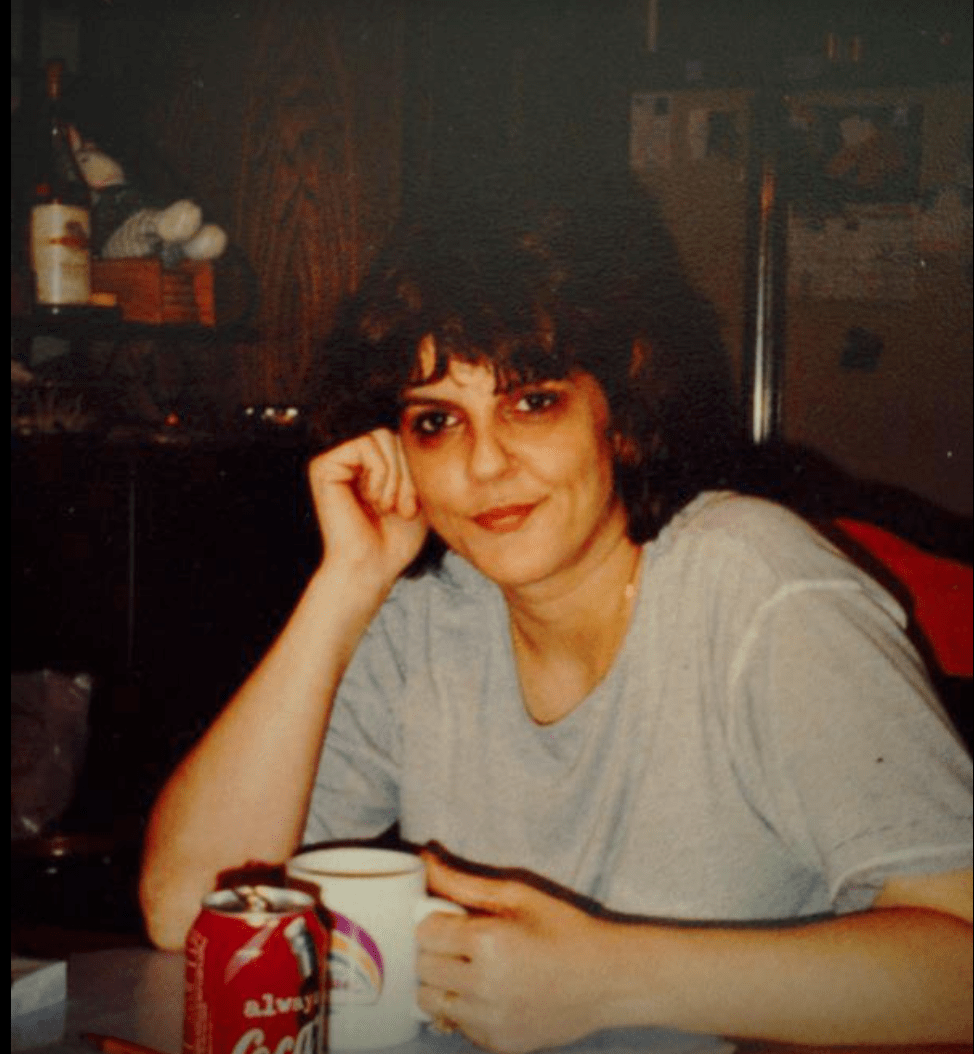
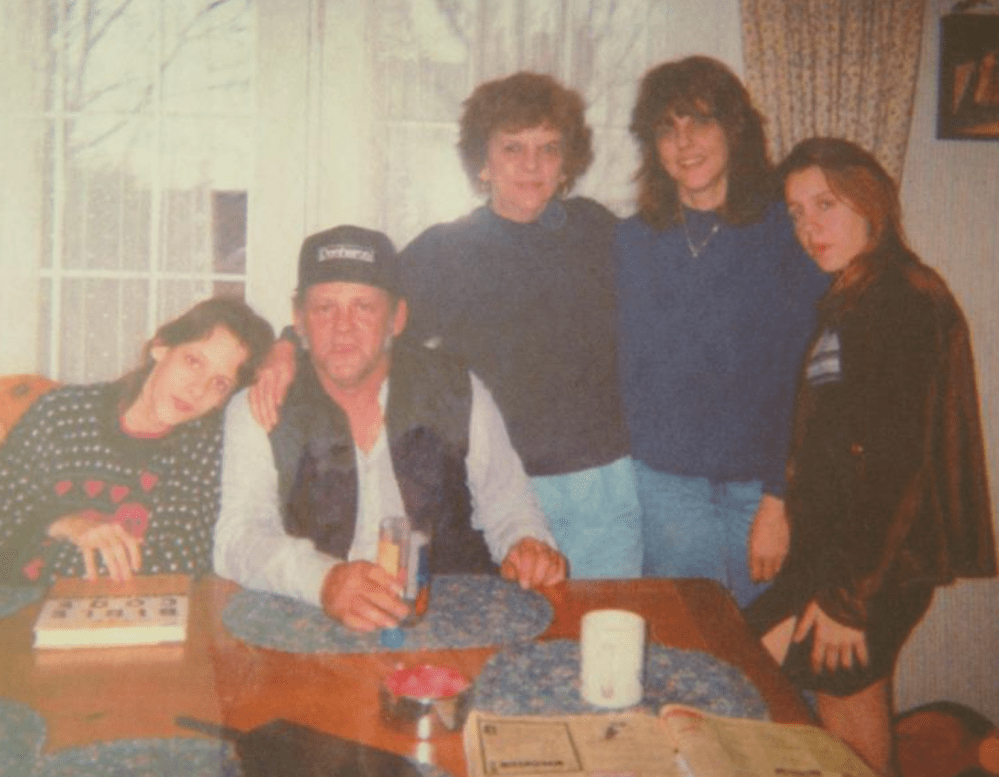
My home is different from the home she created for our family. Her home was eclectic, too, in a different way. While these family photos show our family members front and center, please also pay attention to the decor style. Each of us come into our own by our upbringing, resources, and societal influences during our life course. My mother was someone who was not only a care taker of her children, but someone with a green thumb she did not pass along. The array of indoor plants she kept is not something I’ve mastered in my own life. We can barely manage cut flowers and I’ve only recently nurtured my daughter’s $7.99 orchid from Trader Joe’s, mostly because that thing only needs 2 Tablespoons of water once a week. My mother’s home reflected a country influence with an interesting love of Chinese white and blue ceramics and black lacquer screens. She liked floral print fabric place mats and could sew curtains for our home.

When we lived in our Chula Vista, California townhome with its patio (probably the same size of slightly smaller than my current one), our home was filled with some trending home decor items of the 1980’s and 1990’s. We had woven wood bowls similar to these and oversized wooden utensils for wall decor. She had these macrame style owls on our walls and our childhood birthday parties lacked the overdone party themes present in today’s childhood parties to make them Instagram worthy. She was not a person who lived being photographed so it’s hard to find photos of her and also photos of our past homes to show off her design choices.

She was a simple woman in her preferences and style. She loved to read. Aside from V.C. Andrews novels and true crime books, she would regularly pick up gossip magazines. She dressed pretty casually for the most part but also had some dress clothes, particularly for going out with her girlfriends. I never adopted her love of going out dancing with friends, but she helped to build my love of reading. Her book collection was not off limits to us and she is also the reason I had quite a love affair for Pier 1 Imports for many years.
Screen Shot 2019-06-09 at 11.09.17 AM

Screen Shot 2019-06-09 at 11.08.15 AM
Our dining room in our Chula Vista townhome.
Screen Shot 2019-06-09 at 11.07.37 AM
Our last Christmas together. My mother was dealing with Stage 4 lung cancer.
Screen Shot 2019-06-09 at 11.07.16 AM
The floral print tile in the background of these photo is one of my mom’s last design choices in our Rhode Island home.
Screen Shot 2019-06-09 at 11.07.00 AM
My late mother in our Imperial Beach, CA home (possibly 1996). 
Screen Shot 2019-06-09 at 11.06.30 AM
My sisters and I in our Imperial Beach, California rental home.

It’s fun to think of what her thoughts would be on my adult home that is so vastly different and also similar to her own and the plans for which are more global than local in inspiration. We both have been drawn to blue in our homes, with a wedge wood blue once dominating her kitchen cabinets whereas we’ve chosen Behr’s Dawn Gray (a dramatic dark blue in natural light that appears gray at other times) for different parts of our current home. Our family garage in our Imperial Beach home served as her exercise/home office and our home is littered in different areas with weight plates and other exercise equipment. I’ve replaced her Tony Robbins cassette tapes with a series of self-improvement and writing reference books. In lieu of her Asian inspired home decor and wooden wall art, my family’s first home features various wooden furniture and someday our forever home will feature geometric Middle East inspired tile. I am not as fond of floral prints and plant maintenance but I am not opposed to some cacti and succulents for greenery in our outdoor space. These low maintenance plants are well-suited to my poor nurturing skills and the needs of our local environment.

And to end on a real light note, I am not sure what my mom would think of my vegan and vegetarian food choices. As a mother of four, she had more practical choices to make with her limited food budget. I think she would have been hesitant to try things like tofu, jackfruit, almond coconut milk, and vegan cheeses. While I am not happy when we have food waste, I also recognize it’s good for my family to try new things like these items so I test out food recipes–even vegan and vegetarian options to encourage more fruit and vegetable consumption in my household–more than I think I ever saw my mother do during my upbringing. (Side note: We aren’t strong fans of vegan cheese but we do like the vegan ice cream options we’ve had in the past.) I know in making these comparisons, too, there will never be a complete “apples to apples” comparison with my mother’s choices as so much as changed in society from 1984 when I was born to 2000 when she passed and where things are now in 2019. It’s still fun though to think of what these stories mean for our family. As I’ve learned, our sense of ‘home’ is uniquely created and something we continue to develop over our lifetimes which impact not only us but the people we bring into this space.

Finding Self-Confidence

Good morning, everyone.

April kicked me a lot so I wanted to drop in to say hello. I know I am not the only one who faces setbacks or hits a rough patch in life and as much as I share motivating things, I want to be honest I don’t have perfect days either. I’ve talked a lot less about those as my writing has progressed, but it has been a journey to be confident in the face of setbacks and disappointments.

Year after year, I’ve worked on finding self-confidence. I admired more confident peers in high school and when I went to Florida Southern College, one of my goals was, “To be more confident.” Even during my career as a Marine, I didn’t feel confident in my abilities. One of my best achievements was beating the perfect run time (as a woman) for the 3-mile run section of the physical fitness test; the perfect time was 21 minutes and I ran that test–and the only time I managed to do so–with a run time of 20 minutes and 15 seconds.  I had been a good runner in high school but never managed to be a top performer in my track event or cross country, but I wasn’t as content with my perfect Marine Corps run time for as long as I hoped I would be. Instead, I beat my self up for being a poor performer in the other Marine Corps skills areas, like the fact I was never able to improve my marksmanship skills from marksman to sharp shooter. In my current role as grad student, I get nervous each week I have a paper due because I want to do exceptionally well. I still find it hard to feel like I will succeed on that weekly assignment although I completed my first grad program with a 3.96 GPA and I have a 3.95 in my current program.
My nagging insecurity is why I reach out for self-improvement/reference materials and look for new tools to accomplish what seems insurmountable or to carve out a different routine because I know no one else can cure me of bad habits.

Oddly enough, as much as social media gets a bad wrap, I constantly find motivational sentiments on Instagram that I hoard in collections on my profile. I love knowing other souls want to spread good messages out into the world and it doesn’t matter that we may never meet. The things people choose to share reveal a lot about them, whether we are talking about filtered or unfiltered content. This reality is something that speaks me, particularly as I come to the conclusion of my current class and I’ve spent this last week sitting down with the idea that knowledge is a global public good.

Screen Shot 2019-05-04 at 10.20.17 AM.png

On an individual and global level, we all experience some traumatic or discomforting events in our lifetimes that alter our worldview. We might become more timid, angry, disillusioned, or ambitious as a result of these circumstances or the people that bring these events to our lives. I know, for me, one of the biggest problems has been letting go of failures and failed personal connections. I do not like when I’ve faced rejection in the workplace or people who treat me like what I ask from them is too much. I am the person who—although it’s taken me years–jumps in with both feet. I have struggled to find my voice and to use it. Now that I am more confident in my abilities, I am more open in what I share and to the audience(s) I share my thoughts.

Shedding the insecurities that harm my self-confidence has not been easy.

Screen Shot 2019-05-04 at 10.21.01 AM

It’s taken a lot to realize people who treat me poorly or who cannot compromise do not reflect my self-worth. Everyone has his or her own hangups that can hinder their ability to live an awesome life or to treat others with the utmost respect deserving of their person. My ventures into graduate school in 2014 and again in 2017 have taught me I do not want to compromise on my goals or lifestyle to make others feel more secure in who they are. I do not want their negative comments to creep into my mind and make me feel unworthy. I also do not want any rejection I’ve ever faced to keep me from self-improvement. When I lost out on job opportunity after job opportunity in 2012, I felt no one would ever hire me or if so, it would almost be a fluke. That thought process did a great disservice to my efforts to earn dual Bachelor’s degrees and to perform well on all the jobs I had done up until that point in my life. I should not be my worst critic and I say the same thing to you.

Whatever bad things you say to yourself internally or aloud are things you need to stop repeating.

Screen Shot 2019-05-04 at 10.21.25 AM.png

Yes, there are a lot of things outside of our control, but there are many more things we can control that we do not give ourselves credit for and which we should. Each day we wake up represents a fresh opportunity. We can get in better shape. We can attempt a new hobby. We can seek out new income earning opportunities or accrue more responsibilities within our organizations or communities because we desire for these areas to be more appealing. We can add loved ones to our families or add friends–true companions, not superficial relations–to our support network.

This blog–and the time I’ve invested in it–represents a bigger change to who I am as a person than I expected it would when I took the baby steps into writing for a public audience; it’s shown me how I’ve been developing personal confidence over nearly a five-year period. It shown me what I can accomplish by reaffirming I am worth continual investment and I should ignore anyone who naysays my personal projects. It’s shown me I can learn from tragedy and rejection. It’s shown me I am an educator although I do not wear the professional title. It’s reminded me, more importantly, I must nourish who I am before I can serve others. In this last way, I’ve also learned there are times when I must cut back on my writing commitments. I used to feel so guilty about not being a consistent blogger but I am more confident now less posts but more substantial posts speak more to who I am and what I find meaningful.

In referencing writing, I didn’t have the heart this past month to contribute significantly to my Iraq memoir. The month become a period of personal reflection and I’ve had to remind myself to be grateful for the things that did not pan out. These realities gave me life lessons of what not to accept in my life and brought other people into my life I would not have otherwise known. I’ve met so many people who accept me, quirks and I, and who respect the pace with which I tackle personal and professional goals. I have also grown in confidence because I learned I was standing in my own way. I learned, day by day, I could stop harming my own progress and this past month was a reminder I’ve gone through this process more than once. Each time I start to let doubt creep in, I can also kick it right back out the door.

April may have been a disappointment but I have many more days, months, and years ahead to shake it off. I also have the power to appreciate today for what it is and who I am in this moment.

Screen Shot 2019-05-04 at 10.48.05 AM

See you next month, and stay motivated!


Learning to Spend Money Wisely? Me, Too.

I wanted to share some thoughts on a podcast I recently listened to because it’s on the issue of money. I listened to it maybe a week or two ago and it was hard to imagine not sharing it. (In fact, I’ve already shared it with a friend and felt more people could benefit from it.) Although the intended audience for this episode is service members and there’s guidance for veterans, too, I think the message can be encouraging for everyone to work on building their personal savings or just check out any of their other episodes for inspiration.

image1-2

I want to share everything is my own viewpoint. I am not writing on behalf of anyone I’m discussing today. I am also not writing in any way related to my employer since some things I want to share are related to the higher education industry. I do not receive any financial gain from anyone, but I found these tools useful for my purpose and I feel others might as well.

Current readers know I’ve made some poor money decisions, been unemployed, and found having the Post-9/11 GI Bill, earned through my military service, has changed my life. Some have also read my thoughts on using Dave Ramsey’s baby steps to improve my financial situation. This entry is along that same vine. More recently, I’ve picked up other tools for my financial toolbox: podcasts and a new budget book. 

I didn’t imagine I would get into listening to podcasts. I’m not entirely sure why because my mom used to listen to motivational tapes when she drove my sisters and I to school. I think I thought they weren’t something I needed. Mostly, I listen to music at work but a coworker mentioned listening to podcasts and by chance one day, I found out some of Refinery 29’s Money Diaries are available on podcasts. I know it shouldn’t be that exciting to me, but reviewing some of these money diaries where these women (and sometimes their partners, too) make substantially more money than I do is a form of social education. Money shouldn’t be a social taboo to talk about because we have the ability to harness our money better and we haven’t always been taught how to make those decisions. I have listened to other ChooseFI episodes, Millennial Money, and Bigger Pockets Money, which from one of their episodes is being rebranded Wider Pockets. 

I am certainly one of those people who was a bit late to making informed decisions about money. My friends, Jacquie and Ken, introduced my husband and I to Financial Peace University and it was the first step in the right direction. Our daughters are a month apart in age and by learning of their money story, we were free to say, “Hey, this is my money hurdle right now.” We had carried some serious debt with us from our time in California and took a money hit when we moved to Wyoming. I think this is the first time I ever truly discussed money with my friends and to be honest, it wasn’t easy. Their support was an important stepping stone and they are still great friends to this day. I wish I kept better notes when we were doing FPU but we managed a $9,585.10 turnaround in 91 days by exhibiting some discipline. We started the program January 2011 and by the end, we saved $1,839 and paid off $7,746.10.

This podcast episode is something I could have used during my four-year Marine Corps career. My career was a missed opportunity to save like crazy since we were just a family of two and before then, I made the decision to not commingle my money while dating. I just wasted my money on stuff like clothes, a computer, snack foods, and dining out. The only responsible thing I did was pay off my student loans. I know the opportunity to save like crazy is still available here and now, but it will look different. I don’t have free health care and dental as I did in the Marine Corps. I don’t have a housing allowance like I did on active duty. I don’t have any GI Bill benefits remaining. The awesome thing though is I am in a great position to earn more money as my career progresses and soon enough we’ll have a second income again.

I won’t completely unpack the episode from ChooseFI because I think that does a disservice to other listeners, the hosts, and the interviewee, Military Dollar, but there is an observation I have from personal experience. The implementation of the Forever GI Bill and the removal of the delimiting date–opens up a great window of opportunity for Post-/911 GI Bill students. (Note: The delimiting date is still applicable to certain recipients, but if you’re interested in learning more, check out the VA’s website.)

As a veteran who has used Chapter 33 benefits, I think the removal of the delimiting date will help cut down on the number of veterans and eligible family members who feel pushed into school before they are ready for higher education. I think if people feel more comfortable taking their time and understanding their personal and professional interests, they will–by and large–make more informed decisions about their schooling and perform better academically rather than flunking out and exhausting benefits before earning a degree. 

The other gain I see is the ability for veterans and eligible family members to conserve their entitlement for graduate programs. Some of what I’ve heard in listening to money podcasts is community college as a “life hack” and while I wouldn’t call it a life hack, I do agree it’s a smart investment. Community college is a cost-effective measure to reduce the expenses. (I’ve done it so I’m not just spitting out words here.)

Saving Chapter 33 benefits would be another “life hack” if we want to call it that for the purpose of today’s discussion. When I completed my undergraduate studies, I did not imagine I would ever attend grad school but that door opened up for me. Knowing this information now and as I complete my second graduate program, I love encouraging others to make more fiscally responsible decisions in regards to their education. Although I am no longer an Arizona State University student, I want to use their tuition and fees structure to make my point about maximizing the Post-9/11 GI Bill; that’s where I got my first graduate degree from and just to clarify, this discussion does not translate equally to private institutions as the VA has a tuition cap per academic year for private and foreign schools. Starting August 1, 2019, the tuition cap is $24,476.79 and if you’re interested in more info on VA education rates check out va.gov.

In this situation, we will imagine a veteran student who is at 100% with 36 months and 0 days remaining (i.e. a student starting fresh in his or her program.) This situation also assumes a student certifies for full enrollment each term. For simplicity purposes, I’m acting as though no other forms of financial aid are being utilized.

  • The student would receive book stipend up to 24 credits in an academic year ($1,000).
  •  The student would receive the Department of Defense rate for housing allowance; ASU’s rate is $1,602 a month for a full month of attendance. (Eligible students using this benefit before 1/1/2018 had a higher BAH rate. Partial months of attendance are pro-rated.)
  • The student would receive tuition and fees covered to the highest in-state rate.


The undergraduate example uses Ira A. Fulton Schools of Engineering programs at the Tempe campus:

Screen Shot 2019-04-05 at 3.51.26 PM.png

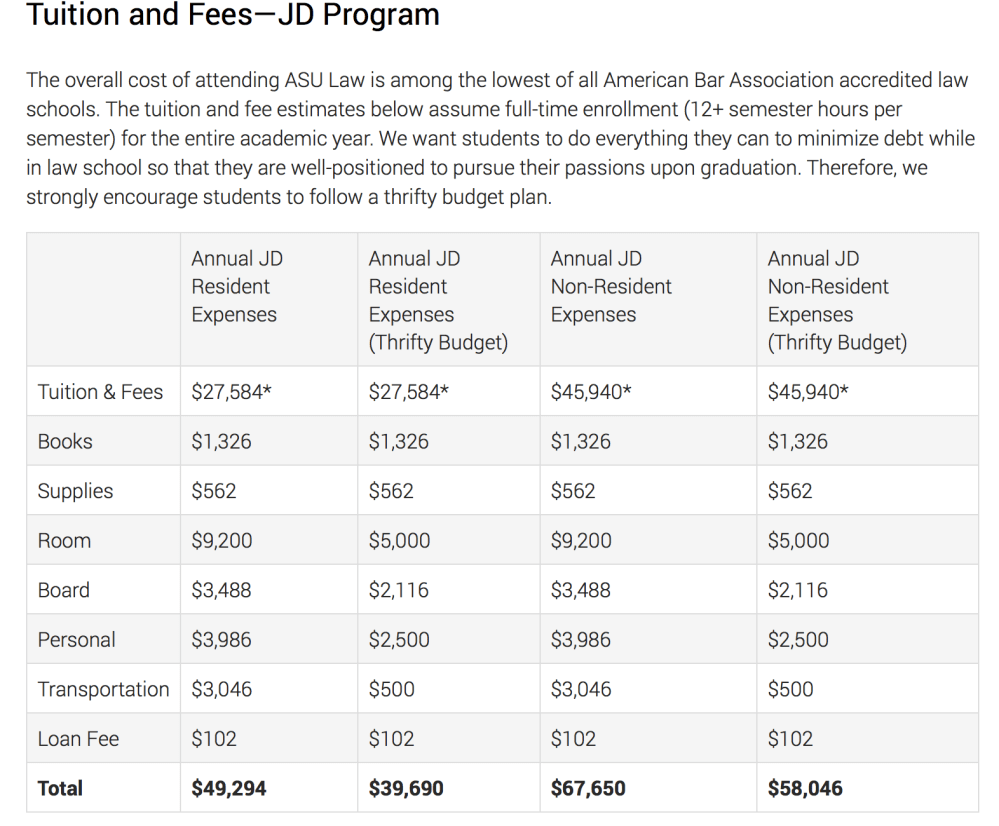
Here’s the Law program information:

Screen Shot 2019-04-05 at 3.39.33 PM

Screen Shot 2019-04-05 at 6.46.28 PM

It doesn’t take much to look at the cost of the law school tuition and fees to see why–for most students–if they can, they should reserve an appropriate level of benefits for their most expensive program. In most cases, that’s likely to be for grad and professional degree programs. A traditional term is sixteen weeks, so we’re talking approximately 4 months of entitlement per semester. A three-year program, like the JD program, uses approximately 24 months of benefits leaving the student the opportunity to have 12 months beforehand at the undergraduate level program.

I want to take a moment again to compare the fact the VA can pay the tuition and fees for this student at the JD level for ASU, a state school, although the total expense exceeds the tuition cap for private schools of $24,476.79 regardless of undergraduate or graduate program of study. 

It’s just some food for thought I wanted to share given the fact if we had found ourselves in a better financial situation when my husband returned to school in 2012, we also would have been benefitted in the long run to conserve benefits for his law school program.

Non-veterans could find something similar with employers who offer tuition reimbursement. They wouldn’t get the benefit of a book stipend and housing allowance like what’s attached to the Post-9/11 GI Bill, but it’s a good place to start to avoid accruing student loans or to reduce the overall portion of student debt.

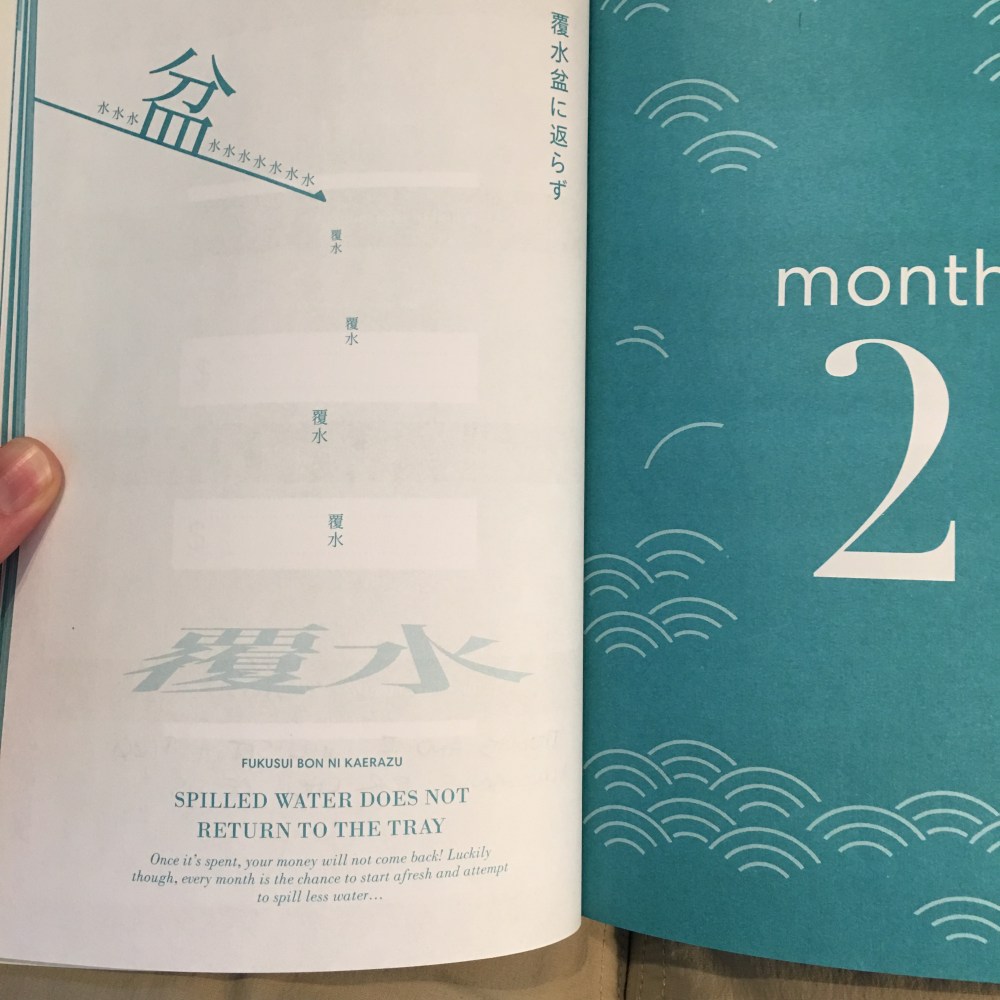
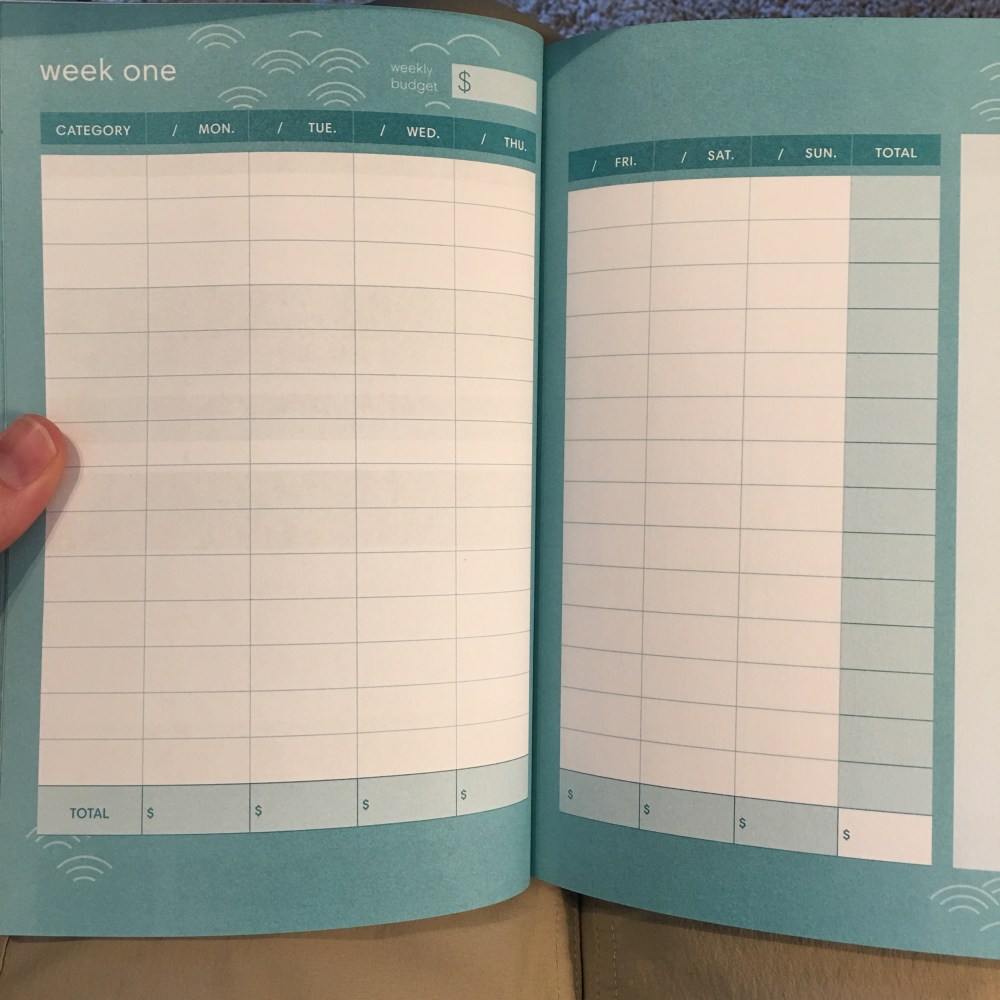
The other tool I started using recently is a new budget tool.

Screen Shot 2019-04-05 at 7.10.01 PM

We are only a few months short of us returning to being a dual income family and I want to just kill it on tackling debt, building savings, and contributing to our retirement. I like the teachings of Dave Ramsey but I am interested in changing things up a little to suit us better. I like the concept of the zero based budget Dave preaches but I didn’t like all the categories of the FPU budget so that’s why this book is particularly appealing to me.

IMG_7118IMG_7119IMG_7120

Once we both are working, my goal is to maintain our monthly budget at our current spending. The big change for us is holding off on buying a new house so we can have a yard instead of an 11 by 17 patio. While we’ve wanted a more suitable home space for entertaining, it’s logical to stay put so we can snowball our debts sooner. We are also fortunate the home we own is in good shape and we have some equity in it which will allow us a cushion leftover post-sale. I also think if we avoiding falling back into over consuming, we can enjoy our careers more. With this goal in mind, we will take some inspiration from the intense focus in the FIRE movement. We’ve discussed not fully embracing FIRE (Financial Independence, Retire Early) but we are onboard with being more intentional with our money. I found it interesting to learn the opposite of the debt snowball (starting smallest debt to largest) is the debt avalanche (starting with highest interest down to smallest) and as I explain below, our option is to pick a middle ground between the two. It’s clear the new budget tool/FIRE inspiration/Dave Ramsey Baby Steps as a combo is worth testing out to see how we like it.

This past month, I noticed we fell back into overspending on dining out. I think taking the idea of “money envelopes” again from Dave Ramsey is important for this budget category as it is our Achilles heel. We did do better in other categories like spending on gas and grocery shopping. I am being more intentional buying meat on sale and relying less on recipes. It’s easy to cut back at least $20 a week by reducing meat consumption and by using less recipes, we are cutting down on food waste. Thankfully, we all also like simple entertainment on a regular basis like being outdoors and riding our bikes, walking around the neighborhood, and watching shows. This lifestyle keeps our entertainment budget low without feeling like we’re deprived. Our longterm goal of serious travel will be something to save up for, but we’ll make our first trip happen in the next few years.

The last thing I wanted to talk about today is another deviation we’re taking away from the baby steps in FPU. This is my middle ground between the debt snowball and the debt avalanche. Baby Step 2 is to “Pay Off All Debt (Except the House).” We owe less on our house than we will for my husband’s education so we’re switching these around.  I’m not sure how other people might feel about it, but especially after the housing market crash, it’s better to pay off the house first in our opinion than those loans. It’s not like the law degree could be taken away due to failure to pay but according to Business Insider, nearly 10 million lost their homes due to foreclosure during the housing market crisis. I’d rather have a paid off roof off my head and those student loans sticking around a bit longer, so that’s the plan.

If you’re not familiar with Dave Ramsey’s 7 Baby Steps, here they are:

  1. Save $1,000 for your emergency fund.
  2. Pay off all debt (except for the house) using the debt snowball.
  3. Fully fund your emergency fund (3-6 months of expenses).
  4. Invest 15% towards retirement.
  5. Save for the kiddos’ college. (If you don’t want to have kiddos, let’s move on to step 6.)
  6. Pay off your home early. (Don’t want to own a home. Let’s move on to step 7.)
  7. Build wealth and give.


Thanks again for dropping by. I’ll check in with you all again in May.


Want to Go to College? Do It On Your Own Merit.

I grew up watching “Full House” with my family and honestly, it’s hilarious that famous parents like Lori Loughlin (aka Aunt Becky from “Full House” for those too young to have seen the show when it was on air) wasted enormous sums of money paying bribes to get their kids into colleges. I wanted to drop in last week to share my thoughts on the matter but my second class of the year started up and I got busy. Today marks the end of week one so I have a few moments to check in and say hi.

I’m enjoying (like many other Americans around the nation) seeing their endeavors now blow up in their faces. As a parent, I couldn’t imagine trying to use a back door or a side door to get my kid into college. That action would fly in the face of everything else I tell her to show sincere effort to become successful.

It’s embarrassing the amount of effort being spent on getting kids into college, some that clearly don’t need to be there because either 1) it’s not their desire to be there or 2) they are not academically ready for collegiate settings to get in on their own merit or 3) it is absolutely not necessary for their career ambitions. Taylor Swift is a good example of someone who is widely successful without needing a college degree. It doesn’t matter if you like her or hate her, she has a good reputation (Trust me, I’m not paying a nod to her last album.) of putting in the work needed to become a success. She applied herself consistently to her craft and over time used one successful move to build the platform needed for her next move. 

I felt drawn to writing on this college admissions scandal, something a bit outside what I’d normally write about, because I am a first generation college student from a middle class family, and if I can get into college, these over privileged kids could have found a legitimate way to do it as well.

It is my hope my sentiments are not diminished by the fact I choose not to apply to any of the colleges named in this admissions scandal. There was only one school of interest to me while I was in high school and that was Florida Southern College. It was the only school I applied to and I was accepted, attending for an entire year before leaving to become a United States Marine. Upon return to college as a working adult when I separated from the Marine Corps, it was quite necessary to select a college from those in my surrounding area.  I am ok with that reality and NPR came out with a great article titled “Does It Matter Where You Go to College? Some Context for The Admissions Scandal” if you want a more professional opinion on school choice than what I can provide, but here’s some food for thought.

It takes a desire to be successful.

It also takes patience to know success is not a straight line trajectory and a college degree WILL NOT always open doors you think it will.

I’ve worked in higher education since October 2013 and it might frustrate some parents to hear you shouldn’t push your kid into college, but I’m saying it now. If your kid is getting “F’s” left and right because he or she doesn’t want to go to class, don’t push him or her into a collegiate environment. It’s a crappy thing for all the other students who actually want to be there to have that slot taken up by your child. Let them leave and return when they are ready. Let them leave and never return, if that’s the path your kid needs to take to become successful in his or her interests. I am sharing my story as a reminder sometimes the unconventional re-entry into school matters and sometimes it doesn’t. That’s ok.

I was a perfectly average kid in high school. Even though I lost my mom the end of my sophomore year to her battle with lung cancer, I graduated with a 3.75 GPA. I went to Florida Southern College, a school I loved, for one academic year before it sunk in that at that point in my life, I didn’t need to be in school. I took some subjects seriously and others not as much as I should. I was distracted by a lot of things in my life and it was better to leave than end up knee deep in student loan debt while I figured things out. The Marine Corps was mostly the right choice for my next move in life. I don’t recommend military service unless you look at it holistically because sacrifice to serve is multi-faceted. There are many gains as well, but I’ve covered those matters a lot. I will be brief today on what I gained financially.

My access to the Montgomery GI Bill made it easy to know I could afford college after my four year enlistment ended. I returned to the classroom because I was ready to be back in school. I knew I would be subsisting on ‘jobs’ instead of a career if I did not complete a bachelor’s degree.

The good thing is I had a ten year window in which to use said benefit so I didn’t need to enroll right away. It just worked for my goals at the time.

When I later graduated with two Bachelor’s degrees from the University of Wyoming, my GPA was a 3.0. I did well in classes I liked and when I didn’t do well, I can tell you I didn’t apply myself to my fullest capabilities. (Notice a trend from earlier?!)

Obtaining a full-time position after graduation was more of a struggle because the economy sucked in 2012 and I moved from Wyoming to Arizona. I felt it was difficult to stand out as an out-of-state candidate when other college graduates attended schools in-state and employers recognize what they are getting from one school versus an unknown school. This reality did not lead me to fail. Instead, I had to try harder. Here’s that issue of ‘merit’ coming back into play.

I showed my employer I could quickly become one of the most skilled persons in our office and I am not a slouch; I continued to broaden my skills so I could handle nearly any task assigned to me. I like people to associate my name with quality work.  I also took up a graduate program with my second employer after completing my undergraduate degree so it was interesting to take those of those lessons and use them to serve my students.

I will also be honest in saying as much as I love my first graduate degree and what I was able to learn from that experience but when it came to seeking a new employment opportunity, I was losing out to candidates with graduate degrees in business, counseling, and education. My second graduate degree in public administration is more practical than my first in social and cultural pedagogy but I do not consider my educational experiences as a loss. My first program was mostly funded by the bulk of my Post-9/11 GI Bill and a tuition waiver.

My first degree has been invaluable in helping me understand my military service, systemic problems in military communities and services for veterans, and many other things. I could not write the memoir I am writing today about my first tour in Iraq if I had not completed this graduate program and dealt with the professors who encouraged me to unpack my military experiences. I am also a better communicator with friends and family about my service and where I want to go from here. I have also used that time to grow this blog. I do not profit from my blog like other bloggers may do as it was not my intent to monetize my blog.

I will be interested to see how this college admissions scandal moves forward, but I will reiterate please do not send your kids to college if they don’t want to go.

I have another article for you to read as well because it’s a lot of fun. It was shared with me last week. Emily Petrarca’s Imagine Committing Fraud for a Kid and Then She Just Starts Vlogging speaks as well to the influencer culture going on nowadays. Perhaps the issue will spark another little documentary about the problematic side of influencer culture like Netflix’s Fyre: The Greatest Party That Never Happened.

While we’re having a little fun laughing at the situation, please enjoy these photos.

image2

image1
Officially a nontraditional college student! It’s been a few weeks of working 40 hours a week and putting in 20 something hours for my current class. I got everything I needed from @shewearsdogtags and it’s only taken me sixteen years. #gradstudent #nontraditional #secondgradprogram #noadneeded #thedishesarereal #nosleep #allonme


Seasons of Repair and Growth

Hey there!

I took a break recently from memoir writing. It wasn’t entirely planned but I’m in a class that’s more difficult than I expected so the easiest thing to take off my plate was extra screen time. My eyeballs are pretty tired nearly every day from work and school work that places me behind a computer.

Life has calmed down a bit after the New Year’s fireworks, but I am still learning to navigate life–and triggers–here with an eye on building supports along the way. I am not sure if you’re familiar with the idea of instructional scaffolding but this approach has become evident in how the trajectory of my post-deployment care routine and coping has changed over the years.

As resistant as I was to the idea of having others’ support along the way, it has helped me manage chest pains related to anxiety and work out a better routine while working, going to school, and trying to maintain a social life. The more I’ve been able to identify things that bother me, the better I am at minimizing the stress these things add to my life.

I realize my life, particularly after leaving the Marine Corps, has included seasons of repair and growth worth discussing today.

2007 and 2008 were probably more reparative years than seasons of growth. I left the Marine Corps in July of 2007 so I wasn’t completely cognizant some of my Marine Corps habits weren’t helping me on my way back into civilian life. I joked recently with extended family about the competitive nature of drinking in the Marine Corps, but that’s a good example of unproductive habits.  I also harbored a deep resentment of medical professionals given my lackluster visits with medical while serving. I did not have a proper diagnosis regarding my chest pains and I was not confident in the civilian professional who concluded stress played a role in their presence.

2009 to 2012 were significant years of personal growth. As I stepped away–not entirely willingly–from employment, I had the opportunity to build my life in other ways. I mostly lost access to my military community because we were not located near a Marine Corps base and I kept in touch with friends via Facebook. It was a good time period to be surrounded by friends in similar life phases as mothers, college students, and future mothers. While I was pretty vulnerable living in an area not surrounded by my own family, I found my footing in the classroom and learning to serve others by building my culinary skills and using this gifts to build my community. Food culture is a means to gather and learn from each other and honestly, I’ve learned a lot about myself because I’ve failed more in my culinary pursuits than I have in an academic classroom setting. I was blessed my friends were willing to try my new creations and many of those friends are still part of my extended family today.

2013 was a difficult year for me. Nothing seemed to be going right for me and I was pretty bitter my first year out of college did not produce the opportunities I expected it would. I was naive to think holding two bachelor’s degrees would serve as an insulating layer against life’s problems. The year did pick up as I found a role working with veteran students and it invigorated me. I also managed to start improving some personal relationships which restored my confidence.

2014 was the start of a significant transformation in my life on a financial and educational level since I returned to academic, entering my first graduate program and utilizing the Post-9/11 GI Bill® that helped reduce the burden employment had placed on my family.

2015 became another season of repair for a myriad of reasons. Ten years after my first deployment, this year brought on a lot of the same personal challenges I felt after my first tour in Iraq and coincided with the city of Ramadi being taken over ISIS. I was–and am fortunate-my support circle stuck by me. I had the chance to see I don’t have as many “fair weather friends” in my life that I encountered with some people back in my Marine Corps days. I recognize not everyone wants to handle the stress of Marine Corps life–friendship or otherwise–and it’s easy to see the same struggle in the veteran community. Some people walk away and never return. The people who stuck by me the most this year have helped make the years since some of my most productive.

2016 proved to be a strong year for me (for the most part) as I completed my graduate applied project and learned more about my deployment than I ever expected I would. I am not saying it was an easy endeavor as it brought a lot of personal issues to the surface, but I found strength I didn’t know I had. The first six months of this year were exceptionally tough as I figured out a new area in my life after losing a friend in November 2015.

2017 and 2018 were both years where repairing my life and growing from adversity occurred. I made the decision to stay in higher education for my professional career but moved from being student-facing to a behind-the-scenes capacity. This change in work environment allowed me the breathing room I needed and the autonomy I wanted in this particular role. Working from home has provided an unplanned bonus when we faced a series of unexpected and expected veterinary expenses with the added burden of  dogs convalescing from surgeries.

My entry back into higher education with the pursuit of a Master of Public Administration is a blessing and a burden at times for the additional demands it adds to my weekly routine with the additional benefit coming at the completion of the program.

To juggle the demands over the last few years, I’ve coordinated more with non family members to mitigate stress in my life, particularly those episodes that increase the chest pains I experience.

While I started working with a great nurse practitioner back in 2012, we only started working on a plan in 2016 to combat the chest pains. I was pretty fortunate to coordinate with her through last year until her and her family moved out-of-state. Another civilian care provider has helped me think about my deployment in new ways that has not only aided me in school but helped me cope more productively with the regular fireworks seasons in our area. Her insights have also helped me think of how to share my deployment experiences with others. The fireworks notifications from the local fireworks company that runs most of the public displays were pretty regular until my point-of-contact left.

The reality is I am a veteran who has had more coordination with non-VA resources with the exception of VetSuccess on Campus at ASU than regular support from the VA. The trajectory of the situation has meant finding other educators to determine why my post-deployment health issues exist and how to deal more effectively with them. With the initial involvement of these persons in my life, I have also learned how to advocate for my own needs, including updating my disagreement with the VA’s decision. (“Funny” story by the way, the VA’s website states it takes approximately 12-18 months for a Notice of Disagreement decision but when I logged into my account yesterday, the internal site indicated it takes approximately 13-30 months.)

I am fortunate with the tools I’ve been given and the people who serve as coaches and support crew to get to the point where I am in my life. The last few years I’ve found a good plan of action to help reduce the frequency and severity of chest pains. This pathway was something I was initially against but the patience of my former nurse practitioner changed my opinion. She was quite patient and willing to let me slowly check out my options because I have not always felt confident with medical professionals I’ve dealt with previously.  I’ve been asked about my deployment and why it strikes a sense of duty in my work now and been reminded I am not responsible for things outside my control. This avenue has been important because it helps me identify when I start to experience a panic attack in anticipation of or during fireworks. With the inconsistent fireworks notifications this past year, I am also more willing to reach out to others to avoid future surprises.

In high school, my mother left me a journal sharing her insights that she saw I was like her in having trouble relying on others. She mentioned that “we all need a helping hand once in a while” and for me to work on my self-confidence. So this entry is me sharing that same message to you all. Our lives are full of good seasons and bad seasons. My mom told me confidence would take me to places I never imagined.

Let my mom’s words help you out today:

“God has you here for a reason, everything has a purpose good or bad.”

Look at your seasons and the people who cross your path. There’s a reason for them to be there.

IMG_6788


Curating the Past

Writing a memoir continues to be a top priority for me. As we enter 2019, I want to inform you my first draft should be finished this year.

Up until recently, I worked through my writing sessions using single spacing and finally caved in this past Thursday to make it double spaced. As a result, I am sitting at 130 pages with my last writing session. It might sound weird but it was easier for me to start when I wrote with the single spacing. I found it easier to identify patterns in my writing I wanted to keep and where certain sections needed greater emphasis on conversation or building the scene. As a young writer, I must admit I don’t have a clue about how to get the final result published but that’s a concern for down the road after I edit a few drafts for content and final formatting.

The writing process is not always easy and I made it more difficult in my choice of subject. This book covers war in a different light and I am working to be fair in my observations but honest in my viewpoints. There are a lot of things that don’t deserve a word on the page and would be an absolute waste of readers’ time and my effort. I also encounter some difficulty in how I present people and conflict. A number of the authors I’ve been reading make it known overtly in their guidance or subtly in what they share that memoir is not the place for certain behaviors. It is an absolute lie to craft a version of the past to make the narrator look better and/or to use this medium as a way to get back at people. For this reason when I present a situation where I felt hurt, I am more selective in what I share and think through why I shared that information.

Writing responsibly is important. I am using different resources to see how I can remain accountable while also being creative. I don’t have the same leeway (in my opinion) to write this book the way I do my blog. I have situations where I must show off other people to explain what I was going through which might mean showing off a private encounter no one expected to become public knowledge. This reality is why I lean heavily on books and music to think of how other creative persons have explained parts of their own lives.

I slowed down on my research reading this past year the more I’ve invested in my writing and college classes. Here’s a small snapshot of what I can remember offhand as having a few tidbits that inspired my stories or provided the motivation to push through an area I was struggling with, like the labeling of chapters.

I also found some poems and a few chapters invaluable (although I am ashamed to admit I have a number of partially read books still on my reading list, to include the ones listed here.)

I am probably not giving credit to every work I looked over last year. I guess it’s just important to say what inspires us is not always closely related to what we choose to write about but it gives us a fresh lenses through which to view our own experiences.

Music has a different power for me over books in how it influences my writing. Sometimes, the lyrics speak to my heart. Other times, the energy or solemn mood reminds me of a time where I needed something quiet to fall asleep to or that song that spoke to my anger needing an outlet. Music has a beautiful way of evoking memories and the songs listed below are not fully representative of all the songs that help me in my writing but are some that will continue to serve me in this next stage of my writing.

I have some work ahead of me this weekend, but thanks for stopping by. This might be my only check-in for January but feel free to check out my Instagram @she_wears_dogtags if you need a small conversation fix before I write again.


image1image2

Lessons Not Learned

Last month, I sat down with you all to talk about the second assault into Fallujah and its place in my deployment work and why, years later, it continues to frustrate me that other veterans become greedy little children on Veterans Day trying to collect every little gift they can. I am not writing today to recant those sentiments. I am writing today out of a sense of duty for the other service members we lost during the second assault into Fallujah and the other casualties we suffered in December 2004. Today is the fourteenth anniversary of the last day of Operation Al Fajr (Operation Phantom Fury) and again, I would like to remind everyone I am simply one voice regarding our nation’s war involvement. You may agree or disagree with my sentiments, but if you choose to share your opinion do so in a professional manner. We all deserve respect.

A string of current events doesn’t lead me to believe our nation is any closer to being on the right path again regarding lessons learned about war, not only for our nation but for its impact on the global community. President Trump is withdrawing U.S. service members from Syria and Afghanistan. Secretary of Defense James Mattis offered his resignation and today our President publicly shared his choice for replacement, reducing the amount of time our current Secretary of Defense has remaining in his role.

I want to use a song I feel approximately tackles the complexity of the situation we find ourselves in as Americans. If you’ve never listened to Rise Against’s “Survivor Guilt” the timing couldn’t be better. Those that serve–to include our international military brethren serving honorably–are disproportionately carrying the burden of war that we do not assign to everyone and flippant politics are not helping us prepare for the future of war and reducing the risks associated with troop withdrawal.

For the thirty U.S. service members we lost in December during my first deployment in Iraq, their lives mattered and as a service member who returned home, I have an obligation to ensure others know of their sacrifices and our nation takes proper steps in the future to ensure we are more accountability to our warriors, their families, and our partners. Please take the time as this year closes out to keep the families of the fallen in your hearts because while you and I have the privilege to gather and hold our loved ones, these families are incomplete and our nation is still struggling to learn from these losses all these years later.

I know I may not change your mind about also honoring the lives of all persons who died, but if we can start reducing the barriers between U.S. service members and veterans and the general public, we can at least start to undo some of the damage the current political landscape is taking on our respective communities. It starts with something as simple as reducing the ‘othering’ that is all too common now which is not having a single positive impact on the world. As people, our decisions impact not only those we care for but those outside our peripheral view.

The situation we find ourselves in is not simply a matter of Republicans against Democrats but people ignoring historical events and repeating our mistakes. The human toll is not something we should continue to overlook and accept as normal because it’s inconvenient to do things with greater accountability from start to finish, regardless of where one’s involvement starts, and then use an option like pulling out to fix the situation and pat oneself on the back. The people we lost deserve better and so will future warriors and those that serve beside them.

Screen Shot 2018-12-23 at 5.40.54 PM


Would You Like to be Part of the Team that Fills in the Blanks?

I’m dropping in today to give you all some important news and to ask that some of you join me on a unique journey. As part of my ongoing Notice of Disagreement claim with the VA (Wouldn’t you know we are past the year mark now?!) I made the decision to continue investigating my deployment on my own. I’ve had nothing but time and I figured anything I learned could find its way in the memoir I am building to help broaden discussion about modern deployments and help me discuss service with those who visit this blog. Today, I am writing to inform you I came up empty-handed.

It is important to let you know why I am empty-handed and how we can resolve this matter. I am not asking you to contribute to help my VA claim. I have an avenue to help with that matter (when and if it becomes necessary, which I’ll discuss a bit later in this post). I am asking you–if you’re one of the qualified Iraq veterans I’m looking to find–to share a bit of your journey because our government is doing everyone a great disservice by not having these records already.

I left Iraq in 2005. Thirteen years have gone. If there were viable records, we are out of the woods in regard to operational security. I can understand my government keeping the casualty reports and significant activity reports under wraps during an operation to protect individual units’ safety in country, but I honestly thought I’d learned something about my deployment I didn’t know before beginning this new path.

So what was this path?

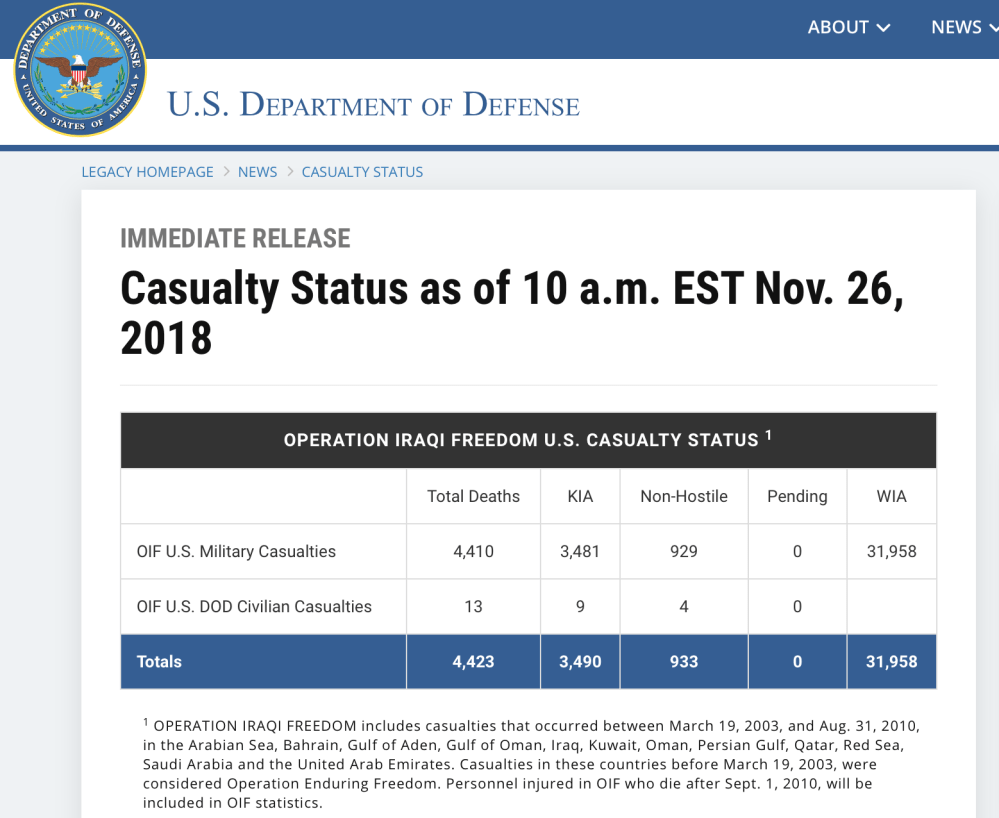
I put in a Freedom of Information Act (FOIA) Request. I figured if any organization had something useful this was where I needed to go. Old news articles haven’t been helpful since the data isn’t easy to gather or necessarily aligned with my deployment. Then again, other sites like the DoD’s website gives the larger picture but it doesn’t allow individuals to break down the casualty information for their respective purposes.

Screen Shot 2018-11-27 at 5.06.03 PM.png

In 2016, when I provided my Final Reveal of my graduate applied project, I came to you all with incomplete data. I am not embarrassed by my lack of progress, but frustrated. How many of the 31,958 wounded military casualties belong to my first deployment? The service members who died during my deployment made up 6.2% of the total deceased for OIF. My job was to process the activity reports that came in from units with this information and yet, two FOIA requests have produced nothing. IMG_5411

This reality is NOT the fault of either the U.S. Central Command FOIA office or the U.S. MARCENT FOIA office. The individuals who worked with me on the matter have been great and I am glad I took a risk to place a FOIA request. The Central Command office couldn’t locate records and encouraged me to take a chance and reach out to MARCENT (Marine Corps Forces Central Command). The second FOIA request is what really opened a door for me.

I learned the Headquarters Marine Corps (HQMC) Casualty Branch is the record keeper of the Personnel Casualty Reports. This information is what can aid me if the VA comes back yet again and doesn’t believe me about my deployment work and the casualty information my unit handled. Apparently, the VA claims representatives can contact HQMC Casualty Branch if they want to confirm casualties from my deployment. So, while we put in a pin in that for me, I do hope for anyone in similar circumstances you now know you have another avenue to get the VA informed by having the VA contact your service branch’s Casualty Branch.

I want you to know my FOIA Coordinator at MARCENT went two steps further than I expected. She coordinated with the specific FOIA office for 1st Marine Division. Their office has no records. In the depths of the email, I was presented a gift,an article, I am sharing with you today. The article shared with me is Peter Sleeth’s Lost to History: Missing War Records Complicate Benefits Claims by Iraq, Afghanistan Veterans. I do not know if our unit records were intentionally destroyed or wiped clean from computers but it is truly a shame our service branches did not leave behind records that can aid veterans, help educate the academic community, and build the transparency with the general public.

I do not think it is appropriate to stop at this step.

I know my fellow veterans (and perhaps active duty personnel) who served in the Al Anbar Province from August 9,2004 to February 25, 2005 can help reconstruct the history of this deployment. This project won’t allow us to have an official record of the deployment, but it will fill in the blanks. For anyone who wants to contribute, I will set up a new tab on my page soon specifically to reconstruct the deployment. I would like anyone who wants to share some information to do so at their comfort level although I provided a guideline below. I expect this process will be quite slow but I am ok if this project takes us years to complete. I think it’s worth it to honor the truth of our experiences.

At a minimum, here’s what I am hoping to compile, but again, I am open to more information:

Date of Injury:

Type of Incident:

Location in Iraq (city or military base, if known):

Branch of Service/ Rank:

Gender:

If you’d like to join me in this endeavor, please email your date of injury information to shewearsdogtags@gmail.com and feel free to share this post with other individuals you served with in Iraq. Thanks for listening and being willing to share your story.

~Cheryl


November Reflections

Today marks the anniversary start date of the second assault into Fallujah.

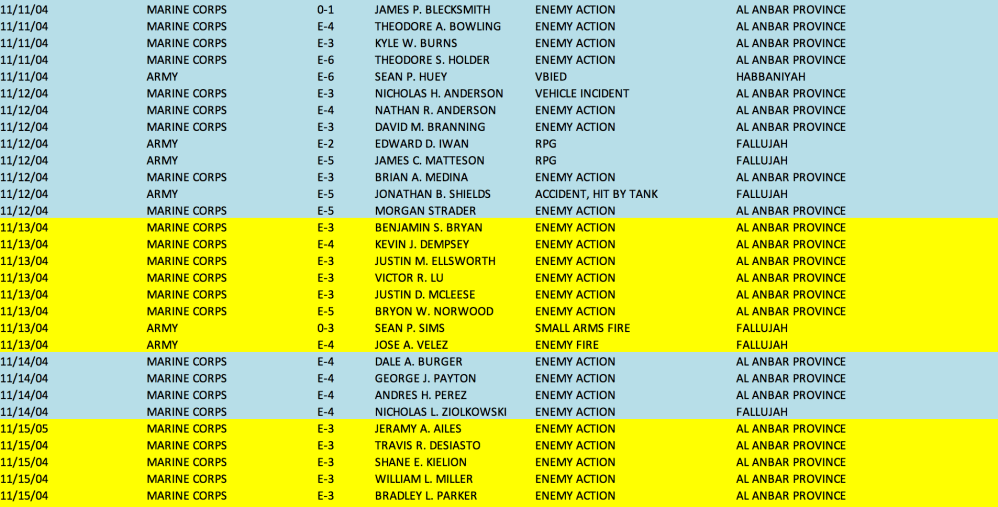
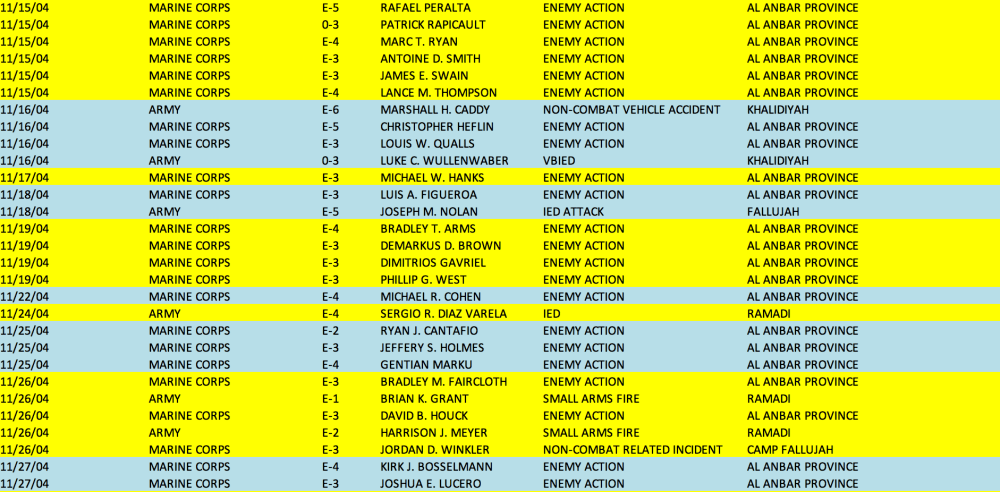
November 2004 was the single worst month for us on deployment and I am always a bit hesitant to discuss the situation. I do not wish to add additional grief to family members who lost their loved ones fourteen years ago by opening a discussion that borders on invading their right to private grief. It is therefore important to mention reviewing the casualty information associated with my deployment is a difficult task for me. I first looked at the human toll of my deployment back in Spring 2016 when I prepared my graduate applied project and on two other occasions, one to further open up war discussion regarding intentional harm and accidental circumstances and the last to help explain to the VA why my deployment circumstances lead to an absence of medical documentation relating to anxiety-induced chest pains. I am fortunate I had a supportive group throughout this process because it was (and is) stressful to be reminded we couldn’t save any of these individuals. While my feelings about losing our service members in no way equates to how loved ones feel about losing their family members, in sharing my sentiments I hope it is understood I write for transparency purposes and to honor our fallen.

Each person we lost could have gone on to be one of the veterans our nation will honor this weekend. I make this solemn statement in the hopes my fellow veterans understand the chances we’ve been given to live life fully. It also serves as a gentle reminder our war veterans wear the label ‘veteran’ differently. It is a matter of luck we made it home. Some did not receive a warm welcome home, like our Vietnam veterans experienced. Others came home physically, emotionally, or mentally broken or found their personal lives falling apart. The ‘beauty’ we associate with homecoming may not have been beautiful for them at all. The charity associated with this weekend is both a blessing and an awkward circumstance. As some veterans roadmap their weekend to hit up each free drink, meal, or service offering of their liking, some of us will likely pick a quieter weekend routine.

I am among the latter group. I do not find the gluttony of veteran discounts appealing. It gets under my skin and makes me feel ashamed. I see veterans (and/or their family members) who complain about long waits and limited selections at franchise restaurants although I also know our most disenfranchised veterans equally are benefitted by the community efforts doled out this month. I do not feel I need the courting of my community because I was (relatively) well cared for by receiving an array of benefits during my service followed up by the robust education benefits earned through my honorable service. The generosity of the organizations offering a discount is not the problem; it’s the way we’ve come to view the opportunity as an entitlement.

If I let you see November 2004, in its incomplete picture, you get a different sense of who I am and why pandering for free food and services bothers me. I gathered this information about my deployment from the Military Times’ Honor the Fallen website back in 2016. As someone working in the command element, I know I felt like I was running on fumes at times while we pulled twelve hour days and I cannot begin to imagine how my brothers serving in Fallujah felt. Again, this is an incomplete list as it does not include the names of Iraqis inadvertently caught in the crossfire of our forces and the insurgents in Fallujah or any other part of our area of operations in the Al Anbar province.

Screen Shot 2018-11-07 at 12.14.20 PMScreen Shot 2018-11-07 at 12.14.44 PMScreen Shot 2018-11-07 at 12.15.01 PMScreen Shot 2018-11-07 at 12.15.12 PM

Wikipedia condenses the operation better than I’ve found in different bits and pieces around the internet. From their site, the second assault in Fallujah, Operation Al Fajr (or Operation Phantom Fury, as it was briefly known) is broken down as follows:

Screen Shot 2018-11-07 at 7.24.00 PM
Retrieved from Wikipedia, Second Battle of Fallujah

I do not mean to be brutal to my fellow veterans who enjoy a feast of drinks and food on Veterans Day. It just does not have meaning to me and I would like to see, if someone will partake in such activity, that he or she also meaningfully contribute to our veteran community over the weekend.

When I was deployed, I could not share the details of my deployment–and the constant killing and wounding of people–to my family. Instead, I could share the hope I felt about one day returning stateside. Over the course of November 2004, I wrote eleven MySpace entries for my family and friends expressing an eagerness to love fully and plan a wonderful life upon my return and separately, I wrote 4 private journal entries–3 about Iraq and how things were looking with the second assault into Fallujah and one to mention Yassar Arafat died. Back then, I was just living in the moment and I think now as a veteran, I realize how much more important it is to use our experiences and agency in a thoughtful manner.

I didn’t always realize how lucky I was to come home. That was a difficult matter for me back in 2005 and I have become better at forgiving myself for the ways I abused my body back then. In many ways, one of the best life decisions I made was to start working with student veterans back in 2013. I want to continue reminding veterans they should find some way to make another veteran’s life better. Our service to each other should not end when our military commitments expire. Sometimes, my family and I have been fortunate to donate money to different causes that serve veterans. This year, I am trying something new.

Tomorrow I am volunteering with the Town of Gilbert for their Veterans Day ceremony. I have never contributed my time to a public ceremony. It is an awkward position for me stepping out from behind the computer as I like behind the scenes work and/or academic  settings where it is quieter and more controlled. If I can take this baby step though and get outside my comfort zone, I know you can, too.

I encourage you to please find something this weekend (or this month, if your weekend is already jam-packed) to serve veterans that is outside your norm. Think about your life experiences, your proximity or distance to veterans, and the need for positive veteran transitions. Serve where you are and let the experience be as private or as public as you feel comfortable but serve with an open heart.

(NOTE: If I have many any mistakes regarding a service member’s name spelling or rank, I offer my sincerest apologies. I worked to transcribe this information dutifully from Military Times’ Honor the Fallen in 2016, but again, it was a difficult assignment for me. Opening up each bio and seeing someone who had previously been ‘nameless’ to me made the loss a fresh wound. Any mistake is mine, and mine alone.)

MOS School: The Path I Chose

Becoming a Marine is one matter, but it is equally as important to discuss our individual roles in the Marine Corps. All jobs are important regardless of organization, but when the average person thinks of the Marine Corps an Infantry Marine is who they usually think of. I cannot blame them for their viewpoints because representation plays a significant role in our knowledge of the world and the people within it.

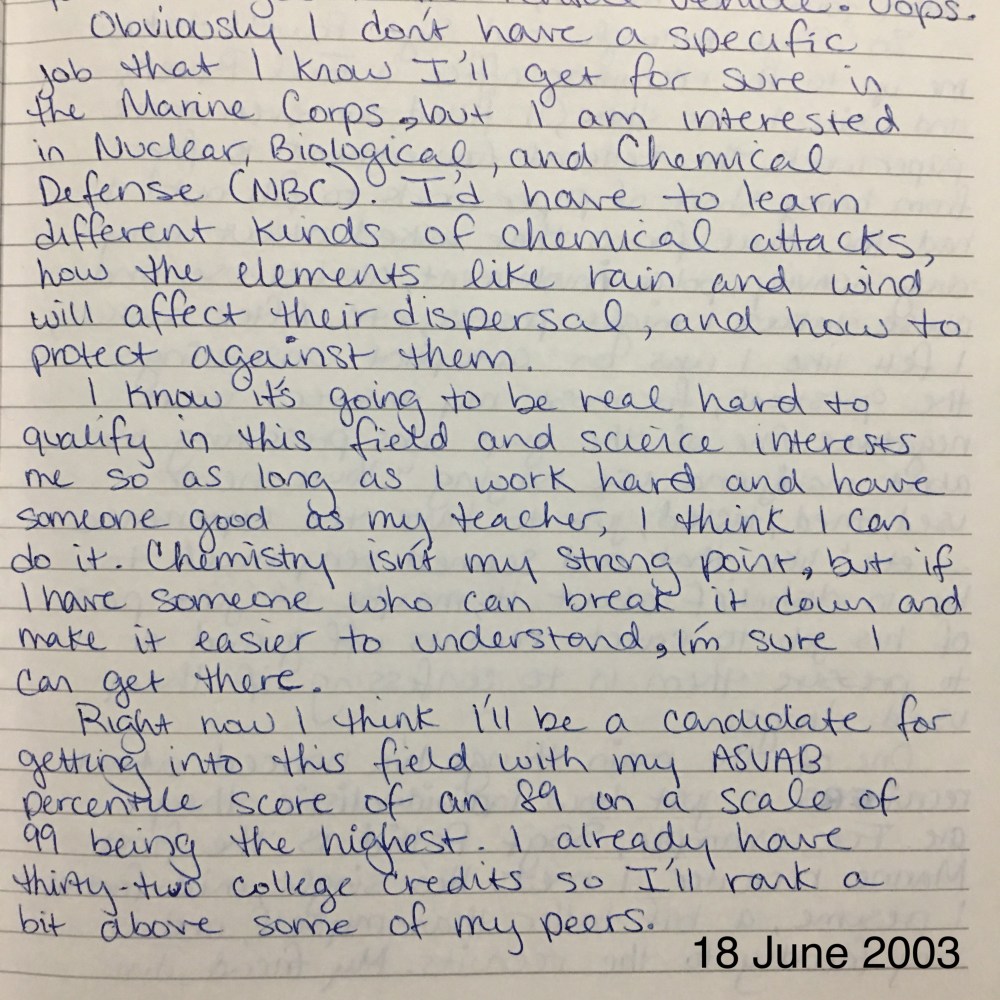
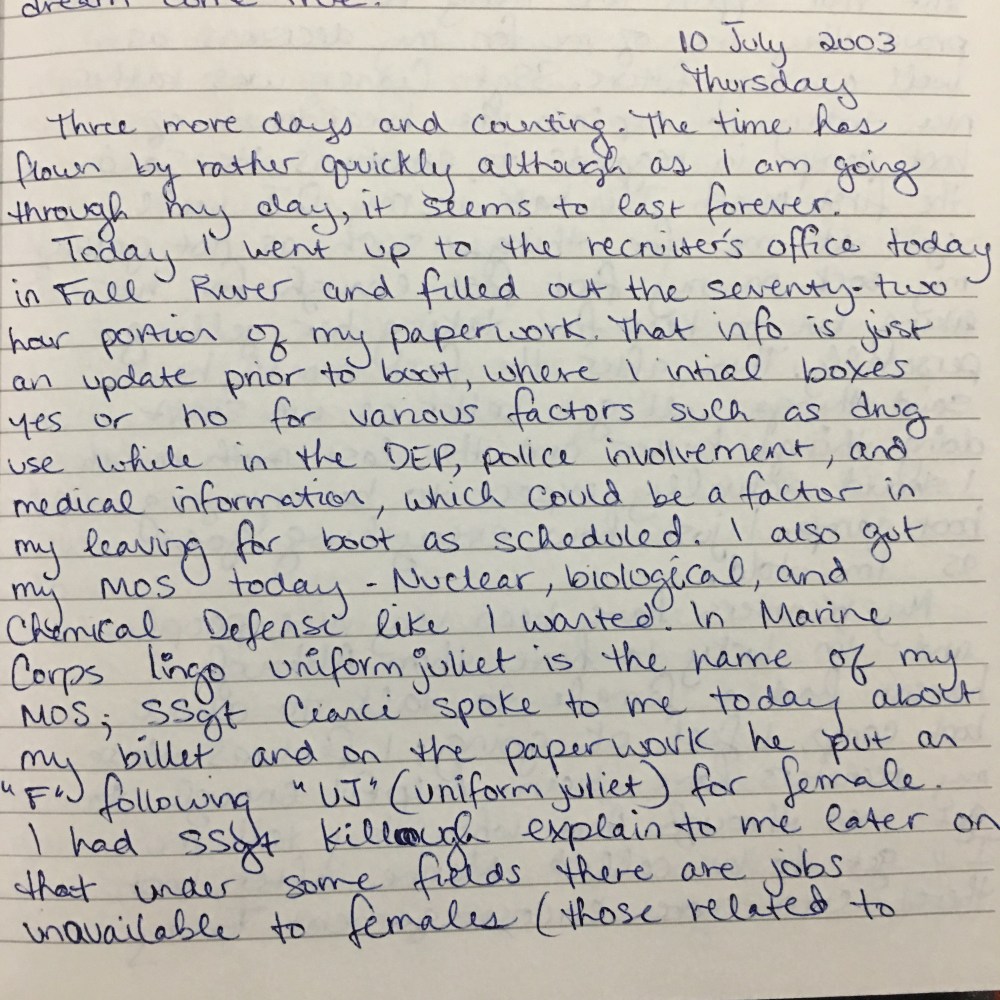
When I made the choice to step in the recruiter’s office, I wanted a new path in life. I wanted to serve in my late friend’s place after his murder. I felt I could volunteer and become a Marine, finishing an enlistment (or longer) in this role. While he chose explosive ordnance disposal as his military occupational specialty (MOS), I opted for Nuclear, Biological, and Chemical Defense. I was adamant I did not want admin or supply because–although I knew next to nothing of the Marine Corps–I felt these would be roles women were naturally pushed towards. I liked the idea of Combat Camera but I was not confident I was as proficient as I needed to be to serve in this capacity.

When I reviewed the job description for Nuclear, Biological, and Chemical Defense, which transitioned to Chemical, Biological, Radiological, and Nuclear Defense, it intrigued me. I shouldn’t be so surprised because this was after 9/11. I saw an immediate need, other people I knew supported the idea, and I met the ASVAB score for this particular responsibility.

IMG_5591IMG_5592

MOS school was more of a challenge than I expected.  My typical academic study habits and strengths did not serve me well. I left high school with a 3.75 GPA but having the cadre criticize us when we chose not to study and micromanage other aspects of our training left me feeling drained. The 24/7 mentality of being a Marine from boot camp, MCT, and MOS school (later followed in different ways in the fleet) was a real struggle for me. I like having a separation of my work/academic life from my personal life and it was nearly impossible to find during training.

I felt out-of-place especially with our female instructor who was highly critical of the fact I was dating a Marine outside our schoolhouse. MOS school was more an exercise in misery than an opportunity for me to become more embedded in the Marine Corps.

This is a hard reality to reflect back on, particularly because I wanted to serve to honor my friend.  Unfortunately, I learned early on that my maturity would not translate to being treated as an equal and my desire to “walk away” and feel at home at the end of the day wasn’t going to happen.

I learned to adopt a “learn it,” “regurgitate it,” and “brain dump it” way of behaving to get through schoolhouse life. This attitude is not conducive to longtime learning, but I hit the markers I needed to in order to graduate. To this day, I will tell you, I always wished I learned my MOS better. The knowledge was not an easy thing for me to learn, and years later, I cannot recall the basics. Practical application exercises were just as difficult as understanding the knowledge areas. Aside from not being a natural fit for my job, I was starting to feel like I would never fit in as a Marine.

As difficult as it was to integrate into the schoolhouse, it was an interesting time period in my life. I saw historical events through a different lenses, seeing the darker side of science and technology not truly discussed in lower level academic classrooms. We got a grittier version of historical events, learning more about how humankind created destructive products and gear to combat such threats.

If I can leave you with one good recommendation on this topic, it is to read The Biology of Doom: The History of America’s Secret Germ Warfare Project.  As well, I would also like to encourage each of you to stay open-minded in your learning process. It is not conductive to only learn things that show a positive representation of your country and culture.

IMG_4672
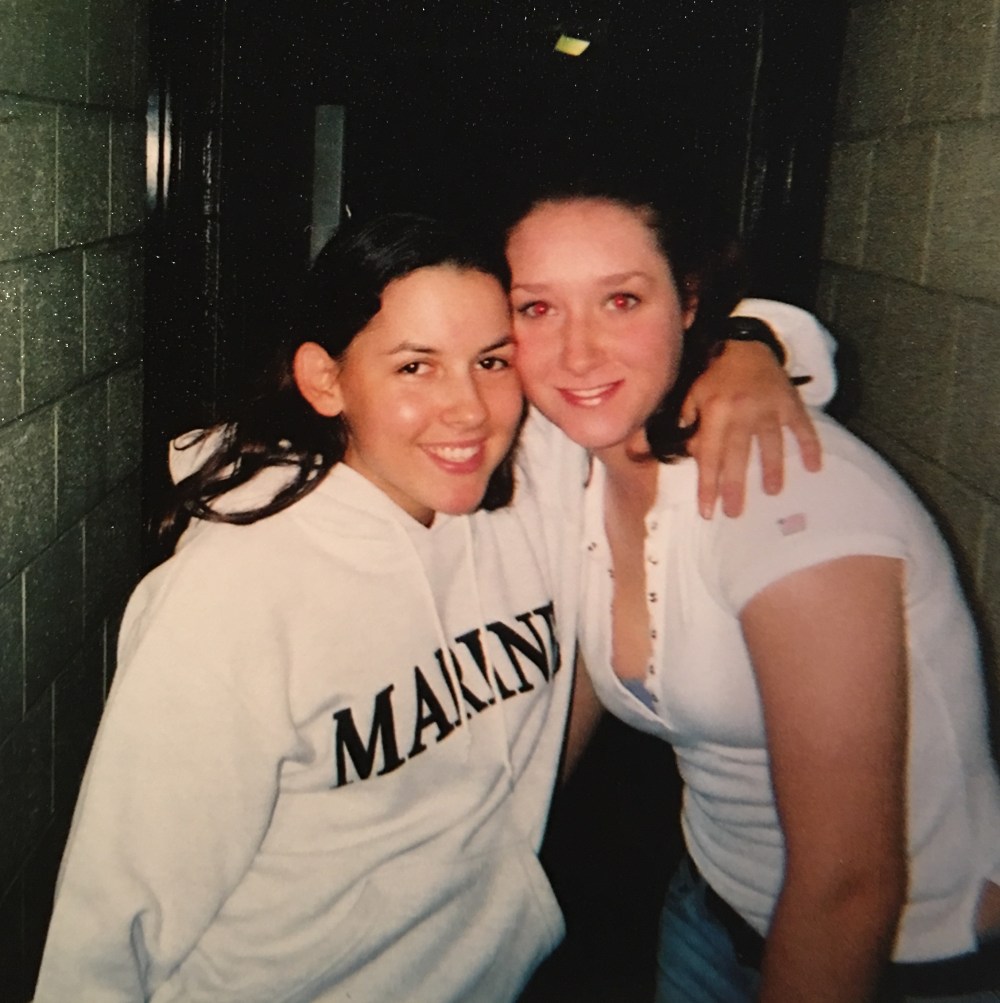
Me (on the left) and a former friend who was attending the MP (Military Police) training school at Ft. Leonardwood, Missouri.
IMG_4673
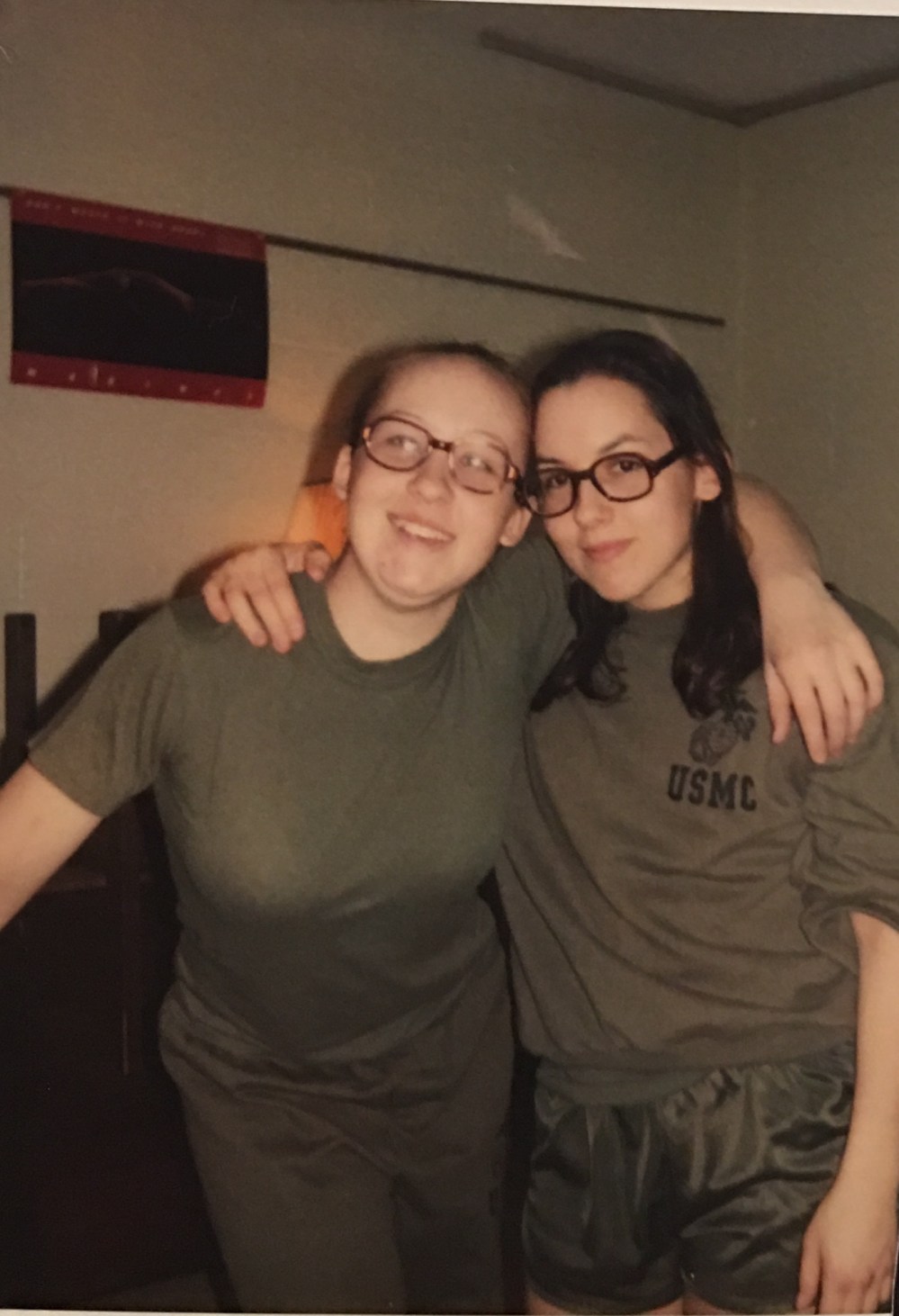
One of my former NBC roommates (on the left) and I during our training. FYI, I just borrowed the glasses for the photo.
IMG_4675
Roger Castleberry, one of my classmates. Unfortunately, he was killed in Iraq, but he was a pretty neat person to come across in my training because he choose to lateral move into our MOS. Sometimes, it’s great as a young Marine to come across individuals with more experience who are easygoing and prove the Marine Corps is more multi-faceted than instructors let on.

IMG_4671

IMG_4666
One of the Marines I met in training who I am still friends with to this day.

IMG_4667IMG_4670

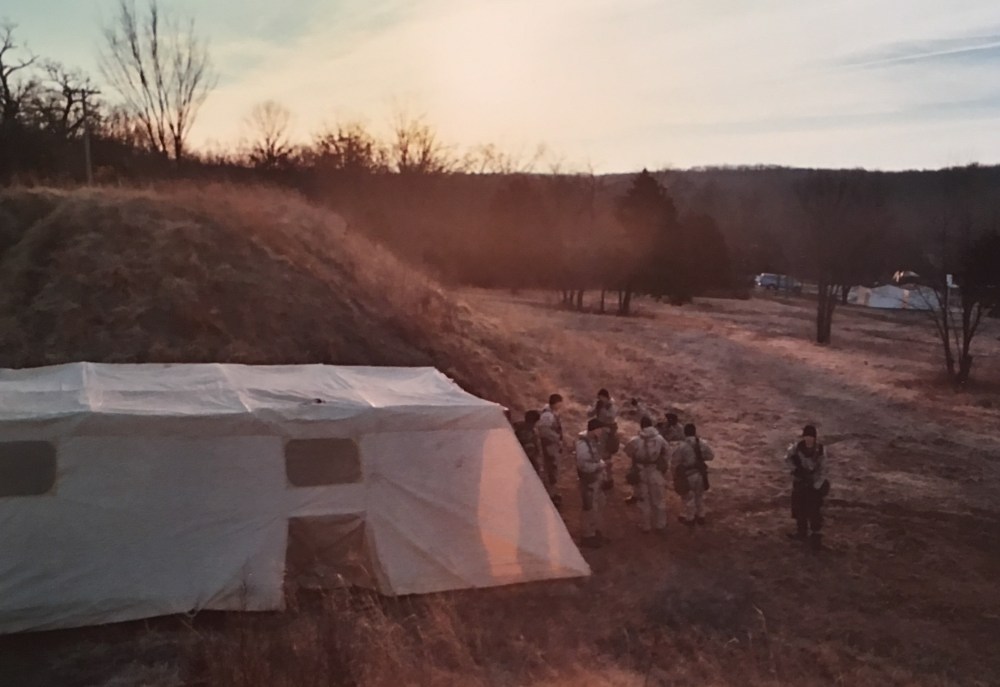
I do not have photos from our most important training endeavor when we walked through the Chemical Defense Training Facility. Prior to walking through the building we ran a practice walk-through outside so we understood how to safely walk through the building. We also tested our masks to ensure everyone had a functioning product prior to commencing our training exercise. The live nerve agent training was an event that felt quite surreal; it was hard to believe as we stood around and watched our instructors bring out containers with the agents those weren’t simulated products. Thankfully, nothing went awry and we performed the necessary tasks asked of us. The experience certainly taught me to trust my equipment, but I have not always found it easy to instill that trust in others.

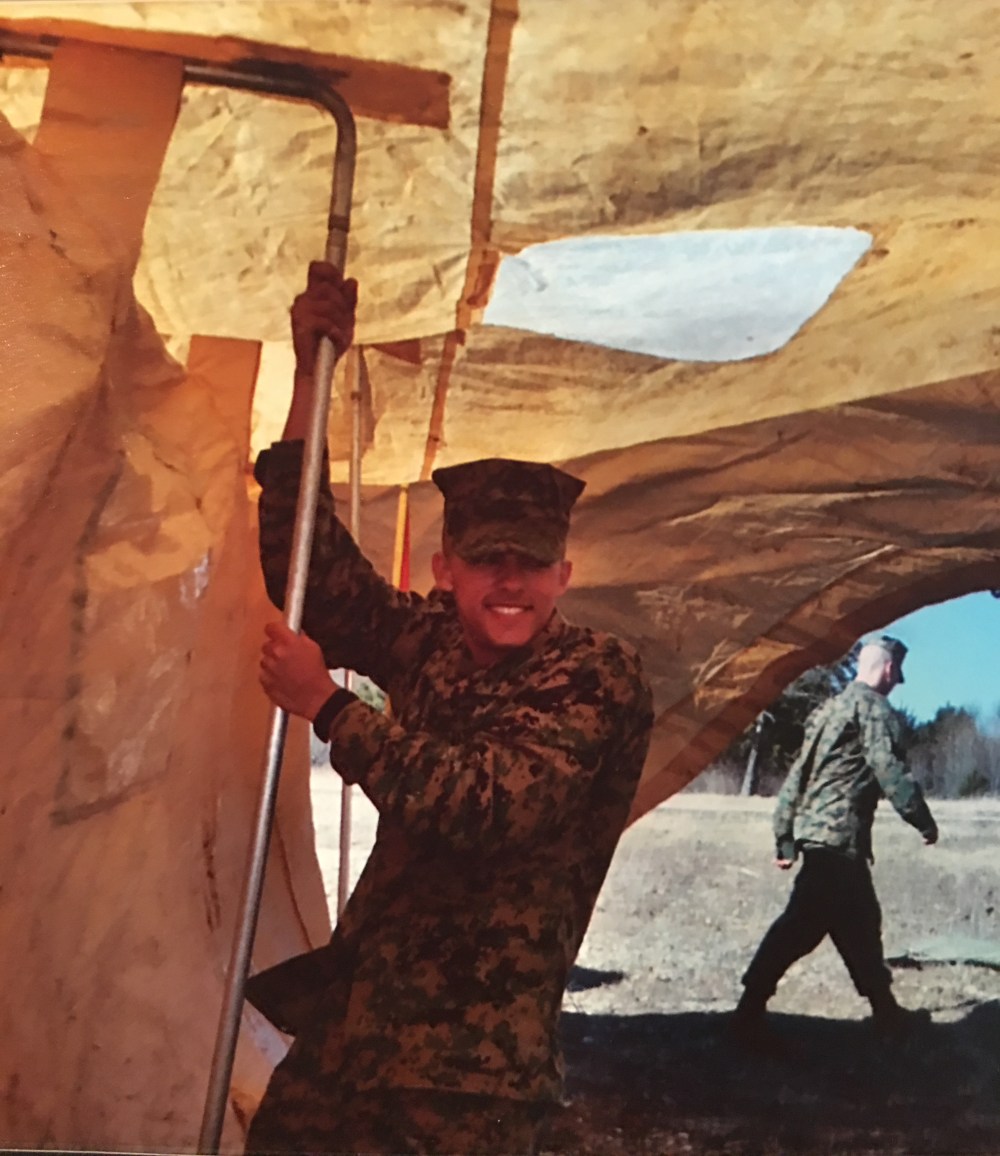
One of the most difficult things is encountering Marines resistant to annual training. I am not a confident public speaker anyways so teaching classes always made me feel uncomfortable (and still does). I like work behind the scenes and I had inadvertently chosen something that would put me in a public element on a number of occasions in my short career. I felt my confidence was harder to build when senior Marines, for whatever their reasons, would be rude and disruptive to our work. I had one Marine in particular that made some commentary about a different style mask when I worked with 3rd MAW. I felt he made the remark to make me look incompetent and thankfully, I had a senior Marine on my side who shut him down and publicly indicated that mask was no longer in use.

IMG_4669
Me (front left) with some of my fellow Marines on our graduation day.

As I continue to share my experiences please remember I am an imperfect person who served in the Marine Corps. I was not particularly skilled in many areas like my peers. I lacked military bearing (and still lack it). My judgment bit me a couple of times, in quite big ways. I marched terribly (whether I was leading or following). This place is an intimate look at the Marine Corps, through my eyes. I have been just as difficult at times with other Marines as others have been to me, and I acknowledge my failures as a leader. I try not to make those choices again.

As I bring this entry to a close, I am fortunate with my educational background I met the criteria to serve as a CBRN Defense Specialist. It allowed me the opportunity to serve a different role in Iraq. There is a tenacity I brought to my work in the Command Operations Center I don’t feel everyone can do. It is emotionally taxing work, and it is not visible the way infantry work is seen by our culture. The jobs are connected and it is not a matter of pride that guided my work but a dedication to my fellow Marines. In the years that have passed, I’ve only met a small handful of Marines who served in Iraq the same time I did. It is an honor we contributed in different ways to keep our Marines safe and I am happy I found a purpose in my Iraq role I never felt in my stateside duties.

It is always possible I would have served in Iraq if I had chosen a different MOS in the Marine Corps, but it’s not something I could say definitively. Each choice we make opens a door to certain possibilities and closes doors to others. The path I chose brought a number of Marines into my life who are still here by my side years later but most of the people I met in the schoolhouse are names but nothing else to me now. The few who I remain in contact with are excellent people and it is a joy to know life is treating them and their families well.

I am also happy I walked away from this job in the Marine Corps. It wasn’t something I did particularly well, and as one of my current classes is discussing in our assigned materials, sometimes we must leave certain jobs to others so we can serve in more appropriate roles for our strengths.