Iceland: A Two-Year Journey in the Making

Iceland—a bucket list country to visit for many—landed on our radar as a place to visit for a milestone anniversary. The timing of the solar eclipse added another element of selecting a cruise to visit this (expensive) country over less cheaper options for our first family trip abroad. 
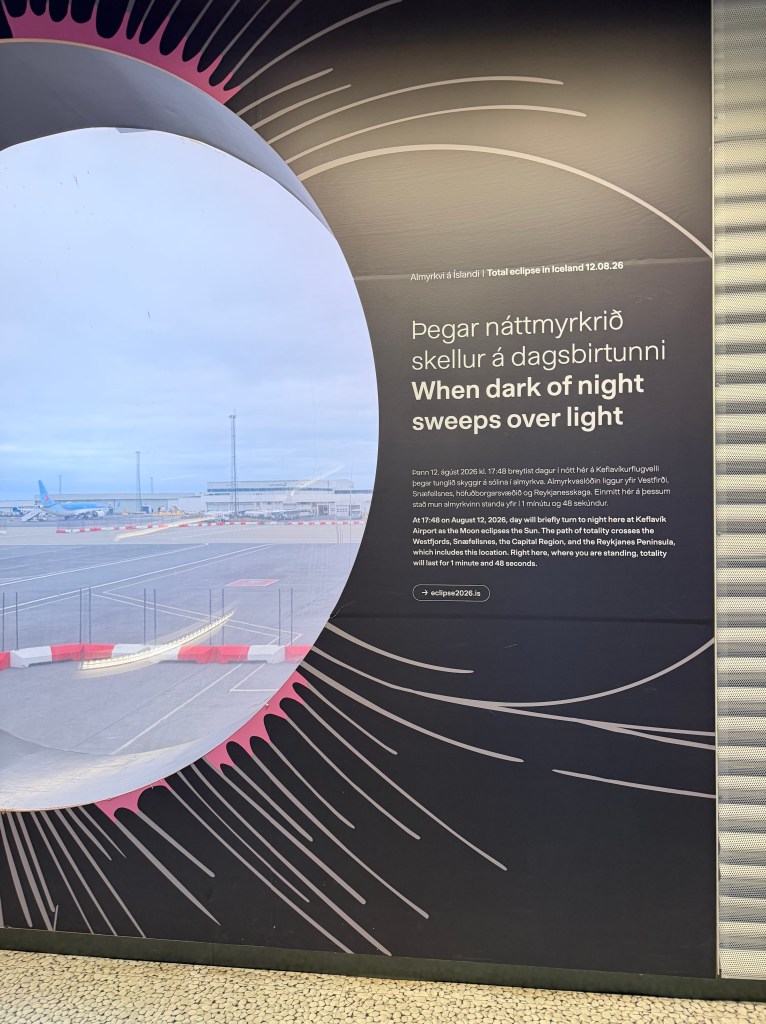
Signage at the Keflavík airport in Icelandic and English that describes the period of totality for the solar eclipse as it would have been for the airport: one minute and 48 seconds. I love the messaging that reads, “When dark of night sweeps over light.”

Friends who traveled/lived in Iceland temporarily for their work loved it. Work acquaintances loved it. Everyone had one thing to say: Iceland is expensive. Not it’s unsafe, unclean, unfriendly, etc. She’s going to cost you a little extra—prepare accordingly. Thanks for the warning. I did my best. There was some overspending simply because we found ourselves enamored with Iceland and didn’t want to miss out on a few extra things. (Note: There will always be plenty you’ll miss out on, like us. We missed out on the Northern Lights, which started to crop up again the last few days of our time in Iceland. We weren’t getting up after midnight to try and experience them.)
Iceland is expensive for locals and tourists alike. During our stay, the currency conversion was this—1,000 Icelandic krona (ISK) to $8.24 United States dollars (USD). Menus would show a decimal point instead of a comma in their pricing, so 3,890 was listed as 3.890. The current exchange rate showing on Guide to Island’s website is 1,000 ISK or kr (for krona) to $8.25 USD. 

An easy “trick” I did for myself was to mentally move the decimal point over and know that there would be a handful of dollars to subtract to get an idea of a meal’s cost. Let’s go back to my earlier 3.890 meal as the example. Move the decimal once to the right; it now becomes 38.90 for my convenience. It’s not entirely accurate. I can guess I need to reduce roughly 2 “dollars” for each 1000 krona the item costs, but if I’m more comfortable assuming this currently as the cost for the menu item, I pick something cheaper off the menu. With the current currency conversion, the meal is $32.08 USD.  (With my trick, I would have started with $38.90 and could assume to roughly reduce 6 “dollars” landing at an estimate of the meal costing $32.90 USD.) A 1.700 kr beer means you’re paying $14.02 USD. (Using the earlier trick of mine, it becomes, 17.00 and subtracting 2 for the fact a single krona is involved I could make a quick assumption the beer might have been around $15 USD, which was higher than the end result.) Keep in mind though, there is no need to tip; tipping is not customary like the US. I’ve been reading up a little on Iceland’s living wages, equal pay among genders, and it’s been mentioned tip jars are sometimes put out to fund social events for employees. 

Windstar Cruises

We went with Windstar Cruises for our first family cruise. The trip overall was comparable in cost to a small home remodel for my entire family, but we’re reaping all the rewards instead of maybe getting back 66% to 80% of the money we spent on a home project. We learned a lot from our pandemic home upgrades; the market upswing, not the upgrades, made the difference in the sale cost. Our previous home had been purchased with the idea of becoming our forever home, so we started buying finishes that while not lavish were more costly. The money would have been better spent on travel, in our retirement accounts, or in our emergency funds than in a home we no longer occupy hence my reluctance to overspend in our current residence. This place will get what is needed to keep it functional and well maintained, maybe a little tailoring to our taste when items need replacement but I am not onboard with home personalization to the extent we did previously not knowing that this will be the place we call home longterm.

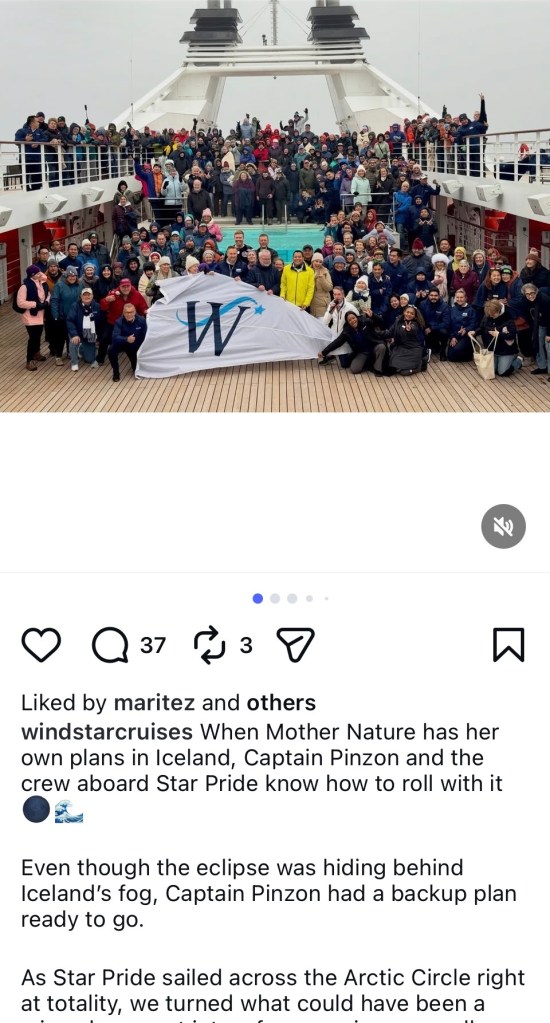
Windstar Cruise Line Star Pride
Coming together to celebrate the solar eclipse is one of the greatest experiences I’ve enjoyed the past couple of years.

With this all in mind, I am sharing my individual portion of the cruise. There are a lot of solo travelers out there and I would encourage them to not wait to have a companion to do a big adventure. I see a lot of single friends of mine enjoying international travel by themselves and I think the safety of a cruise line like Windstar adds to that comfort. The initial cruise costs $6,439 with $14 for applicable taxes added. This amount was for the solar eclipse experience, the room, food, our drinks package, and the gratuity we added. I noticed some cocktails on ships were advertised to be about $10 or so for those without a beverage package. If you don’t pre-pay gratuity, I believe the suggested amount was $16 a day. The customer service was phenomenal; each staff person truly contributes to the success of the cruise experience. I had excellent support when it came to requesting dairy free meals. Even though I don’t eat a fully dairy free diet at home, I was concerned the limited bathroom situation on ship might be problematic if my lactose intolerance was hard to manage even with medication so I requested dairy free meals. I limited myself to the rare dairy treat when I knew I had medication on hand and a bathroom was nearby in case I felt unwell afterwards. By this I mean, I was only enjoying dairy on ship if eating a treat in our ship cabin. We also had great support when I inquired about how strenuous certain excursions might be since I deal with neuropathy and didn’t want to pay for an experience I would ultimately regret. With the advice of the crew member managing the scheduling of those remaining assignments, we felt it best to opt of out certain waterfall excursions that could be too painful. (The one “misstep” I noticed was whatever chef/cook decided calling a plant-based cookie shortbread was appropriate. I say this kindly, but shortbread is a particular type of cookie. I knew this to be a non-traditional shortbread as it was a plant-based cranberry shortbread but the ‘shortbread’ should have been swapped out from some other descriptor. If you are a foodie like me, shortbread conjures up a certain expectation. Instead, this item was essentially a no-bake chewy cookie, but other than that, the team excelled everywhere else!)

Not all travelers will pay for insurance ($708.29), laundry ($66.50 for unlimited service), or excursions (varies). We paid for those additional items, because they mattered to us. There were far more excursions than mattered to us and to do all would have been financially untenable. Each additional item will certainly expand your budget if you choose to add it, so it’s best to stop and think, does this thing align with my/our values? For that reason, we saved for two years to go to Iceland and with this cruise line and to bookend the cruise with a few days in Reykjavík before and after for safe measure. You can also pre-purchase an excursion and there is a window to cancel the excursion, as needed, if something changes. That lesson will come in handy for the next cruise.

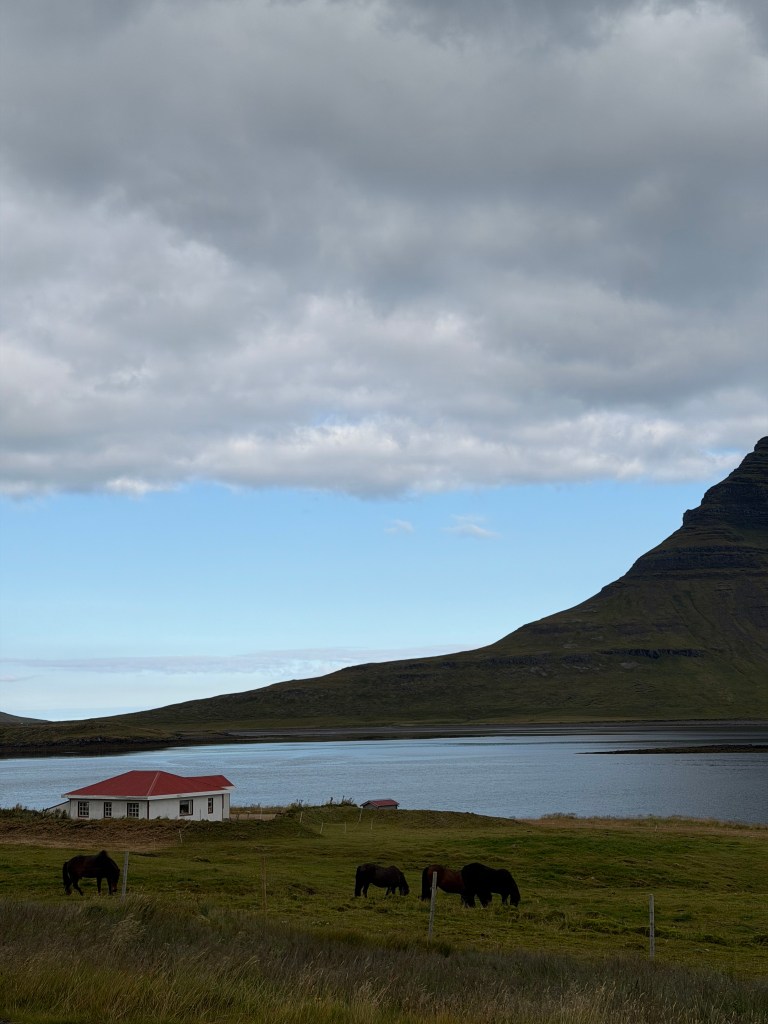
Grundarfjörður, Iceland

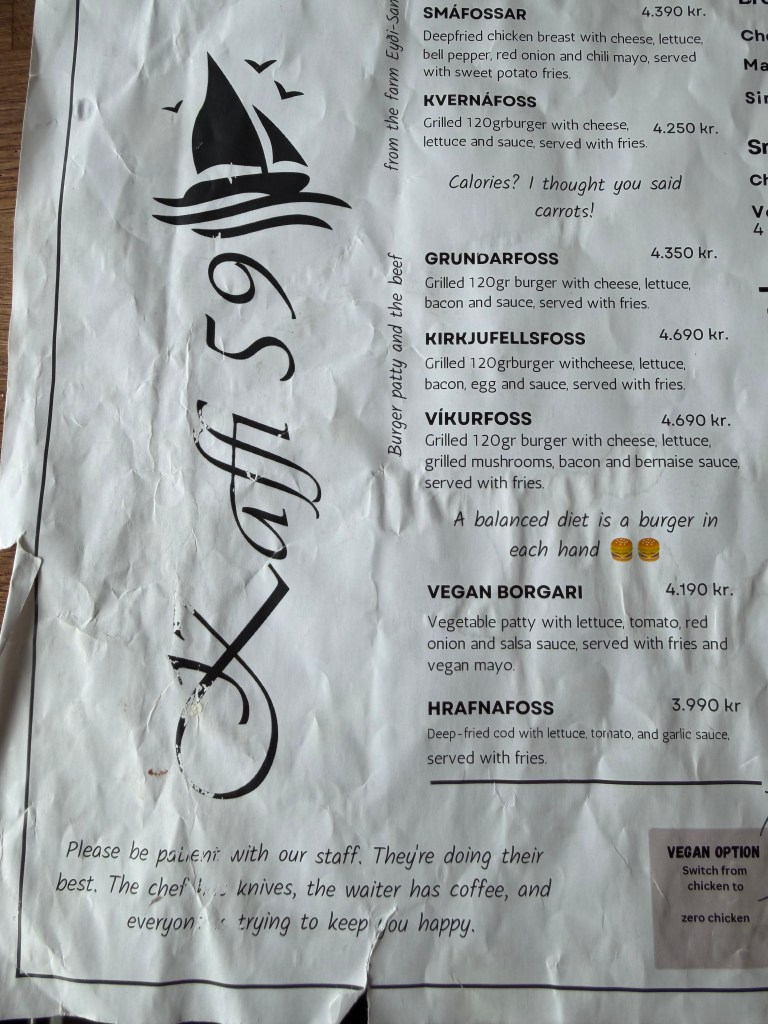
When accounting for the fact all meals, a bounty of snacks (as desired), and drinks were included on board (other than if we wanted to buy full bottles of wine), it was financially more savvy to consume our food and beverages on ship during the cruise than out in the port communities. We learned this lesson during our first stop; our diner lunch at a Kaffi 59 in Grundarfjörður was more expensive (generally) than lunch options we found in Reykjavík, which has more dining opportunities to offer tourists and locals. For anyone who wants to drop into a local venue there, I would still recommend this eatery. The staff were quite kind; the menu is embedded with a dose of humor; and the food is rather tasty. 

My family and I had a hilarious experience due to a cultural misunderstanding although both the server and I were speaking English. I had asked about the soup of the day to which the server indicated there was none. I took her comment to mean there wasn’t any soup and ordered a vegan burger with fries instead. As if we were actors in a comedy, the waitress takes the next table’s order and the patrons ask if the restaurant serves mushroom soup. She informs them the soup being served is cauliflower and self-service. I had to hold it together and not laugh that I was “denied” soup–unintentionally, of course. Not wanting to be rude, I didn’t joke with my family at the table about it, but my husband and daughter know all too well of my love for soup. We had the best laugh about it once we were away from the restaurant and joked how the little community of Grundarfjörður “decided” I wasn’t allowed to have any soup. The past few months have been extremely stressful with my dad’s health situation and it felt good to laugh over a simple lunch misunderstanding.
For our other stops, when we wanted little bite during our strolls about, we popped into grocery stores. There are some things easy enough to grab without knowing all the details (if you have allergies or food sensitivities, feel free to ask staff for help): chocolate bars, chips, sandwiches (generally speaking I was comfortable with the options), etc. and so on. 
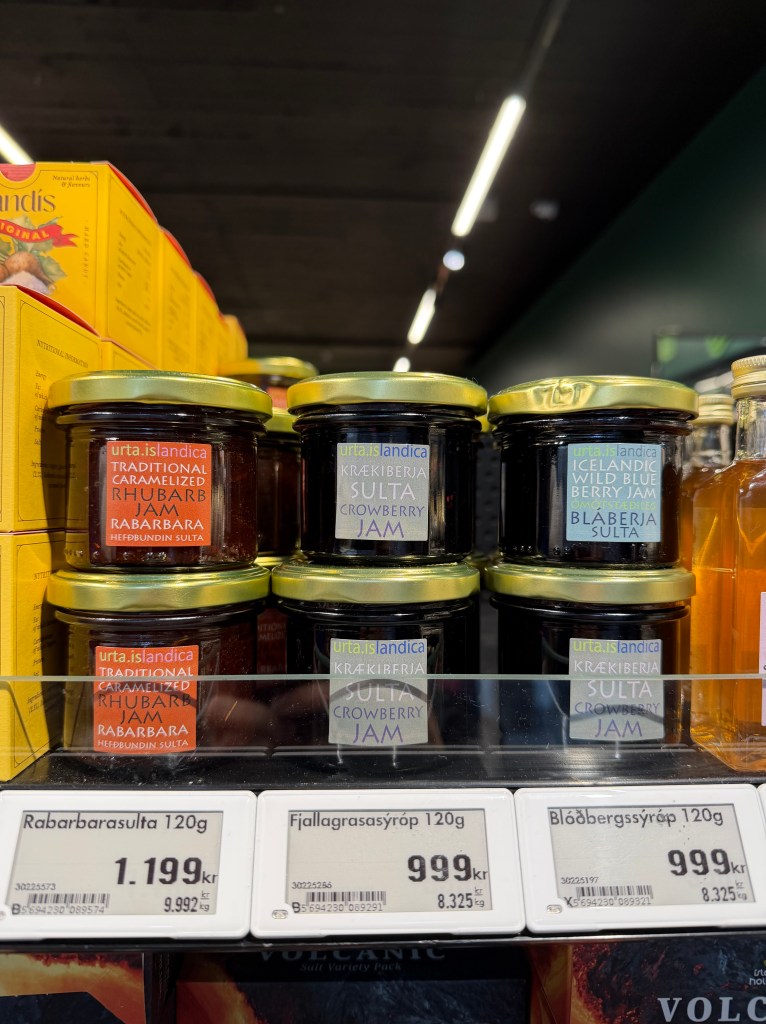
We didn’t try the jam, but I had a crowberry martini at Sky Lagoon and later the crowberry Saft (meaning juice) as part of the Skjól ritual.
My daughter took this photo for us; I love that “ranch” doesn’t translate culturally, so it is known as Cool American flavour.

I learned a little Icelandic before the trip, so it helped to navigate the grocery stores. After receiving a licorice and caramel candy bar (Risa Þristur) from a hotel as a welcome present and not bothering to look at the ingredients list, I learned to look out for lakkris (licorice); I do not like American licorice, and I can also say I now know I don’t care for Icelandic licorice treats either. I never thought there would be licorice in chocolate bars, only in gummy candies or ice cream as it was something I’d heard of. I was only expecting I needed to look out for licorice on dessert menus and that would be where my risk of encountering the ingredient and possibly offending Icelanders would occur. Instead, we were happily ensconced in our hotel room watching a show, tried our treat, equally agreeing it wasn’t to our tastes, and disposed of the remnants respectfully in our hotel room trashcan. The Sirius brand candy bar (a non-licorice flavor, by the way, because they do have a licorice one) left in our ship cabin as a gift one night was more fitting to our American palates.

If you’re interested in trying some Icelandic treats, feel free to check out The Icelandic Store. Their site indicates they ship from Hafnarfjörður, Iceland to the U.S., Canada, and Europe. 

Exploring Beyond Our Original Expectations

Preparing to see Iceland, I think a lot of us outsiders are greeted with the same messaging. There are waterfalls, Northern Lights, glaciers, black beaches (especially diamond beach), Reykjavík’s famous church and rainbow road, and so on. What to visit largely depends on when you plan to visit, your budget, and the time you have available (plus your mobility to traverse and wait out those more difficult excursions because there will be lots of visitors queuing up as well to visit the sites). 
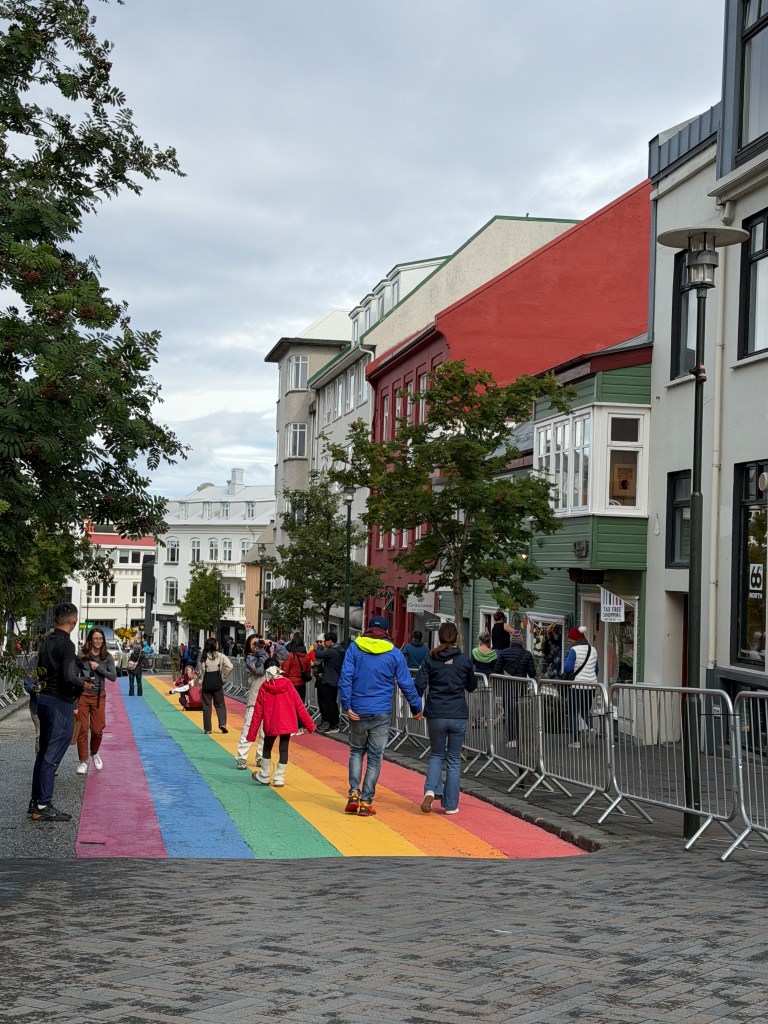
Preparations for Reykjavík Pride parade were underway when we arrived in Iceland.
If you want more historical preparation for your Iceland visit, I would recommend reading Egill Bjarnason’s How Iceland Changed the World.

I wasn’t surprised to overhear a fellow tourist bringing up the name of Jewells Chambers, the founder of the All Things Iceland podcast. Her work was part of my Iceland research; I regret to inform you I totally forgot to drop by one of the plant-based bakeries she recommended. Plantan kaffihús had long been on my list of places to visit in Reykjavík and then I got a bit overwhelmed with the crowds of tourists ahead of the solar eclipse to the point that visiting the bakery slipped my mind. When there are hoards of visitors crowding around storefronts it is hard to see what is what in an area you are not familiar with; if I had planned better, I would have written down the address, both as a reminder to visit and to find the general area when storefronts are crowded with people taking their photos. The owners are kind-hearted and look out for tourists, handing out coffees on treacherously cold days, which is a significant reason why I wanted to visit them.  For all the times they’ve handed out free coffees to strangers, I wanted to be a stranger who came in to buy something as a thank you for their generosity. And then I was a goof who got overwhelmed and never dropped in. 

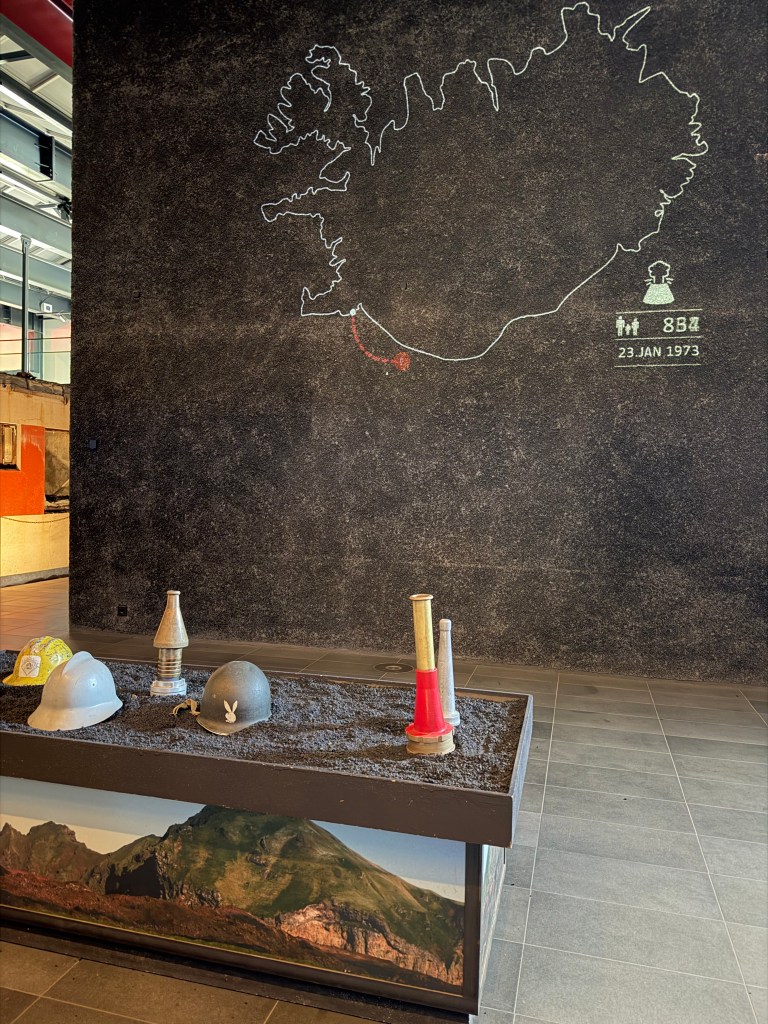
We discovered things about Iceland not on our original wishlist, and I’m grateful for the unplanned learning experiences. The opportunity to visit the Eldheimar Volcano Museum on Heimaey Island allowed us to learn about the destructive January 1973 volcanic eruption there. During our tour, there weren’t enough audio guides to go around. I wandered around, looking at the excavated home, the images, and tried to grasp what I could piece together.  Afterwards, our tour guide and his dad (the bus driver!) took us to the spot where lava had overrun housing developments. I didn’t photograph the memorial post about it as it was close to a picnic spot being used that day although I, and others, captured photos of the site itself and other signage.
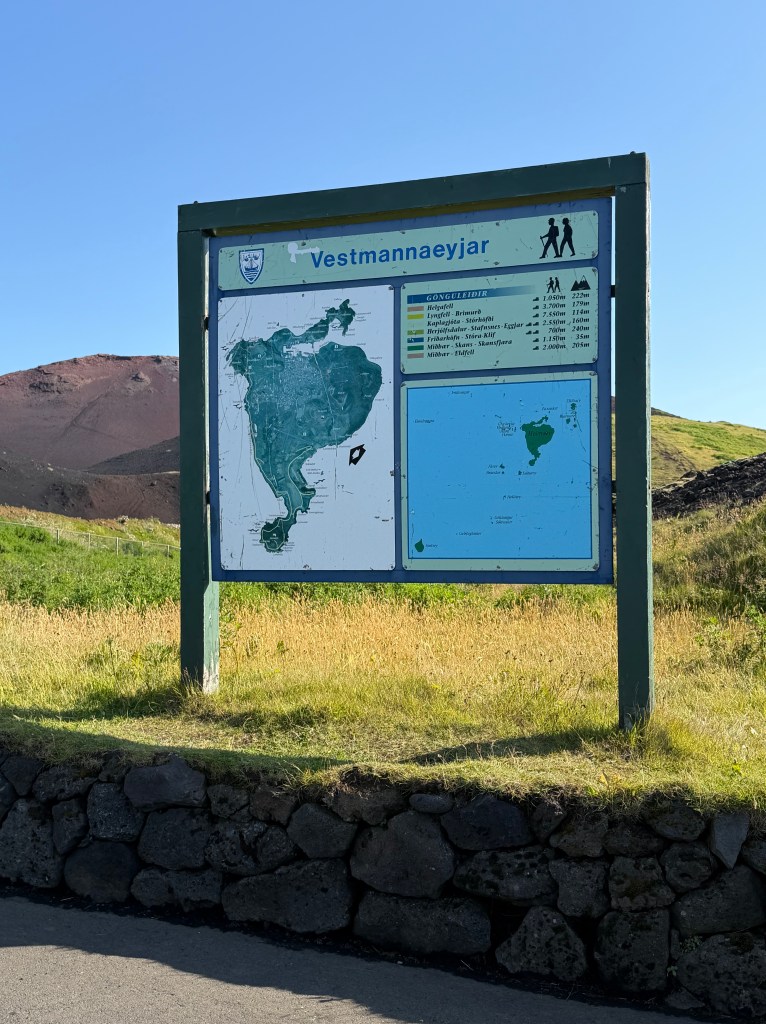
Heimaey Island signage indicating walking distances and other pertinent data.

Challenges

Driving in Iceland won’t be for everyone. There are a large number of roundabouts to navigate. A new thing we encountered are the traffic light patterns; Iceland uses yellow lights before red and green lights. There are bus lanes with their own traffic signals. I happily let my husband be the driver. More so than driving, parking is something to talk about as we discovered not all parking garages operated 24 hours. We left Reykjavík before the city held its Culture Night celebration in honor of its 240th birthday and would have dealt with our 24 hour parking garage, the Hafnartorg Car Park, being closed for the event.  

Iceland is very clean. Part of it seems to be accomplished by not offering a lot of public restrooms. I’d like to say that I’m joking but I’m not. A lot of retailers don’t have public restrooms, but restaurants and hotels do. We located a freestanding public restroom within Reykjavík we couldn’t use because someone deposited the wrong coinage in it.  This contributed to us stopping by Pósthús Mathöll to use their downstairs restroom one night when we weren’t dining at any of their eateries. (Sorry, but it’s true.) We ate at Funky Bhangra and Fuku Mama located within the food hall during our stays in Reykjavík, so I don’t feel too guilty popping in to use the bathroom on the other occasion.

Simple Joys

Getting back to Iceland being clean, it’s really clean. I enjoyed how little we encountered litter in our walks around the various communities. The things you might notice instead are a handful of cigarette butts in the parking garages, graffiti being a bit more prominent, and locals will point out (not too unkindly from my observations) if you are walking in the bike lane in Reykjavík.  You don’t see unhoused persons like we see chronic homelessness throughout the United States; how much is due to weather and how much is based on the social programs is not something I can speak to as an outsider, but it is better that less humans are living on the streets. Living unhoused has a lot of negative consequences for individuals in terms of their safety and health. (A few quick peeks at some Reddit posts and individuals have opened up that Iceland is no utopia despite what it might look like and it is not uncommon to live paycheck to paycheck there.)
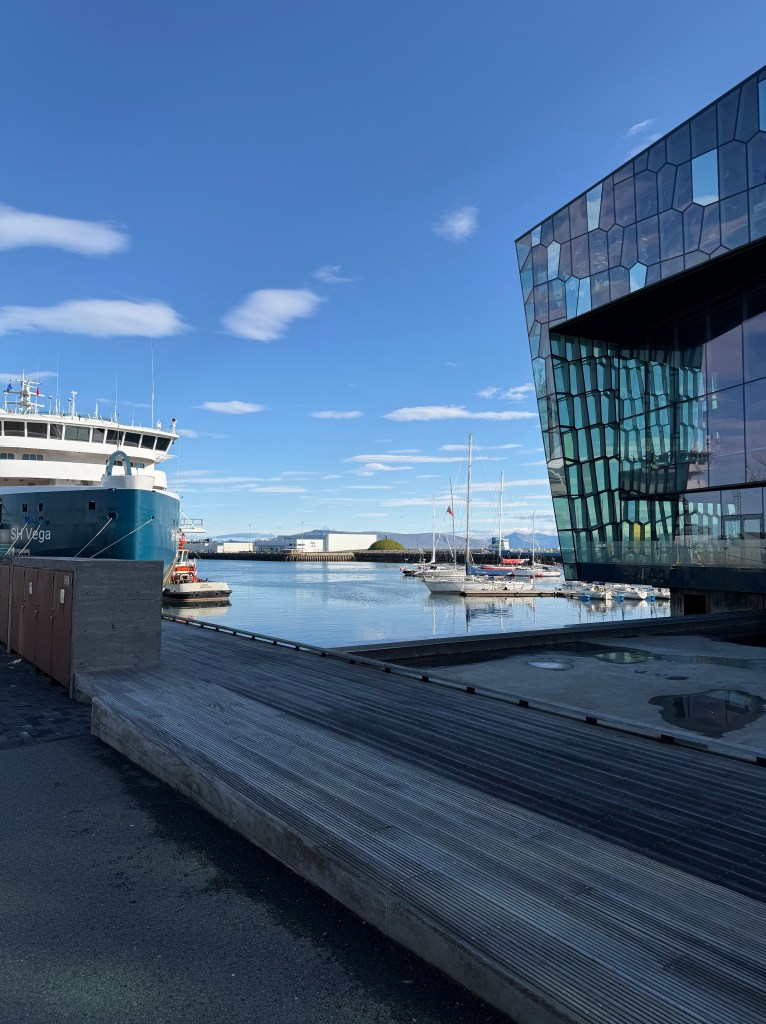
This photo captures a tiny fraction of the Harpa Concert Hall off to the right, the SH Vega to the left, and a handful of boats on the water. The Harpa Concert Hall is stunning in its totality; its combination of glass and basalt columns is beautiful to admire in the daytime, and is stated to provide a beautiful reflection in the evening in you’re out and about that way.

The cost of housing was brought up during our bus tour in Heimaey Island. Our guide mentioned the population there was about 4,500 persons and the housing was about 80 million ISK, which would be about $659,000 USD. It is no wonder then that apartment buildings are significant in number throughout Iceland, regardless of which community you are visiting.  
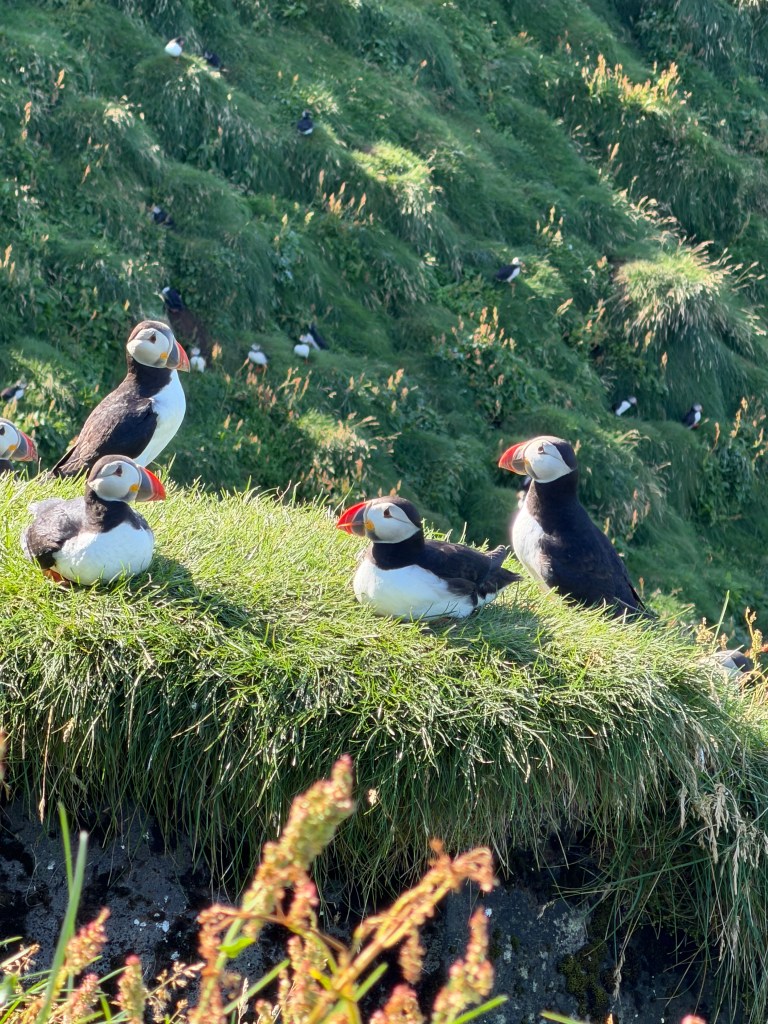
Heimaey Island was my favorite place to visit. I sat on a cliff and photographed puffins. These birds got more of my attention than most of the attractions around Iceland. I felt like a National Geographic photographer and loved my brief self-imposed assignment recording their interactions.

The tap water in Iceland is actually enjoyable. Sounds weird, I know. Please save yourself some money and only buy bottled water when necessary. Our cruise provided water bottles we were free to take out on excursions and we often found an extra one or two refilled in the room upon our arrival back on ship. The water station at Pósthús Mathöll has the Icelandic word for water (vatn) above it, but we found other places simply had a water station and water glasses accessible without signage. Geiri Smart (a restaurant we frequented, located with Canopy by Hilton Reykjavík City Centre) was another place worth mentioning for both its high quality customer service and food. They would bring a pitcher of water to the table and replace it when needed. When we enjoyed our complimentary breakfasts, we’d bring a water pitcher ourselves to our breakfast table.
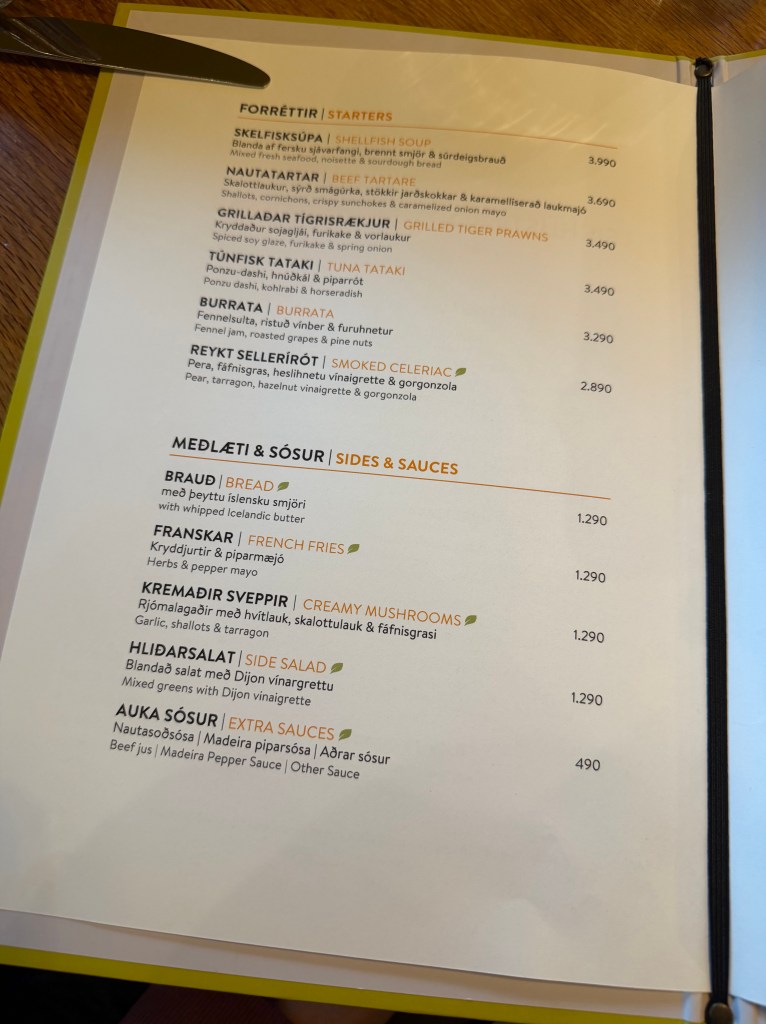
A snippet of the menu from Geiri Smart; everything was wonderful. The bread, in particular, was a wonderful surprise in that it was a little sweet on top and we couldn’t figure out the herbs in the butter. None of us though took a picture of that delightful creation. I didn’t notice this humble bread on their Instagram yet to know how to describe it further to you.

Our “early bird” lifestyle worked out pretty well in Reykjavík. Maybe because this time of year Iceland is enjoying 12 hours of daylight, but we had less crowds for our breakfast outings (around 8 a.m.). Evenings are when the city feels like it most comes alive and gets crowded with locals and tourists. Perhaps it is also because locals are off work and relaxing, but either way, the slower morning vibe works for us and granted me better photo opportunities. Did I share those photos with you? No. Sorry.
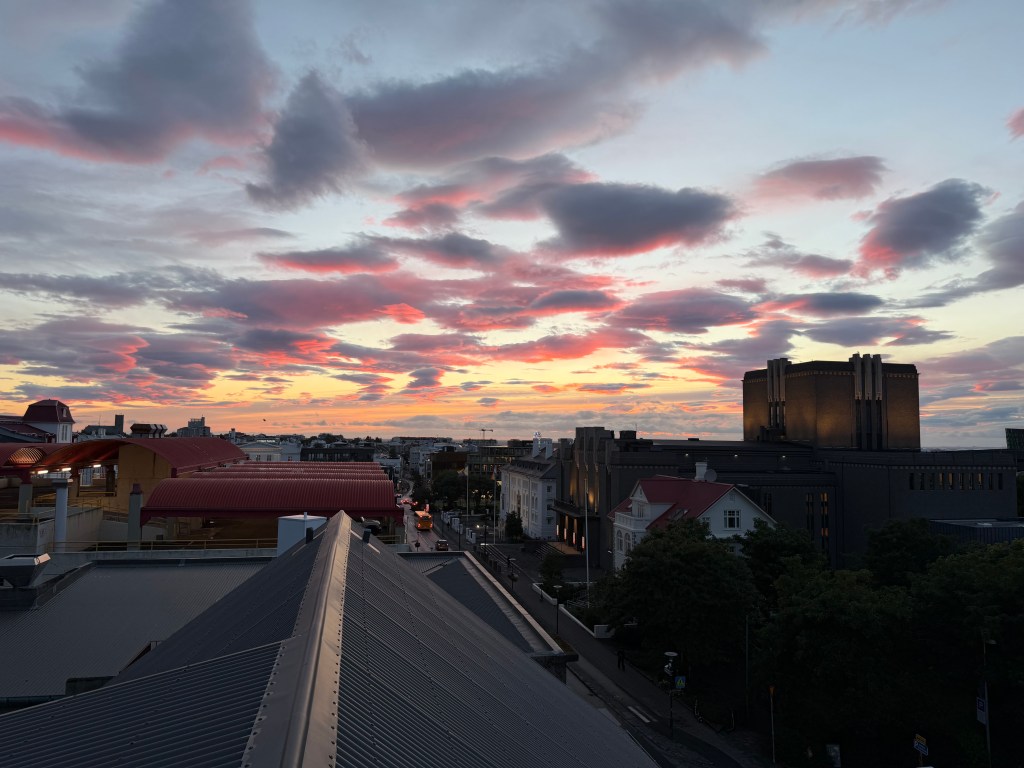
This photo was taken at roughly 10p.m. at night. I loved the skyline view from our hotel room outdoor walkway.

I felt extremely safe in Iceland as a tourist. The population is around 400,000 people and the available statistics indicates an average of 3 homicides occur per year across the country with domestic violence generally being relevant in those incidents. Like any other country, there’s always a concern for pickpocketing, so we were good about keeping an eye on our possessions and watching out for suspicious behavior.

We only bore witness to one traffic accident being cleared off the road during our travels and we had a bit of a comedy show seeing someone who appeared to be trying to flee an officer on a rural-ish road—our bet is it was a tourist thinking it was better to find a spot to pull over the vehicle. We never saw the end of the pursuit as our adventure continued beyond where the situation was unfolding.

I love soup, so being in Iceland was my way of jumping into “soup season” a bit early this year. Our Arizona summers in the Phoenix metropolitan area deliver temps around 110 to 115 degrees Fahrenheit (and slightly higher at times)and fall has been warmer the past few years, too. Craving soup and stews when temps are in the triple digits or just below is asking to be disappointed. Iceland allowed me to make up for the past few years. The temperature was just below 50 degrees in the morning and our highest day was 58 degrees Fahrenheit. We didn’t stay outside on ship too often in the evening, but one night the temperature was 43 degrees between 5 and 6 p.m., by comparison. 

In Reykjavík, I enjoyed traditional lamb soup from Icelandic Street Food and a vegan Italian tomato soup topped fresh basil (2.990 kr or $24.66 USD currently) from Hornið. Geiri Smart has a shellfish soup for 3.990 kr or $32.90 USD at the current currency conversion rate. 

The cafe in Eldheimar Volcano Museum had a mushroom soup that I doubt any place I will ever visit in the U.S. can compete with; we discovered both in Iceland and on the cruise mushrooms are treated better as an ingredient than they are here in our country. Every dish we had prepared with mushrooms was delightful. 

On ship, I tried various soups and their soup adjacent cousin, seafood in broth, when it was presented for lunch. The cruise provided me a chance to try a tomato soup prepared with lemon grass. Also worth trying to replicate at home.

Iceland also presented far too many opportunities to obtain good landscape photographs; I am now challenged in deciding which ones are worthy to cover our walls, which ones can be happy phone memories, and which ones to park in a scrapbook. I’ve seen some of those digital glossy travel books as modern scrapbooks, but I want something “old school.” I have an array of receipts, a newspaper, and an IKEA store map (did you know Iceland had an IKEA?) that I want house together with some photos. 

If you are planning a trip to Reykjavík, might I suggest reading a little bit of the Reykjavík Grapevine magazine?

Well, that’s my little recap of our trip. I wanted to offer a slightly different perspective and photos a little offbeat from everything else I tend to see offered. We did visit Sky Lagoon. I captured photos of every rainbow road I could find. We dropped into Perlan one day, which I also recommend seeing since it is a great way to learn about volcanoes and glaciers. Of course, there is no shortage of waterfalls to see. Plenty of people will talk about driving Ring Road.

I didn’t want my reflection to feel like a duplication of everything else that’s out there. When our stories feel like carbon copies of each other’s, I feel that the heart of the places we visit is ultimately lost in the process.

My travel story should be–and is–different. Traveling with a disability and special dietary needs (even when I don’t follow them well) influences my comfort and wellbeing. I would like to point that I felt, maybe due to where I am at currently in life, that it was easier to see individuals with disabilities navigating around Iceland. I saw tactile paving in Reykjavík to a greater degree than when I see utilized in the United States. A number of families were traveling with family members with mobility limitations for the solar eclipse. Not that I thought it was unexpected, but representation matters. How often do we see persons in that situation in advertising materials? Some of the sidewalks weren’t the best for wheelchairs since there were made of stone, but again, Reykjavík has a bike path and I see that opportunity as allowing persons with mobility issues to be out and about in their community more. On the food side of things, you do need to inform an establishment of allergies. This reality applies stateside and abroad. Not everything can be accommodated. Regarding Windstar Cruises, their full site on accommodation issues spans a broad spectrum and is a valuable learning tool I think for all of us as we build better workplaces.

Thanks for letting me share my experiences. I hope you’ve enjoyed the bits I’ve shared.

~Cheryl

Wintering in Summer: My Season of Hibernation

Dear Readers (longtime, casual, and those who have drifted in suddenly with the tides),

I dare not bother to see how long it’s been since I last posted: it’s been at least three months I believe.

Some might be disappointed by my absence while others hardly noticed, and I have to give myself grace in stepping away from my unpaid work to attend to my life outside of the internet. 2026 has been busier than expected. Not only have I been juggling job searching again as my short-term role comes to an end this year, but my dad’s health has been on a rapid decline. I took an emergency trip to my hometown to see him in June after he was hospitalized in late May. He is hospitalized again and will remain there. He is in need of a donor heart and has been undergoing the numerous steps that precede this lifesaving operation. There are no guarantees he’ll get a heart, but we are appreciative this opportunity is available and will follow all the rules required to buy him more time.

In the interest of protecting his privacy, I won’t have anything further about his hospitalization to share at this time.

Coping in such difficult circumstances looks different to everyone. I was already struggling with his third heart attack last fall and his hospitalization in May. When we got the news that his future depended on a new heart, things got very real for our family that we could only control so many variables and had to rely on the support of our local community and medical community moving forward. A GoFundMe was established to help defray some costs we couldn’t control through other resources–I am grateful to the many people who contributed either to the GoFundMe or in-kind to help out my parents so I could funnel resources out of the emergency fund my husband and I have grown towards flying my daughter and I home to visit while my husband stayed at our residence to take care of our dogs. It would have been painful to not make the journey home, and I realize many families don’t have that privilege when loved ones are sick, particularly if loved ones are overseas or if the person wishing to travel is undocumented and must stay put due to the current administration’s targeted efforts to remove them from this country.

There’s a book that has long been on my “To Be Read” list, and with good timing, it appeared at my local public library as an omen to weather the storm we’re passing through. Written by Katherine May, it’s titled, Wintering: The Power of Rest and Retreat in Difficult Times. I’m nearly done with it, and I will likely consider buying my own copy to have on hand for other future hard times. My original intent was for it to soothe me through my own health issues–two years into an autoimmune disorder diagnosis journey that continues to unfold–and now its purpose is more to guide me through my feelings that I will never have enough time with my dad and I’m not ready to lose him. I know this as a child who lost her mom at 16. I feel the Universe should reward me with more time with my dad to make up for my early loss, but also that’s not how life works out sometimes. Each day I am confronted with “This might be our last day.” so I check in and make sure we have some sort of of conversation. Today’s not a great one since my stepmom had to put their 15-year-old dog down and that’s hitting my dad hard, but we still deserve a conversation. It centered on grief and pain are ok to hold. As much as I said it to him, it was an important mirror to hold up for myself as well because I struggle with letting others see me be vulnerable.

And in that vein, here’s this beautiful passage from Katherine May’s book that serves me today and might serve someone else I don’t know.

“A hospital creates a particular kind of winter. Jenny Diski captures it well in Skating to Antarctica: the layers of sterile white that offer both discipline and comfort, often at the same time; the sense of personal obliteration. It’s a temple to a certain kind of faith, the residual trust that there is a higher authority who knows the answers, who can save us.”

~Cheryl

Canadian Citizenship by Descent: A New Family Reality?

I grew up knowing my maternal great-grandparents were Canadian. And like a lot of Americans, my family had a history of physical movement and family problems resulting in quite a dysfunctional path to get to me. My maternal grandmother didn’t share a lot of stories, but the thing that really stuck out in her storytelling was that fact her mother had put her in an orphanage twice when she was a young child. It was something that never made much sense to me, and I never knew my grandmother’s two older brothers who might have shed some light on matter. I have a brief history of what my great grandfather did for work, but I don’t know if where he and my great grandmother got married in Canada had little in the way of work opportunities that resulted in their move to the United States or if other issues were a factor. Given the fact my grandmother was born in 1935, it is easy to surmise my great-grandmother might have, if she had been a woman in another era, opted for an abortion rather than bring another child into this world she didn’t want or let that child be adopted by another family. We will never know. I don’t have any of her documents that might provide some clues. From what has been shared, my great-grandfather was the one who protected my grandmother. Her brief life with the Catholic nuns at the orphanage who greatly shaped her faith was interrupted by a man whose duties as a father brought her back under his household.

My grandmother shared parts of life from her teenage years onward also in limited fashion. She married young, bearing her first child when she was sixteen. The details of how long the marriage lasted either lost to time or never shared, but she relayed to us that she had discovered he was already legally married to someone else. Yet another story of disappointment for her to bear. If my memory serves me correctly, her first two sons were born of this marriage. Her second marriage–if the brief tidbits of info I found online are accurate–began when she was eighteen and it lasted until my maternal grandfather passed away in 1992 when my grandmother was 57. My grandma and grandpa added four more kids to their family before his passing. (Sadly, most of their kids have since passed: my uncle Roger died first at 17 due to alcohol poisoning before he could serve in the U.S. Navy; my mom died at 34 from lung cancer when I was in high school; my uncle Paul, a Vietnam Veteran, died in 2011 at 60 years of age; my uncle Dennis was 68 years old when passed away from a short battle with stomach cancer in 2023; my uncle Michael passed unexpectedly in 2024 at 62 although we are all fairly certain the heart failure he experienced was directly related to continuing to cope with the death of his wife, Judy, who passed less than a year prior. It is a big weight to bear for my surviving aunt to not have her parents or siblings and her own spouse, my Uncle Duke, passed away 22 years ago. We do what we can to bring joy into her life, but the relationship with her kids, grandkids, and nieces like me is not of the same depth as the relationships she lost.)

For anyone wondering where these thoughts were going, I want to reiterate how much my family did not leave behind good records for me to trace our history. I don’t know that any of us ever thought much of genealogy and what it might mean to us or our descendants. So, and not feeling sorry for myself here, I’d have to say the short version of my family history is it’s full of a few broken branches (two marriages each for my grandmother and mother), young entries into motherhood (true of my great-grandmother who had her first kid at 21, my grandma at 16, and my mother a few months shy of her 18th birthday), and early deaths: factors that all complicate my quest to understand where I come from. We’ve just been people living life while we can, and none of us likely ever anticipated that Canada would pass Bill C-3 expanding citizenship by descent past the first generation. I missed this in the news last year as I struggled to keep up with all the crap going on in the United States and abroad related to Trump’s unfortunate second round as President.

Now, I am being realistic with myself. I have limited time right now to do my research and when my schedule opens up as we near summer, I may still struggle to unpack my family’s history. The other part of this process is considering the financial costs associated with records requests; I am in a better financial situation than others who may want to get proof of their Canadian citizenship. My quest to tackle this process for my family history is not time sensitive. While I will fly through Canada later this year for a trip abroad, I don’t consider that a proper visit to Canada. (I’ve wanted to visit Nova Scotia after reading a book in late elementary school/early middle school that included it as a setting.)

I do want to be clear this option is not to escape the United States as other Americans are considering now. For me, this is about something that I feel would make my grandmother happy. Ultimately, our family deserves to have a better collection of family birth records. If, in this process, we secure everything we need for my daughter and I to have Canadian citizenship certificates, we’ll have a new chapter in our family history and who knows what the future might hold because of it. (Note: My husband isn’t eligible unless he’s got some Canadian history on either side of his family we don’t know about it.)

~Cheryl

Budgeting in 2026

I write today’s post with full awareness there are such larger events more important than my blog. The wave of violence created by federal agents in Minneapolis made me quite hesitant to stick to today’s topic—budgeting. I decided to not adjust my focus, because I know how much of a difference better budgeting makes in reducing our stress (something we can control amid all those larger things sometimes outside our sphere of influence). Before I jump in today, it is my sincerest hope to see some restraints put on ICE and Border Patrol. If their actions were truly in upholding the law, they wouldn’t be running around in unmarked vehicles, masked, entering homes without warrants and failing to properly identify themselves and delaying care to assaulted protestors. This time of thugs has got to go.

Getting to serve you all within my capacity, you deserve to feel more control over your money (regardless of how much you bring home). We live in a society too often asking us to part ways with our money, be it requests to support your kid(s)’s school, political campaigns, local businesses, big box brands and their onslaught of advertising, and so forth. You are under no obligation to cave into peer pressure; as the saying goes, you cannot pour from an empty cup. Everyone draining your coffers conveniently for them also don’t or rarely contribute back to you in your time of need (in case you ever felt guilty for saying “no” or “not today” to their causes).

I recently finished reading Tori Dunlap’s Financial Feminist: Overcome the Patriarchy’s Bullsh*t to Master Your Money and Build a Life You Love. Some of the things she discusses are things I’ve implemented before reading her book or listening to her podcast, Her First $100k. She is honest about her disdain for Dave Ramsey’s outdated rules for financial freedom. And I’ve mentioned before that his teachings were causing me more financial stress than they were relieving. I also want to take a moment and say how fiscally scary it is to carry cash envelopes; if you get robbed, there goes money you cannot necessarily get back. If a person steals your credit or debit card, you can work more easily with your bank and contest the charges, reducing your liability for losses. Years ago, someone got access to one of my card numbers—still not sure how—and there was a charge for a flight to London. I coordinated with my bank and within a few days the situation was fixed. (My parents helped me financially for a few days while I waited for a new debit card since I was back in their state instead of where I lived at the time.)

Her guidance might rub something people the wrong way, and that’s ok. Her words point out directly systemic oppression’s role in crafting financially inequality between racial groups and men and women. Her frequent use of swear words might be off putting to others as well—personally, I use the word f*ck all the time, so who am I to judge?!

Do I follow everything she discusses in her book? No. Like she said, personal finance is personal. You mix and match based on your needs and goals. It’s a bit like finding a recipe you’re quite certain you’ll enjoy, but as you’re tasting it, you find it needs something added or swapped in due to liking other flavors (travel’s not your thing, ok save for something else you value more) or due to missing the ingredient in your pantry (in your case, say an employer doesn’t match your retirement contributions equally).

My financial picture changed dramatically last year, a good reason to re-evaluate financial goals. And it could potentially change (for better or worse) within the next five months. I am in the window of time where I should hear if my position is renewed. With my current health issues, it has been important to recognize if the role is not extended, I need to keep looking for positions less likely to exacerbate my problems. (Oh so much fun to have this extra layer of stress while job hunting as a pre-caution.) I generally like my position plus it pays well, so it would be ideal to have it renewed for another year. Staying in the same role has an added benefit that my supervisor is aware of my health issues and supportive of last minute health appointments when I need them. I also know, should I struggle with medication side effects or worsening symptoms, once I am past my 12 month mark, there is always FMLA leave I could access. Granted, I also could put in an ADA request at any time. (I haven’t taken advantage of my ADA rights at this time, but I do plan to submit a request after some additional medical tests.) 

With financial planning, I like relying on more than 3 buckets that Tori directs money to “go into.” The 3 buckets is great for beginners and people who don’t want to think too hard about their money. Right now, my husband and I still struggle with excess spending (like groceries and dining out) that I like seeing the percentages of individual category expenditures to help me track progress and setbacks. 

To aid me in my task this year, I chose Monarch as our budgeting app. (Note: This is not a sponsored post. I used my own funds to pay for the app.) They offered a 50% discount (still on their site as of this writing with the code NEWYEAR2026), making it worth the try. I had used YNAB (You Need A Budget) previously and their site kept having issues not syncing properly with my accounts, so my transactions were falling behind in being recorded. Not great when you paid for an app to make tracking easier. 

I love that Tori asks her audience, what is your first money memory? and mine feels pretty easy to recall. My mom was sitting at our dining room table interviewing me for paid household chores. The pay was paltry but I leapt at the chance to make money. Reflecting on the experience, it was pretty wise of her to interview us kids to make the tasks feel more important. (She also followed through and evaluated our adherence to cleaning up to her standards.) Me desire to support myself hasn’t changed much in life; as a kid, I took on more paid chores because I wanted more access to money and my almost relentless pursuit of higher education to make more helps me avoid being unable to attend to my wants. Needs are not being ignored here; I think I just realized the past several years that I could find something to support my family’s needs, but I wanted to ensure we’d do more than just survive. 

Tori’s idea to keep a money diary is a task I feel can be accomplished a bit more easily using Monarch as each transaction has a section to put in a note. I’ve used it recently to annotate why my phone bill spending was higher. After years of carting around an iPhone12, I upgraded, which could have been delayed a little but my phone’s battery life struggles didn’t make me sad to consider a replacement. I take some pride in not always getting the latest gadget: to me, it would be a waste of money.  

When I look at Tori’s idea of three money value (non-need based) categories mine are as follows: 

  • Travel
  • Groceries (beyond the basics, I’m talking food exploration type experiences)
  • Dining out (enjoying new foods and ogling restaurant decor is fun for me)

The top three things that matter least to me:

  • Designer clothes and accessories
  • “Beauty” splurges (say no to Botox!)
  • Exercise classes/gym memberships (I can sweat it out for free at home in my comfy clothes.)

My financial goals coming up in the next few years: 

  • Overseas trip this year (still saving)
  • Hawaii trip next year (start saving later this year after our overseas trip is done)
  • Fully funded emergency fund (full funding planned by May 2029)
  • Japan trip 2028 (start saving after this year’s overseas trip is done)

These goals matter for a few different reasons. First, my husband and I love travel, but we’ve never done a fun trip together overseas. Most of our travels were with the Marine Corps. Second, Hawaii was on our radar in for 2020 and then this not-so-little nightmare called the pandemic derailed us a few times from going there. That emergency fund matters. If I hit a bump in the road where I cannot work for health reasons or with of us ends up unemployed, I’ve over-planned our savings by assuming funding needs with both of us being out of the workforce. And Japan, well that is a gift for our future high school graduate. 

I am grateful my views towards debt have changed. I used to feel it was always bad and the right educators have taught me otherwise. Learning when debt is a tool to leverage versus when it is a burden is something I think we should all learn sooner in life whether or not we choose to take advantage of it. 

Now, that being said, I still wish the SAVE plan would have been allowed to go through. I qualified for Pell Grants while working on my undergraduate degrees and in 2013, the year after I graduated, I started a position making only $32,500 a year. The plan would have offset the years I struggled and it is hard to still see how much our society favors businesses, using the example of those businesses who obtained forgivable Paycheck Protection Program (PPP) loans during the pandemic while a lot of government officials criticize students who took loans out for their education and entered a workforce with stagnant wages. 

My financial priorities have changed over the years. Back in June 2017 money was tight. I left my pretty poorly paying job that paid into Arizona State Retirement (a bit under 12% contributed by me and an equal match by my employer). If memory serves me correctly, I was making about $36,000 and left for an only slightly higher paying position at $38,000, but the other employer, Grand Canyon University, did not pay into Arizona State Retirement. The small stretch in my monthly take-home was ultimately not worth it in the end. GCU’s low contribution to my 401(k)—I believe it was a 30 cents to the dollar as an employee I contributed and only up to 3% employee contribution, so even if I had more money to spare any extra contribution on my part resulted in no extra employer contribution. So, here’s how it looks. For a $38,000 salary, the 3% employee contribution is $1,140. 30% of my $1,140 leaves me with $342 my old employer oh so graciously chucks my way. 

If we looked at the same salary with an employer who pays into the Arizona State Retirement System, the results are dramatically better—assuming you can take a hit in your take home pay. ASRS currently is at a 12% contribution rate. This means the employer and employee both contribute $4,560 off the $38,000 salary. Nice, right?! What I wouldn’t give to go back and make some more financially sound decisions for myself!!!

Now, my goal is to stick it out with any one of the ASRS employers for however long I live in this state. ASRS is a defined benefit plan (guaranteed monthly benefit at retirement) compared to a 401k. Older me likes this safety net a lot more and having less take home pay is something I can manage now. 

Now, my responsibility to myself is to continue to always make enough that I can stick with an ASRS employer and ride the lower take home pay to serve the “retiree” me I hope to be someday. I don’t know if I’ll stay with the same employer I’m with currently; it is an option I’m exploring, but I’m keeping my eyes open for other opportunities, too. 

Aside from looking to retain my current salary, my husband and I are working on reducing certain expenditures in our lives to have more discretionary money for other purposes like domestic and international travel. We are opting to dial back some on grocery shopping and reigning in our dining out budget. We are going through a home loan refinance. We lose roughly a year of progress so we can take advantage of a 1% interest rate reduction. Bringing some closing costs to the table temporarily reduces our overall savings, but we’ll make up the difference before the year ends. If we were say 12 years into our mortgage, refinancing wouldn’t make any sense, but right now, it will give us an additional $400 or so buffer each month that matters if I don’t stay in my current role. Avoiding car loans is nice, too. Not taking on car loans is another way we’re reducing expenses in our lives. We have two paid off cars; mine is 7 years old and has less than 37,000 miles on it (one of the few gifts of the pandemic was driving a whole lot less!). I want to keep my car for at least another 5 years if it continues to run well. Once our daughter starts driving and later on drives a lot on her own, my husband’s car will become her vehicle and he’ll get a new car.

So that was a lot. I’m been itching to write about our financial journey, so thanks for walking this path with me today. 

—Cheryl

Holiday Greetings

Hello, everyone. 2025 is almost over.

This year has seen a lot of change for my family. The freedom to rebound a bit financially has come at a good time as the economy has worsened here in the United States. I am blessed for the times I’ve been able to serve closest to me and those I don’t know but who need support throughout the year. I used some of our good fortune to send love back out into the world: sometimes it took the form of money in the most dire circumstances and other times it included donating furniture or clothes which no longer served us. I choose intentionally to not share the value of our charity, because I think that not only makes the action performative but it also has the risk of making those less capable of donating feel like they are not contributing as meaningfully to society. If their fiscal position means they need more for themselves, any amount of charity is enough. If they have more time constraints in their life, each smile and act of positivity is as meaningful as if they were able to host others or attend conferences or show up to petition. There are many ways to serve others and one is not more valuable than the other. They all matter to the end goal of caring for one another.

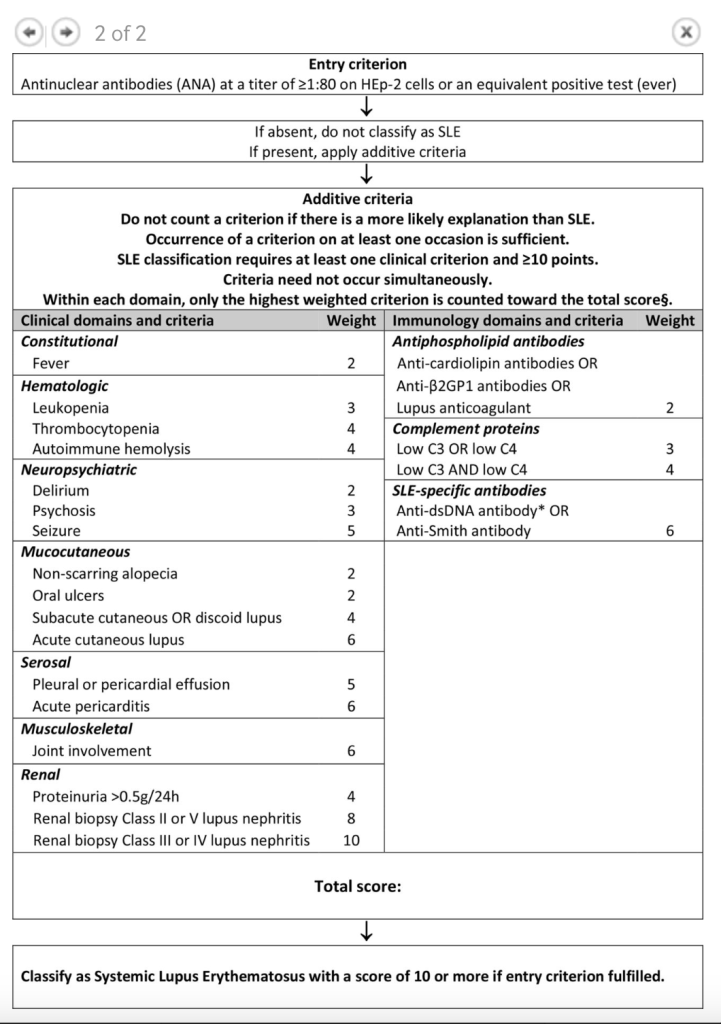
Little side quest for a second, I am still waiting for a diagnosis for my health issues. I figured some of my longterm readers might want an update. It kind of surprises me that we’re not calling it lupus at this point. I have the positive ANA test with the appropriate titer level. The joint involvement is a 6 and the photosensitive rashes (acute cutaneous lupus) I’ve developed warrant a weight of 6 putting me at a 12 overall, exceeding the minimum threshold by this 2019 criteria to classify my health situation as lupus. I meet with my rheumatologist in early January, so I’m bringing up this issue again. Currently, I don’t meet with a neurology team again until February and even then, that’s not a meeting to do a skin punch biopsy, which has been almost impossible to get.

Planning a relatively low key Christmas celebration and honoring a friend’s recent promotion by hosting her a party this past Friday have been two of my biggest joys recently. Our Christmas dinner plans have shifted as we have far too much leftover food from the party; we’ll eat up all that and either shift the holiday meal into the weekend after Christmas or–as needed–make it our New Year’s Eve dinner. Our party leftovers include taco dip and lime leaf scented rice, Mexican street corn, puppy chow (aka Chex Mix Muddy Buddies), brown butter chocolate cookies from Whole Foods, and this wonderful shortbread chocolate lover’s dream dessert a friend made that is modest layer of shortbread with a layer of brownie and caramel topped with a thin layer of ganache. We have a huge responsibility to avoid food waste where we can and additionally, it does not hurt to have a holiday meal composed of leftovers. The food was still made with lots of love and is meant to be enjoyed.

Here are some tiny peeks of our home dressed for the occasion.

The gold garland comes from Bonjour Fete and the family of green reindeer are 3D printed.
The wooden Christmas tree decor is something I picked up at a holiday market years ago.
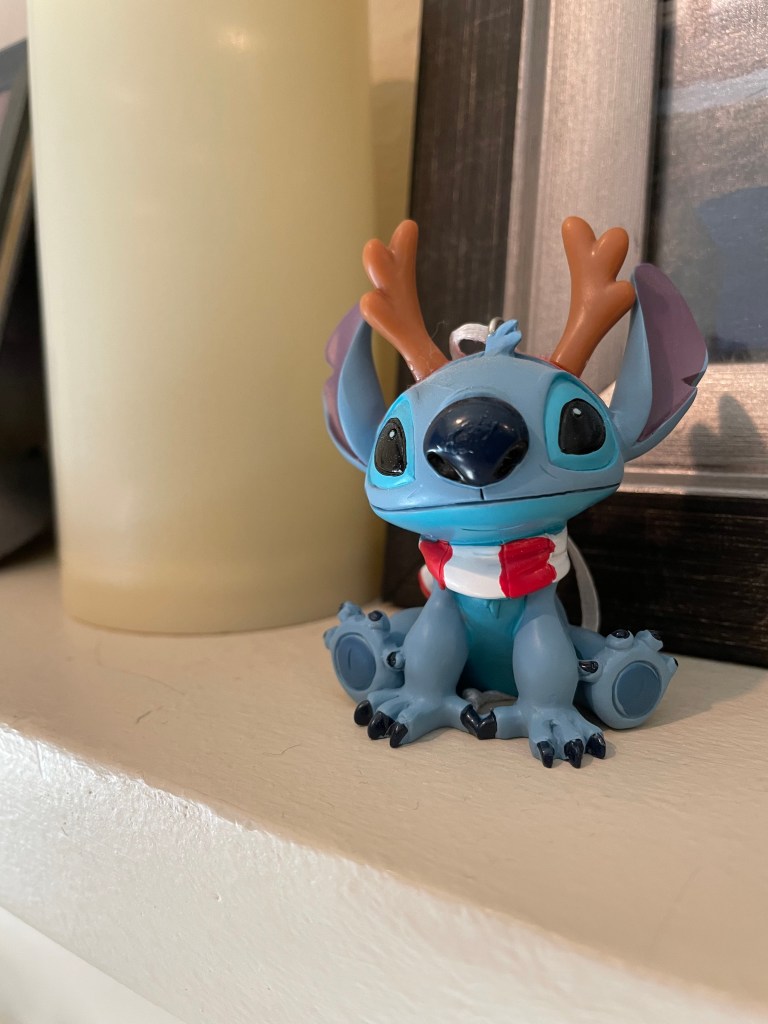
I am a huge Stitch fan. I even have a Stitch beanie for the few days it’s cold enough in Arizona to wear it.
A college friend of mine gifted us this book last year for Christmas. Isn’t it lovely?!
Even my dogs get holiday gifts. Bark Box provided them a dreidel chew toy as well.
The fabulous chocolate-shortbread dessert served on Bonjour Fete paper party plates.
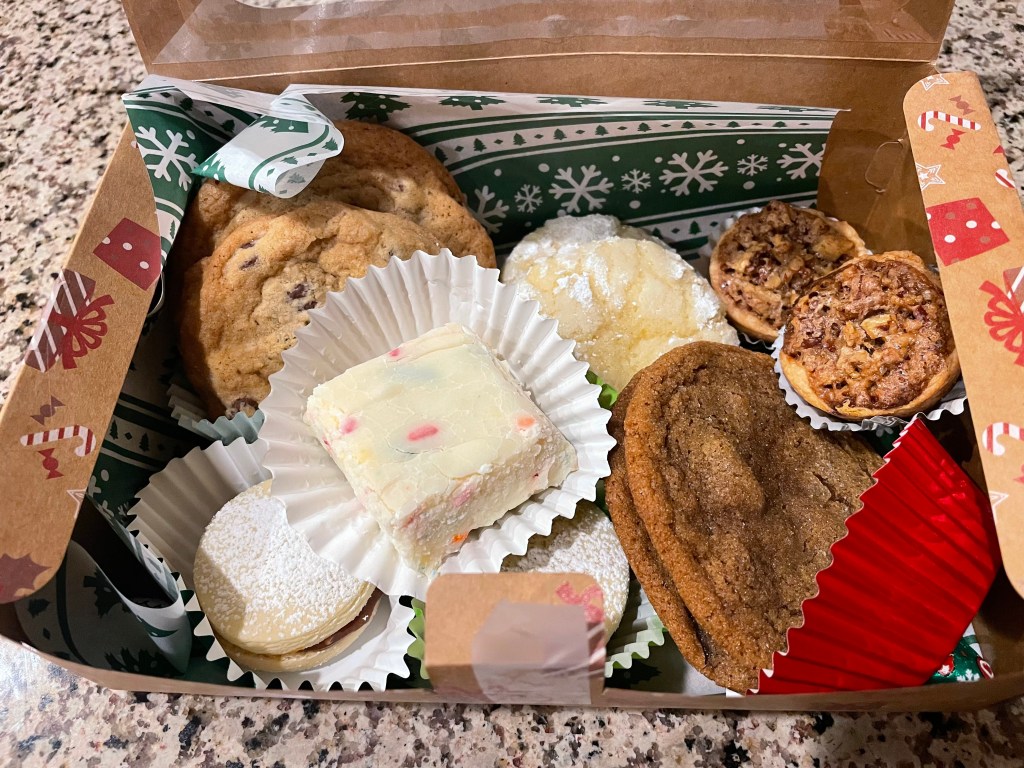
A coworker of mine also sent me home with this lovely box of treats. She did a fabulous job and I love the generosity she’s extended to me this year as a newcomer to the organization.

For the first time in a number of years, I have an extended holiday break ahead of me. I will be using this time to relax with my immediate family instead of traveling back home to see my full extended family. We are saving up (and have been for some time) for a big trip overseas next year. I am keeping the timeframe and the locale a secret (for safety reasons), but post trip, I’ll do a in-depth blog entry or two about the experience. My break plans also include time to do some edits on my memoir, using the DIY MFA book as my editing bible. Additionally, I will stop into my local public library and grab a few reads to hold me through into the New Year. I am finishing up Anthony Bourdain and Laurie Woolever’s World Travel: An Irreverent Guide currently and might finish up another book that’s languished on my bookshelf.

Thanks for dropping by today. I wish you the very best regardless of where you find yourself as the year draws to a close. Please give yourself grace for things outside of your control and praise yourself for the moments where you stood up for yourself. 2025 has not been the greatest year for many of us and rather than pivot straight into “Let’s plan resolutions.” I feel it is best for us to grief what we lost, assess where we are today, and take the time to rest this season.

Food Gratitude and Hushing Exercise Talk Ahead of Holidays

Before we begin today, let’s take a moment to acknowledge holidays can be difficult for a variety of reasons and for many around the world that struggle with eating disorders (past or current), body dysmorphia, discomfort with their size (feeling they are too big or too small) this time of year can be more challenging than it needs to be. As we sit around our own tables or gather with friends or family, let’s remind ourselves we should not be commenting about someone’s choice to eat or abstain from eating certain dishes or drinks. If someone wants a single serving or seconds, that’s their decision. No one should be chided to “walk off” their dinner or earn a slice of dessert either. (I personally like a nice walk after a Thanksgiving meal, but it has more to do with the fact it’s finally cooling down here in Arizona instead of feeling like the inside of an oven.)

Holidays started to be a struggle for me a few years ago when I learned the hard way I had developed lactose intolerance. Between Thanksgiving and Christmas, it often felt like there wasn’t something that wasn’t full of butter, heavy cream, milk, or half and half. I started to dread the holidays, because I’d have to carefully consider what amount of dairy I could tolerate based upon taking Lactaid. I often found Lactaid worked well enough when a meal or snack was simple and only had one dairy source. It didn’t work at all for anything that still had lactose as an added ingredient, so I had to give up a lot of my favorite childhood mass produced chocolate candies like M & M’s. My husband discovered a better lactase enzyme tablet from a company called LactoJoy. It’s great for days where I don’t know if a meal will have a variety of dairy products in it although I am still hesitant to ever try M&M’s again. LactoJoy makes me less anxious about holiday meals, but I still work a little to reduce my dairy consumption around the holidays.

Having a holiday meal where it’s just my husband, daughter, and I is an easy way to find balance. Not that it’s always the case, but I do breathe a little easier when I have full control over the menu. This year we’re enjoying chipotle braised beef cheeks (from Olive magazine’s recipe that uses ox cheeks) over mashed potatoes and celeriac using lactose free milk and ghee and some cornbread muffins (my goal is to pick up Abe’s mini cornbread muffins, which are vegan). For this year, all the regular dairy comes from my dessert selections: a Maine Pie Co. gluten free pecan pie and homemade spiced apple cider ice cream using Yes to Yolks’ recipe. Our super easy Thanksgiving meal and dessert wasn’t really focused on paring back on the number of food dishes to avoid dairy this year so much as it was a way to avoid a lot of food prep that is difficult for me right now. (I made the ice cream last weekend to spread out the labor.) I am still working through a number of medical tests to determine if I am correct and this is an autoimmune disorder I am struggling with for any newcomers to my blog.

This has been a year of appreciating snacks and special treats. I thought about sharing some photos of great meals I’ve enjoyed out at local restaurants, but I think the simplicity of snacks cannot be overstated this year. Going out to a restaurant is work (certainly not something I thought I’d every say!). It’s work on a relatively healthy day to get ready, wait for a table, and wait even more for appetizers, meals, or drinks to be delivered; and it’s more work to go out on days where my pain level is worse and restaurants are colder than expected, there’s no seating available during our wait for a table, and I’m stuck standing around outside in the sun as my skin has become more photosensitive.

I know we all have our favorite snacks. As a huge fan of Oreos, I will tell you we currently have packages of regular Oreos, apple pie Oreos, and blueberry pie Oreos on hand. I can eat Oreos any time of day, but there’s been some other fun stuff I’ve come across the past several months.

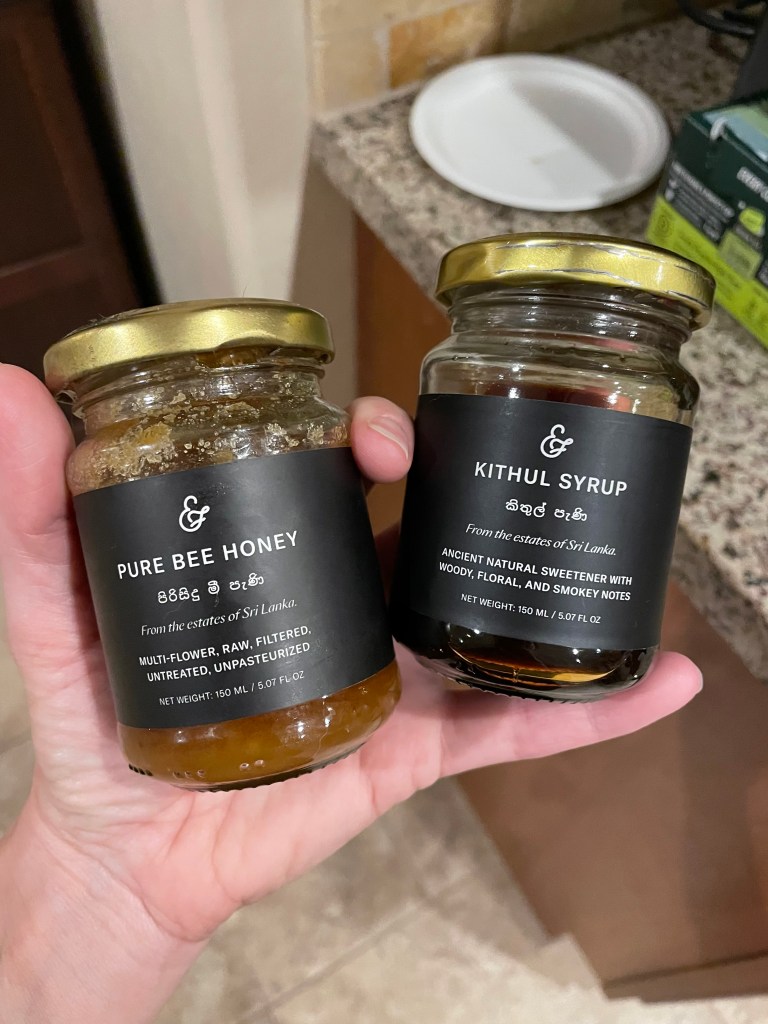
Either of these elevates a cup of black coffee in the morning, but the kithul syrup’s smokey flavor is a nice touch for fall.
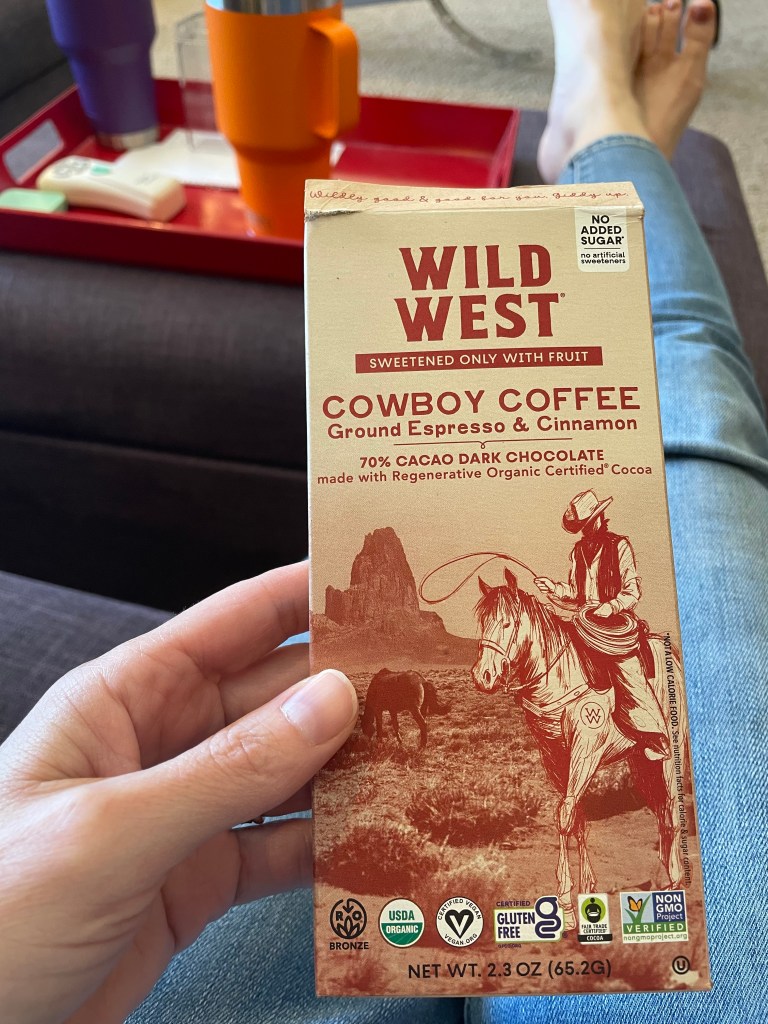
Certified vegan chocolate….and expensive for a chocolate bar, but it’s pretty tasty. It’s normally $7 a bar if you don’t find it on sale. It’s not an every week kind of purchase.
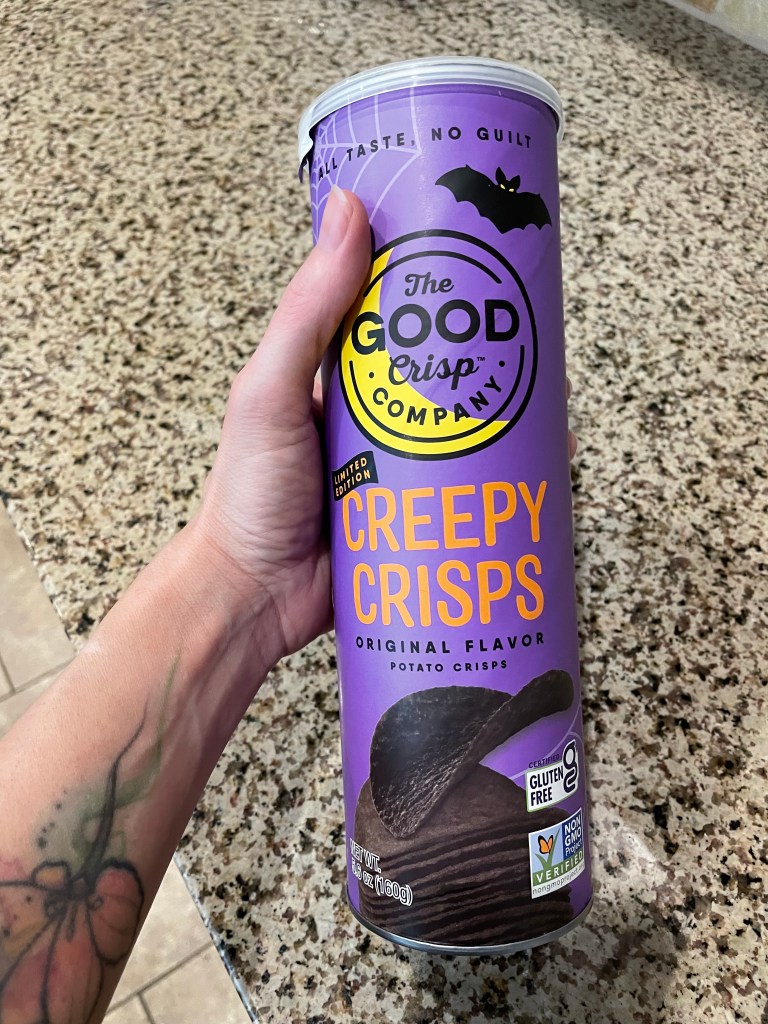
Halloween has a special place in my heart. The moment I saw these chips (aka crisps) I knew I was buying them solely for the novelty color. I already love this brand of chip; the chips are a bit crispier than Pringles and as a food texture person, crunchy snacks make me happy.
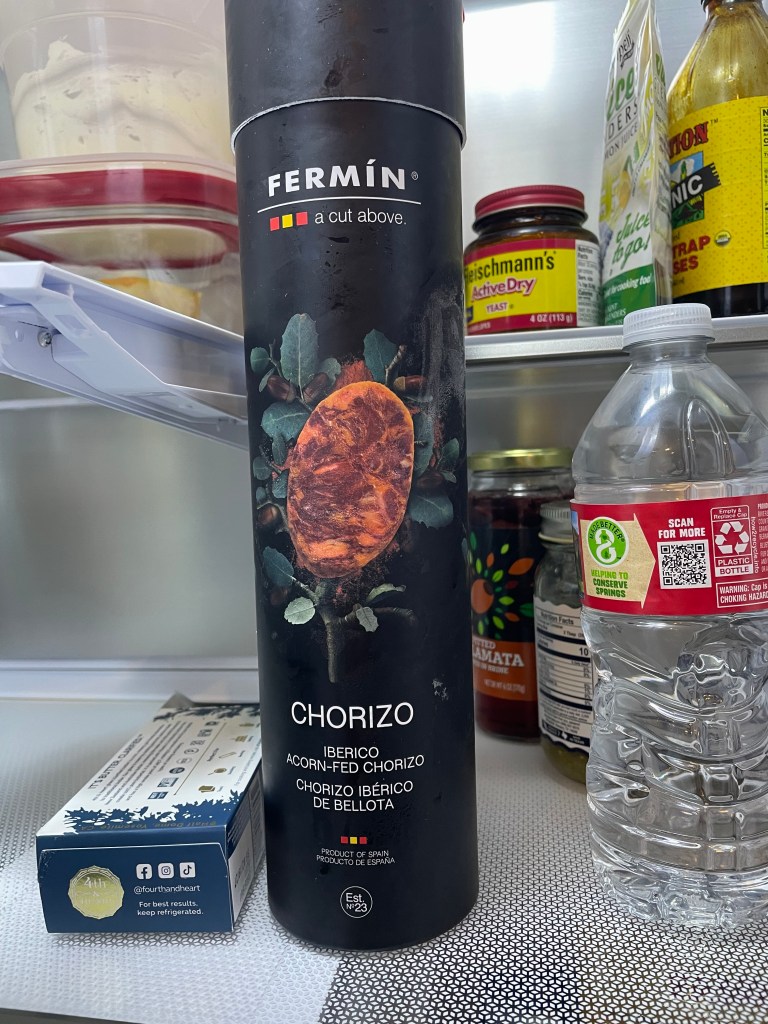
If you need a savory snack, this one is perfect. We had a few slices of chorizo on Ritz crackers topped with homemade pimento cheese. I won’t call it “girl dinner,” because it irritates me that we label snack dinners grown women eat as “girl dinner.” This was our low effort dinner during one busy weekday evening.
I popped into this hotel bar for a little daytime date adventure with my husband. We both love a good Manhattan. Honestly, if I had been more hydrated and had eaten a proper breakfast beforehand, I would have finished my $20 barrel aged Manhattan. (So sad drinks have gotten this pricey.) The resort is already decked out for Christmas with glitzy trees, prepping for an ice skating rink, and bringing in/manufacturing snow for tubing. I do enjoy seeing all the holiday decor without having to maintain it myself.

My drink from Twenty6:

Manhattan – (Barrel Aged) 20
Rotating Bourbon (Russel Reserve, Makers 46, Wild Turkey), Port Wine,
Antica Sweet Vermouth, Angostura & Chocolate Bitters

I need to make something similar at home for either Thanksgiving or Christmas but using rye whiskey.

That’s all for today. I hope as we get closer to the end of the year everyone stays safe and is relatively happy. It’s been a crazy year across the globe and we could all use a few more moments in our lives where we are more neighborly towards each other. Open the door for someone in need. Maybe ask someone what book they’re currently enjoying. Offer to share a favorite recipe (it doesn’t need to be a family recipe, by the way!). Just be a good person and let good come back to you, too.

Take care,

Cheryl

An American Health Care System Reflection: Costs

As the government shutdown in the United States continues, I wanted to take a few minutes and share a bit more about my healthcare journey this year. I am sitting on more privilege that other American peers. For all my health problems since March of last year, I haven’t born an unreasonable amount of health costs. I have my primary insurance and secondary insurance through the Department of Veterans Affairs. It’s the access to the second insurance that has made a difference in being able to seek medical care to the extent I’ve needed in my quest to understand the underlying condition causing my joint pain, nerve pain, lack of physical endurance–all of it.

Before digging into some financials, I want to say, I still have no answers on the cause but the evidence is continuing to point to an auto immune disorder. Earlier this month, I had some additional testing to rule out monoclonal gammopathy of undetermined significance (MGUS) that can develop into multiple myeloma. The bloodwork came back with no evidence of monoclonoal gammopathy and the hematologist also ran an Erythropoietin test for me since there is a blood disorder/cancer called polycythemia vera that has a lot of similarities to the symptoms I’m experiencing. (She had no concerns with the results that came back.) The abnormalities that we are seeing on repeated tests are elevated immunoglobulin M (IgM) levels, which can be evidence of a recent infection (which I haven’t noticed) and autoimmune disorders. The difficult thing for me is other than one positive ANA (Antinuclear Antibody) test, all the other tests that look for autoimmune conditions are negative including the ones that look for specific markers of lupus. This last time she ran an Anti-Nuclear Ab, IgG ELISA test instead of the ANA due to it being more sensitive and the results came back ‘none detected.’

After this last round of testing, I did inform the hematologist, I want to test out a theory of mine. I want to treat my next round of bloodwork in a similar fashion to a cardio stress test. I’ve been reducing my physical activity and have had less exposure to cold environments, which help manage my symptoms and I think that’s part of why my tests are inconclusive. I think if my second-to-last primary hadn’t been such a barrier to seeing a rheumatologist earlier, I would have had bloodwork that shows a true reflection of the inflammation when I hadn’t yet figured out how to manage my symptoms. To try and trigger a response is not something I’d recommend someone else pursue; I don’t know what damage this might do to my body, but I feel it’s one of my last options available to me to get the tests to show what body processes are malfunctioning when I try to live a more able-bodied average person existence (cooking more, doing more chores, exercising maybe an hour a handful of days in the week).

I hadn’t thought about how much of my health challenges I would share earlier this year and then I realized for someone with similar problems, it helps to hear from a kindred spirit running a gauntlet of tests for answers. From very basic research, it’s not uncommon for someone with autoimmune issues to go months or years until a diagnosis is made. (I’m hoping we’re not at the years plural part for me, but I’m already past the one year mark now.) So let’s shift to talk about how expensive all these things are.

Again, not expensive for me due to my particular situation, but this could be an absolute nightmare for someone else. When you sit and look at the battle of the government shutdown, affordable access to healthcare is not a small matter. And I will also say the pending lack of SNAP benefits for many of my fellow Americans IS ALSO not a small matter. And federal workers going without pay IS ALSO not a small matter. I know far too many individuals impacted by the government shutdown currently and it’s hard not be able to assist everyone without also putting my own fiscal security at risk.

Rather than let the conversation run away from us, let’s focus on the charges for some of these medical visits and tests.

Sometime before mid June, my health care costs already hit my family deductible ($3,300). Due to my decision last year to make use of my VA healthcare benefits in tandem with my outside medical coverage, I haven’t had an out-of-pocket expense. I was hesitant to switch care providers, but I went to a non-VA emergency room years ago and paid $200 out-of-pocket to be seen and saw what they charged my insurance company. I knew if my health worsened (and it has!) I’d get to the point where my medical care costs would be unsustainable and I’d potentially have to avoid seeking medical care. Letting medical problems fester is not the solution.

So I hit the deductible before June 15, 2025. ($3,300).

In August 2025, a visit to a neurologist resulted in a $401.08 charge.

A visit for bloodwork in late August had two separate billings: $660.05 and $456.36.

Bloodwork in September (a total of 13 line items) was billed for $2,477.00.

A Veterans Affairs Community Care neurology visit (meaning I saw a provider outside the VA) in September where I was only seen for 6 minutes–six freaking minutes–resulted in a bill for $307.55.

I needed that visit to request a skin punch biopsy, one of the tests to help diagnose a potential “lupus cousin” autoimmune disorder.

My October bloodwork (11 individual line items) ran up the largest amount billed in the amount of $2,937.00.

The physician services portion of that same visit ran in at $359.00.

Dear readers, that comes out to $10,898.04 of medical expenses and no answers.

I cannot receive any form of targeted treatment until we’ve determined what’s broken.

I am blessed that I don’t have to find a way to pay this, but many of my fellow Americans have that problem. That have zero answers and nothing but bills for their time. They are drained physically, mentally, emotionally, and financially. Their plight for affordable health care is different from someone who rarely, if ever, needs medical care and who looks down on those with frequent doctors visits. Your neighbors aren’t a drain on the system; most are trying to lead better, healthier lives and if their health isn’t improving, they’re trying to have a comfortable existence until they pass away. Have some compassion. Anyone can have their lives turned upside by a medical problem.

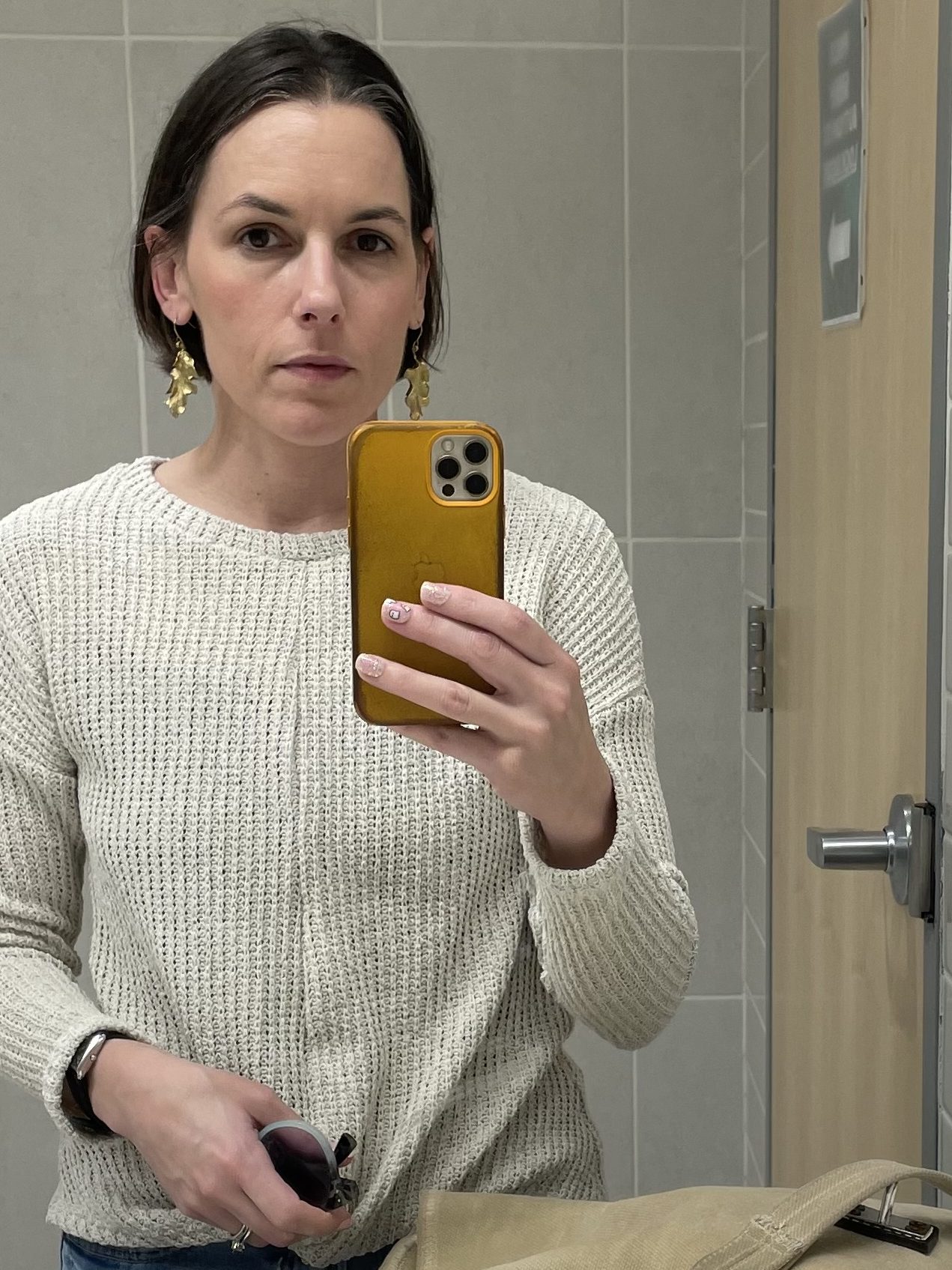
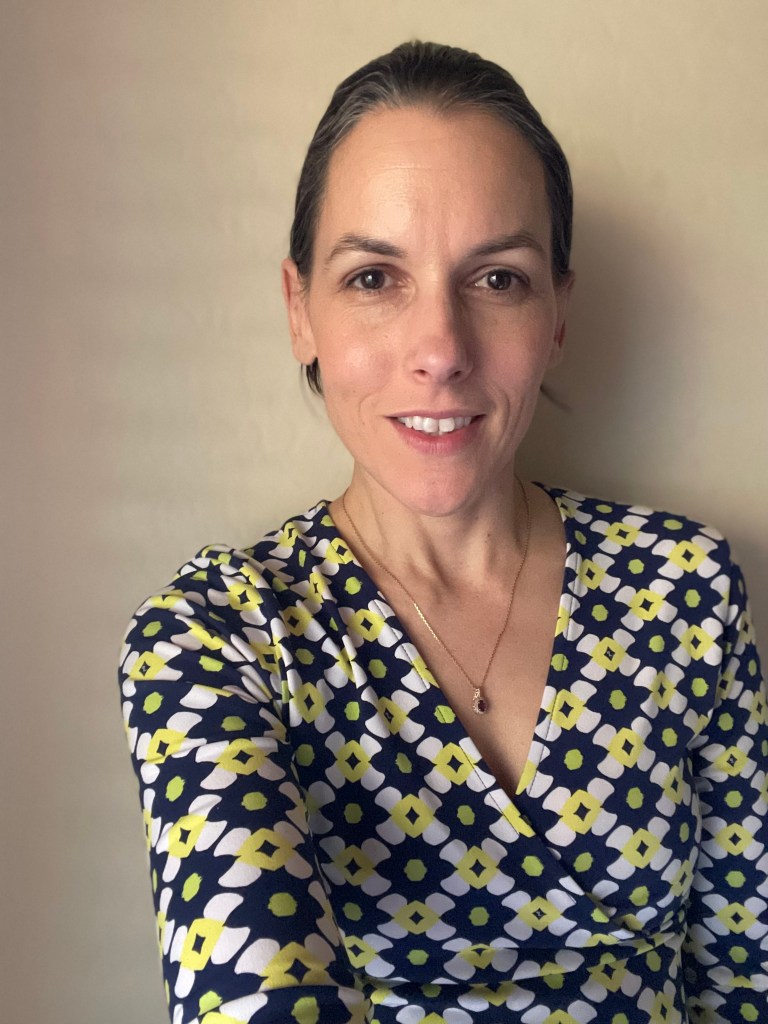
A recent photo of me. You wouldn’t be able to tell how crazy my health has been this past year.

I’ve Never Kept Up with the Rory Gilmore Reading Challenge

Gilmore Girls became my biggest companion during terminal leave–the show filling a void left behind when I no longer congregated daily with people. I became immersed in the small town of Stars Hollow, an imaginary community even smaller than the town I lived in during high school. Rory was–and forever will be–smarter than me. I have no qualms admitting that I never adopted her studious habits although I have considered reading many of the books she’s described as reading or books being associated with the show that have never been in my TBR pile. Apparently, I have a big challenge before me: Goodreads pegged her list just below 400 titles although other sites vary.

If I went back and looked over my life, I guess it’s likely that I’ve read something in that ballpark. I don’t keep all of my books though, and that’s what creates a real challenge for me. Maybe I could be considered a prolific reader even though I am not a fast reader.

This year I’ve taken up a greater appreciation for books from the public library. Not only do I want to reduce how much money I’m spending on books that I might not read more than once, I want to explore books that I wouldn’t have found so easily if I had wandered into a bookstore. Librarians are amazing people, and it is hard to see their world treated like garbage because many on the right have strong opinions against topics and books they find controversial. These professionals are my main points-of-contact for finding non-American, immigrant, and first generation American authors and I love their collections of cookbooks to hone my culinary skills. (Cookbooks are expensive!!!) My life is monumentally improved because these individuals studied library and information science for their career choices and their knack for designing the layout of my local spaces means it’s fun to wander my favorite sections and also to rush to the array of new books for a more unexpected find.

Reflecting on my admiration for the show (for the most part!), I think I am most appreciative of who Rory is as a learner. In this regard, I speak of her life outside of school and not her struggles to keep up with the Chilton students who have more experience with rigorous academic curriculums. We don’t get the full details on how she’s amassed her sizable book collection given her mom’s modest income, but there is a scene where she’s hunting for books at a massive town sale that gives me the idea the community book sales likely played a role. Getting books for cheap (or borrowing heavily from the public library) is a blessing I think we should all appreciate. Learning should always be accessible. (Side Note: Because I did not notice any books in the show with spine labels complete with Dewey Decimal markers, I think Rory’s books are either purchased or gifted to her or she gets school copies to return at the end of her classes.)

To go back to the show referenced reads for a minute, here are books I know with certainty I have read at some point in my life:

  1. The Great Gatsby by F.Scott Fitzgerald
  2. To Kill a Mockingbird by Harper Lee
  3. The Diary of a Young Girl by Anne Frank (I’ve read it two or three times)
  4. Fahrenheit 451 by Ray Bradbury
  5. Of Mice and Men by John Steinbeck
  6. Charlotte’s Web by E.B. White
  7. Lord of the Flies by William Golding
  8. The Lovely Bones by Alice Sebold
  9. The Outsiders by S.E. Hinton (love it)
  10. The Grapes of Wrath by John Steinbeck
  11. Great Expectations by Charles Dickens
  12. The Iliad by Homer
  13. Beowulf
  14. Night by Elie Wiesel (How anyone can deny the Holocaust after having read his story or about Anne Frank I will never know.)
  15. I Know Why the Caged Bird Sings by Maya Angelou
  16. Angela’s Ashes by Frank McCourt (I loved Angela’s Ashes and hated ‘Tis)
  17. Wicked: The Life and Times of the Wicked Witch of the West by Gregory Maguire (I’ve read all the Wicked books…love them all)
  18. Flowers for Algernon by Daniel Keyes (one of the most life changing books I’ve ever read)
  19. The Canterbury Tales by Geoffrey Chaucer
  20. Swann’s Way by Marcel Proust (I powered through it over a few years and I can see why Rory’s mother, Lorelai, gave up on it! It’s exhausting to read for the most part, and then there are moments of brilliance.)
  21. The Odyssey by Homer
  22. Shakespeare’s Sonnets by William Shakespeare
  23. Stuart Little by E.B. White
  24. My Sister’s Keeper by Jodi Picoult (honestly, each book of hers I’ve read has been wonderful)
  25. The Story of My Life by Helen Keller
  26. A Separate Peace by John Knowles
  27. The Crucible by Arthur Miller
  28. Stiff: The Curious Life of Human Cadavers by Mary Roach (I don’t recall seeing this in the original series or the revival, but since it’s included from the list I reviewed, I will keep it listed for now.)
  29. Walden by Henry David Thoreau
  30. Sophie’s Choice by William Styron

How much of Shakespeare’s works outside of her sonnets I read from high school is murky for me. I don’t recall if we read the other works described in Gilmore Girls in their entirety or in selected pieces, so I am not including them here.

I went into this blog thinking I maybe only read 5-10 books that were referenced on the show. To have read 30 of them is a nice surprise for me.

We must remember that reading is a personal endeavor. There are some stories we come across in our schools that we like or dislike. There are some stories we might not encounter in our K-12 education system due to book bans and as adults it is our responsibility to think for ourselves about whether we’d like to read them or not. Some of our peers are faster readers and others savor a book like a quiet afternoon sipping coffee at a local cafe. One is not better than the other: the pace we approach reading a book will greatly influence the things we notice in it. There are times we have to consume a book like a meal on the road. Ploughing through a number of textbooks in a college semester is one such example. Sometimes, we’re busy as parents or holding down multiple jobs and skimming a book gives us enough escapism for that period of our existence. Other times, we want or need to slow down. I am in the second season. I’ve slowed down more than intended last year and this year. My health challenges have made even holding a book in my hands uncomfortable at times, and I haven’t yet found a love for audio books the way others do. For that reason, my reading list is shorter but one of great intention.

I might finally have some real answers this week on what’s going on with my body. The news will likely influence my future reading choices much like how physical pain the past year has taught me to appreciate reading as a different form of exercise.

These books aren’t all I’ve read this year. I read a lot of news and my work entails a significant amount of reading each day. If you’re like me and haven’t added a lot of books to your finished pile, don’t feel bad. Reading in all its forms matters. I’m too lazy to tally how many news articles I’ve read and my work involves reading and re-reading a lot of the same internal and external references that shape my work environment.

My 2025 completed reads are as follow, save for The Lupus Encyclopedia. I read most of the book when I was concerned my health woes were this autoimmune disorder.

  1. Dear America: Notes of an Undocumented Citizen by Jose Antonio Vargas
  2. No Two Persons by Erica Bauermeister
  3. No Ordinary Assignment by Jane Ferguson
  4. The Living and the Rest by Jose Eduardo Agualusa
  5. They Will Tell You the World is Yours: On Little Rebellions and Finding Your Way by Anna Mitchael
  6. Investigating Lois Lane: The Turbulent History of the Daily Planet’s Ace Reporter by Tim Hanley
  7. Year of the Tiger: An Activist’s Life by Alice Wong
  8. The Comprehensive Whiskey Course: A Comprehensive Tasting School in Ten Classes by Robin Robinson
  9. The Cemetery of Untold Stories by Julia Alvarez
  10. The Other Significant Others: Reimagining Life with Friendship at the Center by Rhaina Cohen
  11. The Fun Habit: How the Pursuit of Joy and Wonder Can Change Your Life by Mike Rucker
  12. She Followed the Moon Back to Herself by Amanda Lovelace
  13. Let Me Be Like Water by S.K. Perry
  14. In Conclusion, Don’t Worry About It by Lauren Graham
  15. The Death of Expertise: The Campaign Against Established Knowledge and Why It Matters by Tom Nichols

I am currently reading the following:

  1. Wayfinding: The Science and Mystery of How Humans Navigate the World by M.R. O’Connor
  2. The Art of Danish Living: How to Find Happiness In and Out of Work by Meik Wiking

Before I close out today’s entry, I thought I’d mention that I don’t count cookbooks as reads. Cookbooks are valuable reading resources, too, even though I’ve excluded them from my personal book count. The one I’ve read almost in its entirely over the years is Samin Nosrat’s Salt Fat Acid Heat. Of the handful cookbooks I’ve purchased, including this one by Samin, most will devote pages before and after recipes with paragraphs about the origin of the recipe or ingredients or a story about that person’s upbringing. The same is true for most of the cookbooks I’ve borrowed from the library, and it would be considerate of me to carve some reading time for those stories in the same manner I’ve devoted myself to the recipes within those pages.

Wishing you all the best.

~Cheryl

My Home Is My Writing Space

Good morning, everyone. I am checking in with you all before I start work. Today is a WFH day (yeah). I love starting my morning off with more of a leisurely pace. My new position has allowed me more freedom to work towards completing the first draft of my memoir. I work from home three days a week, giving me an extra hour before my shift to tackle my writing project. My goal is to complete the first draft in October. A desired concurrent goal was to also re-do all the OIF 2-2 casualty data I lost from a previous computer, but I am becoming more aware it’s better suited to a project that runs concurrent to editing my memoir drafts.

Drawing inspiration from Rooms of Their Own: Where Great Writers Write by Alex Johnson, I am letting you all take a small peek at my current home, my preferred writing space. My new home is filled with more natural light than than any of the homes my husband and I have purchased before; it also has more natural light than any of our rental homes, which have been journaling spaces but not any place where I’ve taken up memoir writing. I’ve also occasionally written in my working spaces, but those are brief pockets of break time that only permitted me, at best, a paragraph or two towards my project.

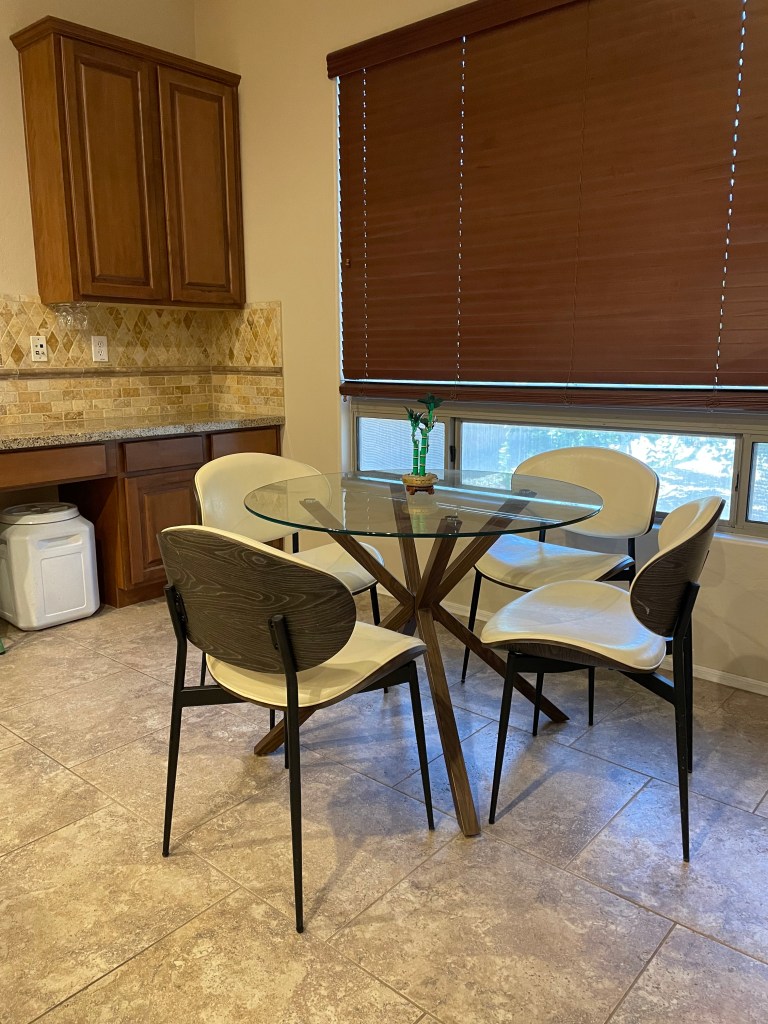
My current home is equipped with a large rectangular dining space that is opened to the living room and within sight line of our kitchen, but my preferred “public space” of the home to write in would be this breakfast nook. I like having the large window behind me. My preference is to write with natural light, but I’ll write in the evening parked under can lights or a ceiling pendant when the task requires it.

I draw a lot of inspiration for my writing from other books. You can learn a lot about what shape you want your memoir to take when you read other memoirs. A big decision I came to was not to use my memoir as a place to bitch about exes and family dysfunction. There might be a moment to share something that speaks to grief and stepping into my own potential due to being let down, but I’ve cringed at how I’ve seen other women left raw emotions in their memoirs instead of taking the necessary time to step away from the experience and learn from it. The two memoirs that made me cringe are Maid by Stephanie Land and Shade It Black: Death and After in Iraq by Jessica Goodell and John Hearn. Instead, I’ve found the way someone unpacks their past with critical awareness is someone I want to learn from; two of my favorites: Mary Pflum Peterson’s White Dresses: A Memoir of Love and Secrets, Mothers and Daughters and Jane Ferguson’s No Ordinary Assignment (still reading it currently). Once I complete my memoir draft, I’ll probably share a list of key books that helped me accept being vulnerable in my writing and those that have helped me improve my actual writing skills. (Dialogue writing is still a weakness of mine; I don’t like putting words in people’s mouths from memory.)

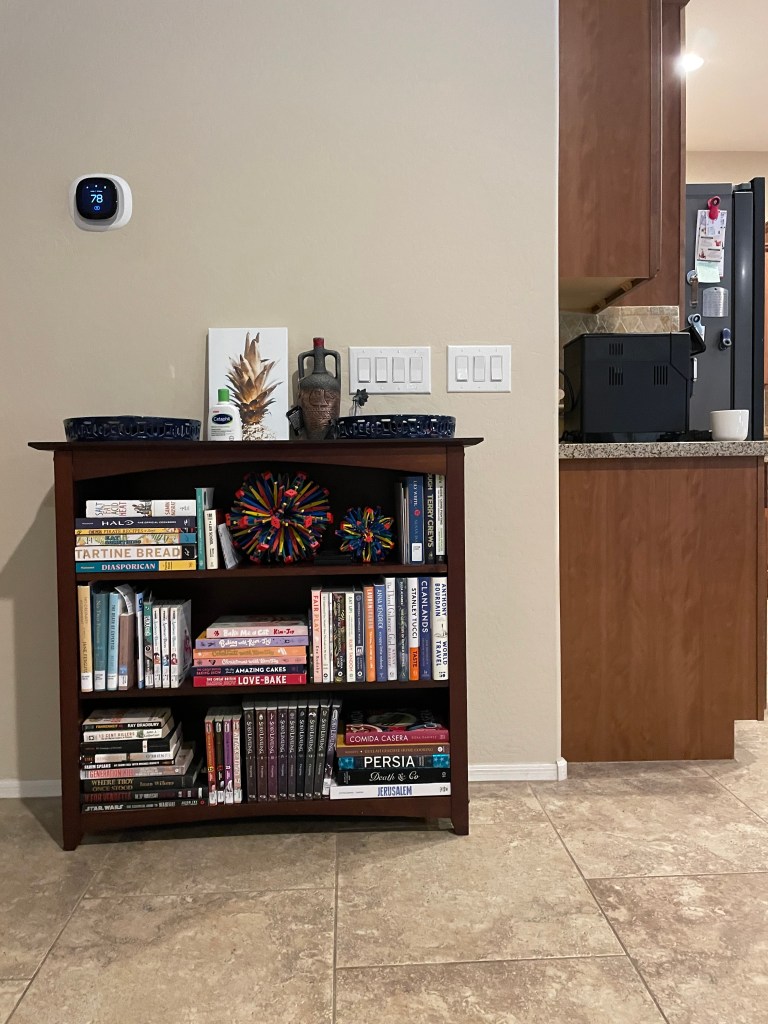
My family bookshelf includes cookbooks, a mixture of fiction and non-fiction works, and a rotation of library books.

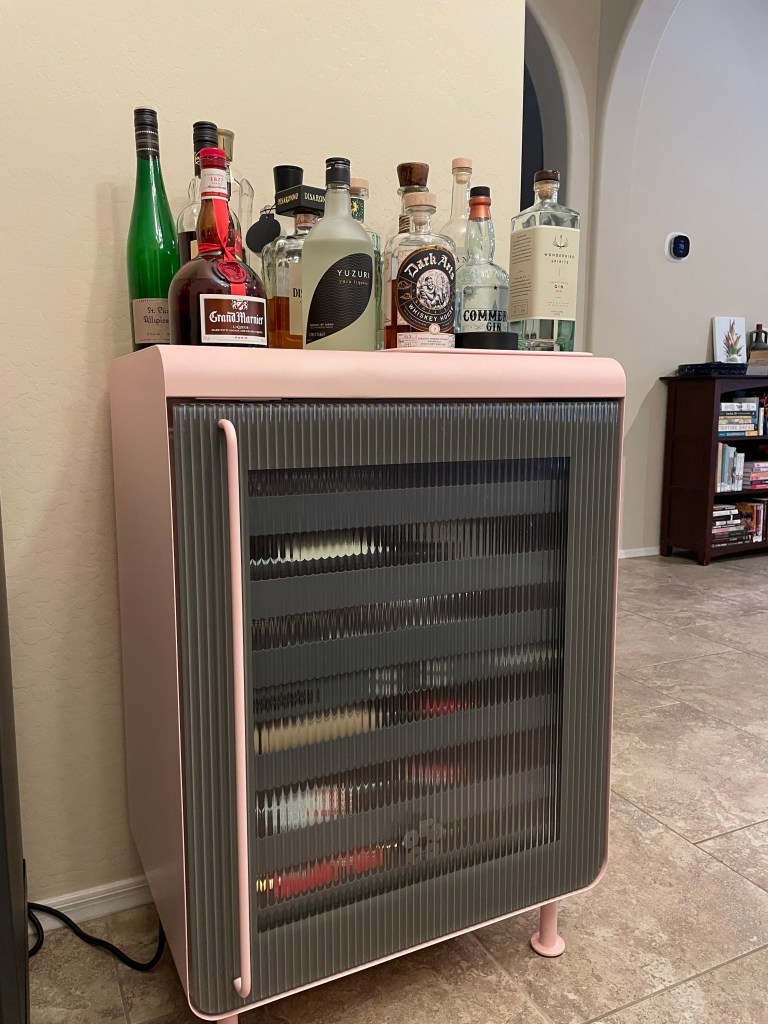
I will admit, like a lot of writers, I also like a glass of something special while I write. Don’t judge! We had the option of purchasing a larger, less expensive wine fridge, but we went with a smaller, retro look Rocco fridge instead. We like the space on top for the bigger bottles and the different zones within allow us to balance the needs of wine, beer and non-alcoholic beer, and a few bottles of spirits. This won’t necessarily be a good fit for those concerned about kids getting into alcohol. We don’t have any little ones running around (save for a high drive Belgian Malinois). Our teenager is also incredibly responsible, and unless we notice a change in her behavior, we trust that we can leave our alcohol setup as is.

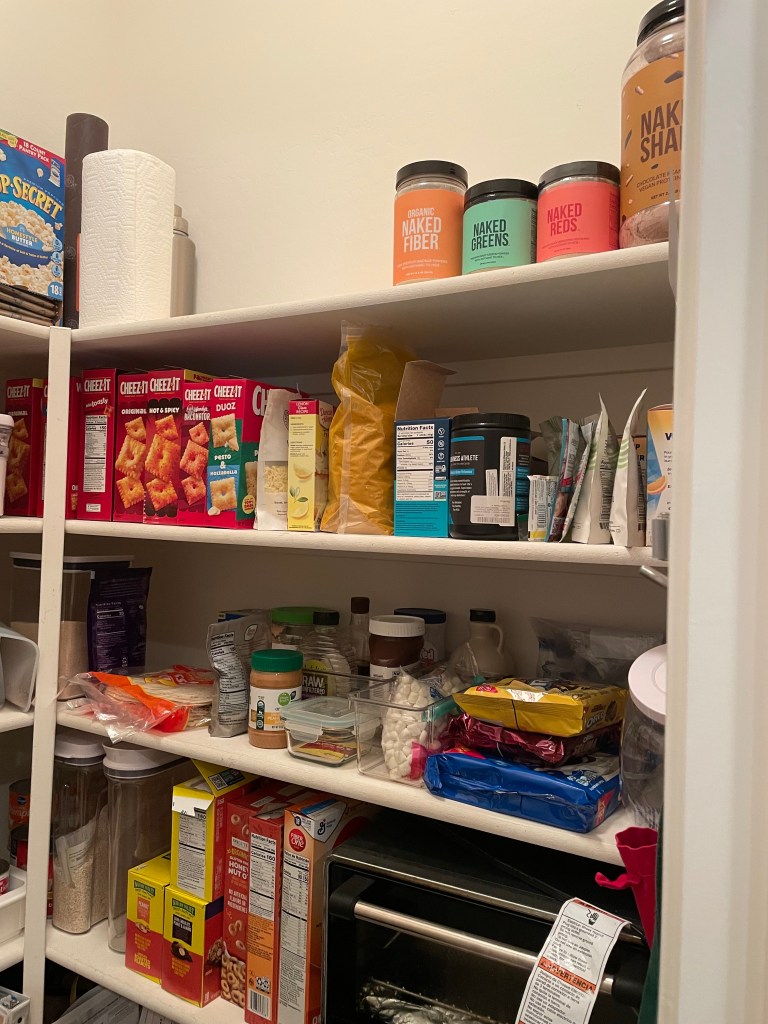
Last thing…every writer needs a snack of some sort. Our new pantry is decently sized. As time permits, I’d like to obtain a quote to make better use of the space, but this is a small peek at what we’ve got going on here. It’s not abnormal for us to have multiple boxes of Cheez-It’s and at least two flavors of Oreos in stock. The pantry is in less of a state of identity crisis compared to last year when we moved in. Out of sight, I have most of our flours lined up together; the salty snacks (olives, pickles, etc.) grouped in a bin; and chips usually end up together as neighbors.

Thanks for dropping in for a quick check-in. I only have a minute minutes left to spare before my paid job commences for the day, so it’s time for more coffee and a quick moment to organize.

Wishing you all the best.

~Cheryl

A New Beginning

Just over a month has past since I left my position with the Department of Veterans Affairs, and I’m liking my newfound settings. I was a presenter today for my new organization, not adding a whole lot to the overall day’s activity with the one PowerPoint presentation, but I was honestly surprised just how many questions were generated off my suggestions.

I carried a lot of doubt with me into my new position. It’s hard not to–I served veterans for the bulk of the past twelve years. As each new day gives away to another, I am starting to see it has all been quite relevant. I’ve gotten so used to laws changing every year that I look for the little tweaks that have the biggest impact. Today, I discussed with the lawyer present in the room how I didn’t have the interest or stamina to put myself into the legal field but my public work is adjacent to it and I feel I found my calling. A calling more natural to me than serving veterans. When I cared for my previous population, I often struggled to separate myself out for the situations they were in; I guess pretty normally that one veteran would want to keep another veteran from struggle. In my new role, I don’t have names and faces that I serve; I look at them as a giant group who need my respect, diligence, and patience to build a better system of tools to access benefits, understand their performance tools, and so forth.

Like my work with the VA, I will remain closed lipped on my current employer. Should we later terminate this working relationship, I will likely discuss my work with greater reflection on lessons learned, salary, and so forth.

Today’s blog entry was really a lot of sharing that I am happy and in the best paying position of my career. I’ve never earned six figures, and it’s wild, scary, and empowering. I get to see all my hard, unpaid (excluding VA education benefits) efforts in school and struggling through periods of underemployment helping me build a better legacy for my family.

Stepping out of veteran-centric spaces, I don’t know where the future of this blog will go. Maybe a name change will be in order. Maybe a new focus will reveal itself. For the time being, I will continue my quest to write monthly and be a voice of strength and encourage others to pursue their wildest (legal) dreams.

Before I close out for the day, a health update is in order.

My newest rheumatologist thinks my health problems are a lupus cousin, Sjögren’s, although I haven’t noticed the most common symptoms. She is also looking at the possibility of small fiber neuropathy. We still have work ahead of us, so right now, I am just accepting the summer heat is my best source of managing pain and choosing to not donate blood whenever blood donation opportunities come up since I don’t know if it’s safe for me or any potential individuals needing a blood donation.

Take care and I’ll try to drop in again in August.

Sincerely,

Cheryl