
For months now, I’ve gone back and forth whether to share that I initiated a new claim with the Department of Veterans Affairs (VA). My health suffered substantially last year, and in speaking about those issues in bits and pieces on here, I finally felt it was important to also share that I put in a claim for compensation with the VA. The important thing to keep in mind is that each person’s claim is different, so what I am sharing today would not mean the same result for someone else. I am just hoping that by being transparent, my experiences will help someone feel more comfortable/more prepared for what a disability claim might entail.
I opened my claim in April of this year. Around that time, the average processing time was 102 days. Knowing this information, I realized my claim could be decided around early August. (Again, we’re talking average. If you’re submitting 20 medical issues on a claim, be prepared for a longer wait time!) Yet again, I made the personal decision to go about the claims process without an attorney. I feel that an attorney cannot advocate for me the way I can, because I am the person living with the health problems. Some others might need more help either based on the severity of their disabilities, their lack of comfort regard legal language, what have you. I also opted to submit my claim online, allowing me to track the status. The stages are a bit basic in nature, but it was enough for my needs. For anyone new to the process, it is also worth sharing that at any point your claim can move back a step in development. Don’t let that be a shocker.
I wasn’t sure if I’d need a C&P (compensation and pension) examination this go around. I had recent medical evidence I provided as part of the the claim. My claim was for GERD secondary to PTSD. For others, there might be a direct connection to their military service, but I feel if that applied in my case, I would have noticed symptoms sooner. Before I continue further, I would like to reiterate that each person’s medical issues vary in frequency and severity. The VA’s schedule of disability ratings takes those things into consideration. You can see these breakdowns by various bodily systems in the VA Schedule of Disability Ratings.
Here is the breakdown for mental health conditions.
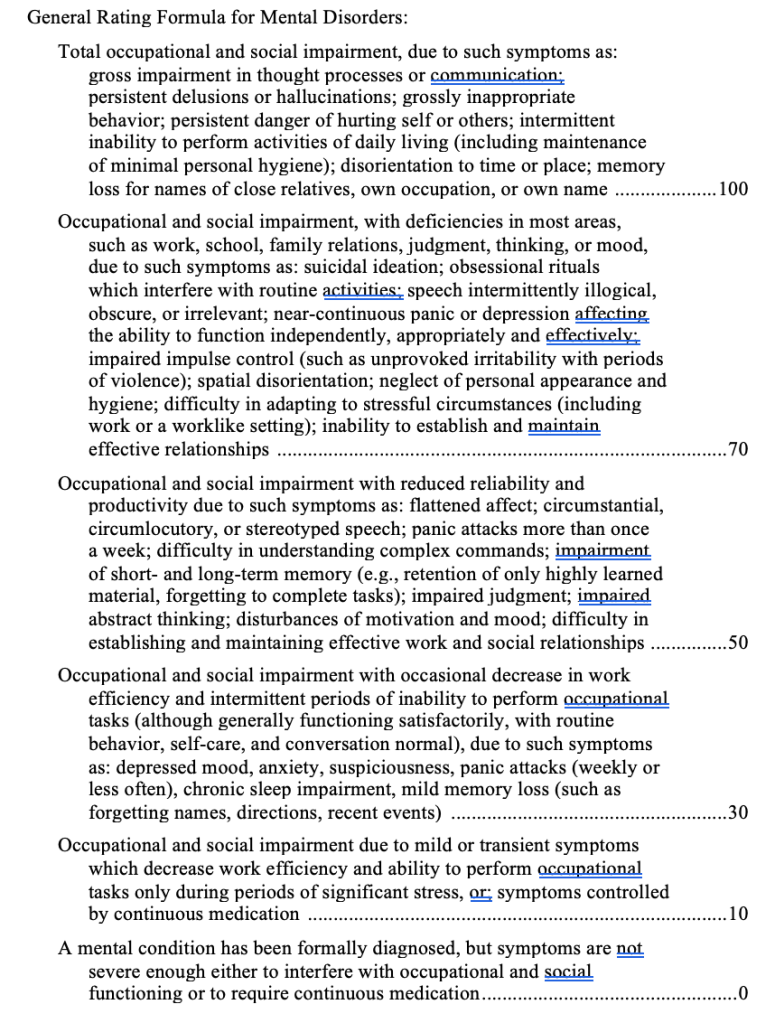
The percentages of 0, 10, 30, 50, 70, and 100 greatly change what type of financial support is made through the VA. A zero percent rating is not compensable. A veteran with a single 10% disability rating receives $165.92 per month from the VA. The same single (i.e. not married or with no other eligible dependents) veteran with a 100% rating (excluding any situations where special monthly compensation applies) receives $3,621.95. For a full listing of 2023 rates, please visit here. When you look at these different ratings, you can see how the impact on the person’s life changes significantly from the condition is diagnosed (and more of a slight inconvenience) to where someone struggles in areas like their employment or social connectedness with others.
My claim also happened to fall in this window of time where the PACT Act passed last August, so I knew it was possible there would be a look back at my service experiences regarding possible hazardous exposures. This is the part I knew would be a bit more stressful for me. I got out in 2007, so some of those things that were once clearer in my memory have faded because the job knowledge is no longer relevant to my career today. These are things though that became important to talk to the provider I saw for my C & P exam. Again, I was partnered with QTC (one of the vendors the VA contracts with for these). A big thing to keep in mind is you might not live close to where the C & P exam is taking place. Each time I’ve had one, it’s been roughly 40 something miles from my residence. There is travel reimbursement for the process, but the situation meant planning time off from work and hoping nothing happened to where my appointment got canceled. (Vendors, like everyone else, might need a sick day!)
I was glad to see that the receptionist staff at QTC were respectful, as was the examiner I met with in early August. Remember what I said about when I thought my claim would be decided? It’s ok though; these things take time. I am not terminally ill, I am not in financially dire circumstances, or have age related factors that necessitated priority processing. I received notice in late July regarding having an appointment in August, which gave me about two weeks to plan for the visit. Meeting with the examiner, I came prepared with a Statement in Support of Claim filled out. Personally, I don’t like going to medical visits, and I have no problem throwing the Marine Corps under the bus for this feeling. Across the board, the providers I had in the Marine Corps were difficult, between being pushy about the type of birth control I should use, and up to and including the person whose half-hearted efforts on my early 2005 medical visits listed my chest pains as not being connected to my deployment, these people made it more difficult for my health conditions to be considered valid when I got out and wanted support from the VA.
I will let you know the provider gave me a moment to share those feelings. I really appreciate that she let me discuss how I attempted to have early symptoms addressed (both in and after service). Talking about deployment stress (or any stress really) will be hard and you just have to be willing to unpack all that during your visit with the provider. These strangers don’t get to know you the way your regular medical providers do. So we just jumped in there. I explained the digestive health problems I’ve had over the past several months. It was tough telling her that at the time where I was waiting for biopsies to come back on four organs my management team at SSA never bothered to ask about how I was coping. We had to go through what my symptoms were, what seems to bring them on, and the frequency and severity of those issues. After discussing those issues, we dove into the possibility of my condition being related to toxic exposures. She brought up a site called VetsHQ that has a list of burn pit locations. I figured as much being at Camp Blue Diamond and serving at Al Asad Air Base, we were around these things, but I never saw anything actively going on. Save for the fact, my team and I used to burn printer cartridges in a small burn barrel outside our work building on Camp Blue Diamond–we’d burn those along with printed documents and people’s cards from home that they tossed into their burn bags by their work stations.
She took it all in stride. The kinds of things these providers probably have revealed to them on a day-to-day basis makes me comparable to psychologists and psychiatrists. We’ve got a lot going on as a specific population of Americans. And the conversation kept going on. I was upfront about how my job as a Chemical Biological Radiological and Nuclear (CBRN) Defense Specialist meant being careful about the risks. During training at NBC School, we went through a live nerve agent chamber and our gear was tested before we walked through the facility for our final exercise. Then again, during my second tour in Iraq, people were screwing around with unknown chemicals in a bunker on Al Asad. My team donned our hazmat suits (think these, not this) and pulled those containers out of the bunker. The chemicals weren’t weapons of mass destruction, but still they were things those individuals shouldn’t have messed with and their negligence resulted in experiencing chemical burns. It is a bit embarrassing though now to admit that much of our job, aside from maintaining our warehouse of chemical protective gear and equipment, was clean off air conditioner units around the base. We’d go out in our regular uniforms and use our decon truck to hose those things off. What all was in the air, who knows.
All told, my C & P took about an hour, maybe slightly more. On top of having the one-on-one with the medical provider, I also had a blood draw. The team needed to see if GERD (which itself is not a disability in the VA’s schedule of disability ratings, more on that later) was causing me to experience anemia. The staff member who did my blood draw was equally as kind and respectful as everyone else. I also appreciate that she got the blood draw on the first try. Over the years, I’ve had a few who mess it up and then they go digging around with the needle in my arm trying to find the vein. It’s the worst. I will tell you though you do not get a copy of your C & P results. If you want a copy, you must submit a FOIA/PA request. Since everyone was rather respectful on this visit, and my last C & P provider was the same way, I don’t feel those results are things I need in my personal records at home. Should my feelings change though or I need information from those appointments, I am aware putting in a FOIA request could take months to process.
Now, here’s where we are today. The VA reached a decision on August 17th, not too much longer than the original expectation based on April 2023 average claims processing times. My claim wasn’t too complicated with one medical issue and only two regular doctors’ records plus the C&P exam results. And after starting this blog post, I realized I did forget to mention to the medical provider–whether this is relevant or not–but prior to leaving for our first tour in Iraq, our unit had all our uniforms laid out on the parade deck and they were doused with insecticide. The team used those sprayers you see professional pest control companies use and sprayed each individual uniform. We had to allow the uniforms to dry fully before we could take them back. The irony is it’s not safe to wear while still wet, but each human perspires, so eventually you have to wonder how much of that insecticide gets onto your skin. Semi-related tangent aside, I wanted to circle back to the fact this was a simple claim due to few issues attached to it, but complicated in the fact GERD is not its own disability within the VA’s Schedule of Disability Ratings. My final decision from the VA resulted in the condition being labeled 10% secondary to PTSD.
This decision is relevant for a few reasons. One, that I can now get treatment from the VA–and my necessary medication–if I’d like from the VA’s health care system. Right now, I haven’t made that decision. I want to ensure the medical care I get is close to home and if my closest VA facility cannot accommodate services for this condition, I’m not willing to regularly travel an hour out of my way when the current gastroenterologist is roughly 20 minutes away. Two, if this condition continues to get worse, even with treatment, I can later file for an increase. It was better, in my opinion, to notify the VA rather promptly about the development of this health condition than wait a few or several years and potentially create more obstacles in connecting the two health conditions for treatment purposes. I say treatment, rather than compensation, because while compensation can help people cope with either being unable to work or unable to work at the same level as peers without disabilities, medical care can become unbearably costly to afford. The third, and last reason, is that let’s say the condition progresses to the point that it results in cancer in one or more organs and that progression of disease results in my death, having the disability on record as secondary to PTSD could make the application process for death benefits and survivors benefits easier on my family. Most people may not want to consider that last reason as being as important or even more important that monthly compensation, but it is hard on families unprepared for a loss of income or the the costs associate with burial.
Let’s go back to my example of a veteran from earlier, the one rated at 100%. That single veteran is currently compensated at $3,621.95 for month for their single disability or combined disability rating. That veteran with a spouse is compensated instead at a rate of $3,823.89; when the veteran with a spouse passes away, the spouse does not continue to receive the $3,823.89 per month. It does not continue to live on until the spouse passes away. The surviving spouse is potentially eligible for Dependency and Indemnity Compensation (DIC) and the basic rate is currently $1,562.74. That’s the base rate, but some survivors could receive a slightly higher payment, but what a huge change in income. We all must be prepared to consider how our eventual deaths will impact our loved ones’ financial standing after our passing. That’s why I am more cautious–I carry more life insurance than my family members would need in the immediate days after I die and I am willing to go through things like the C&P process to get a disability I feel is in one way or another related to my military service on record with the VA.
The 10% rating I recently received does not change my combined disability rating with the VA. This issue is another important thing to discuss today. The VA uses a whole person theory, so a person without any disabilities is considered 100% abled-bodied. Each additional disability that is either service-connected or secondary to a service-connected disability has the potential to increase the combined disability rating; sometimes, it doesn’t though. Let’s say someone’s combined disability ratings are 30%. Their next disability decision is a 10% rating. Using the VA disability rating calculator, their new combined rating is 40%. The calculator will show you from 10%-50%, adding a second 10% bumps up their compensating rating to the next higher increment (done in 10’s). If the previous combined rating is 60% or higher, the additional 10% doesn’t move them up to the next compensation level. This conversation is also excluding certain issues like special monthly compensation. There are additional needs that necessitate compensating the veteran further for their losses.
For the longest time, I’ve been a bit hesitant to talk about these kinds of things, because I’ve also been exposed to veterans who gloat about their 100% ratings. Or, in other circumstances, I meet veterans who talk about the fact they are owed a 100% rating or they are trying to get a 100% rating. It gives me a lot of discomfort to know that I have members of my veteran community who present those opinions. Thankfully, their voices are offset by other great people in our community who also have 100% ratings and I can see how that rating is helping support them and their families in spite of the challenges they experience on a regular basis.
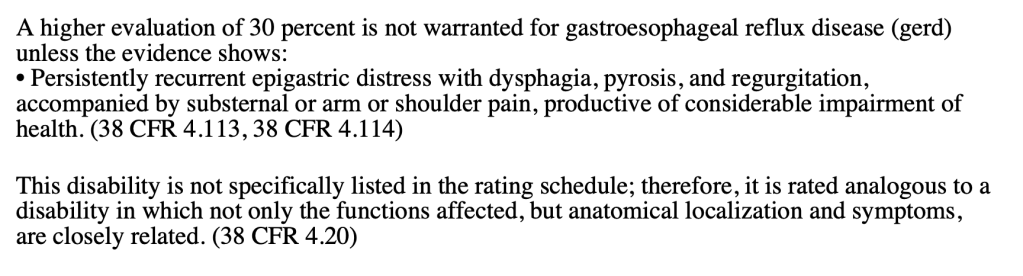
To help show why my rating for GERD is 10%, here’s a snippet of my decision letter. I’ve been fortunate to not experience vomiting with the condition at this time. As well, my weight loss with the condition was quite temporary. Before my primary care doctor knew what was going on, she thought it was a more simple digestive health issue and prescribed a week of antibiotics and a week on the BRAT diet. By severely limiting what I could eat to bananas, rice, applesauce, and toast, my weight dropped down to about 105lbs. Now, I am back around 120, my regular weight. The recent bloodwork at the C&P did reveal moderate anemia, but the combination of symptoms is managed by diet modifications, medication, and has not contributed to an inability to work at this time. My goal is to keep it this way, to the best of my abilities. It is easier on my family financially for me to work (and be taxed on my earnings) than it would be if my sole source of contributing income was tax-free compensation at a higher percentage.

It is a lot of work now to try to stay healthy, but I want you to know each step you take to managing personal health matters. I hope this post has inspired you to do the the things you need to do to tackle your own health issues (and perhaps some financial goals!) to live a better life and to care for your loved ones when you do eventually pass and all that’s left are memories.

 She Wears Dogtags