Pre- and Post-Deployment Health Assessments: Modern Deployment Exposures and Experiences From an Iraq Veteran Perspective

IMG_2428

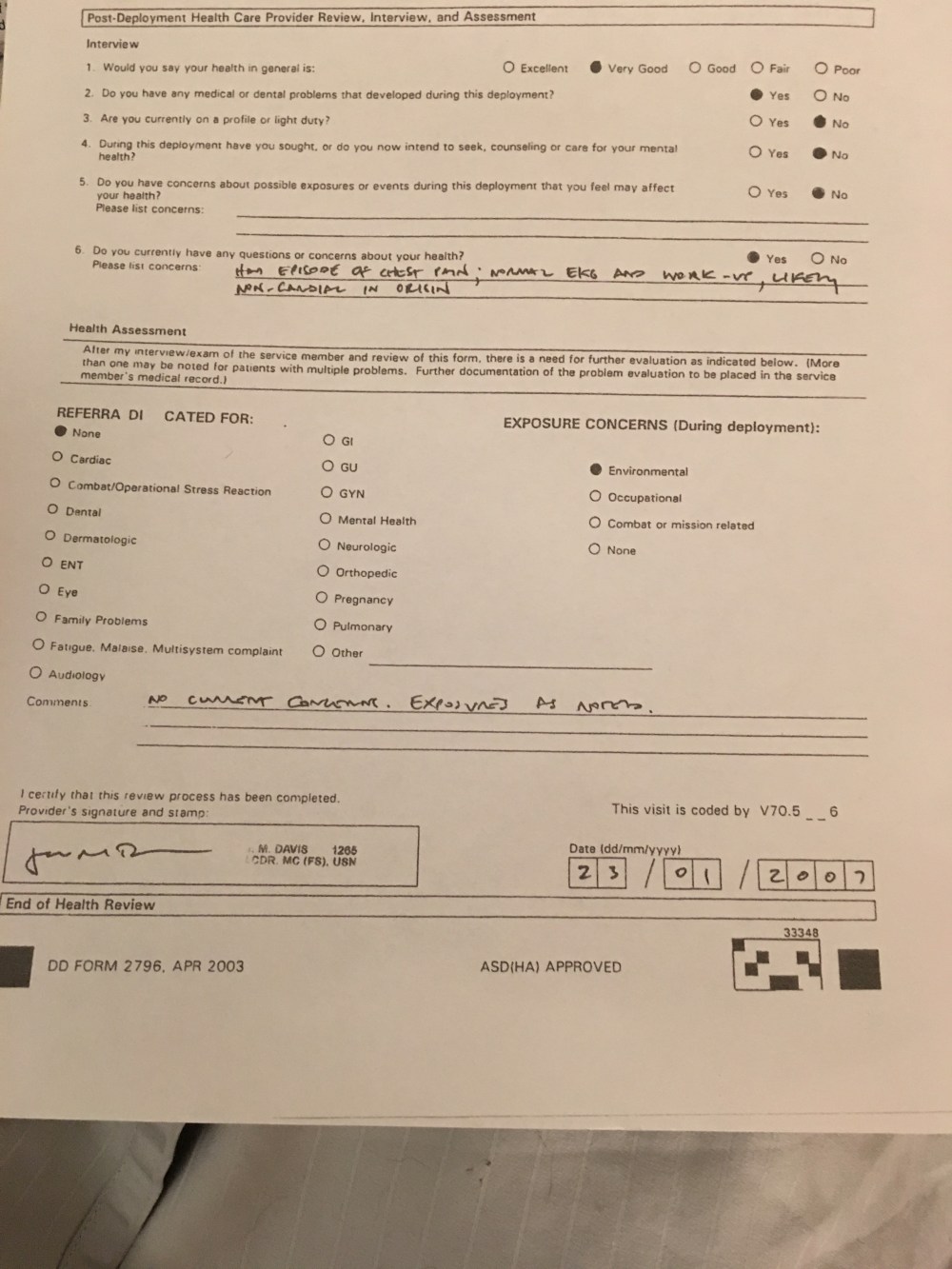
Last week, I heard back from the VA.  Yet again, they don’t consider my chest pains to be service-connected.   This reality kind of floored me.  I actually opened up to them in my December 2016 claim and while it might sound silly to say such a thing, in 2007, I kept things simple.

I didn’t tell them about Captain Brock dying.  I didn’t tell them about my kind of work.  I didn’t emphasize my exposure to mortars, although that information was part of what I listed in my records about different types of exposures while in the Marine Corps.  Back then, I was dealing with chest pains and I knew I didn’t have them before I served.  They started at the tail end of my first deployment, continued after I returned, and remained a part of my life through separation.  I just needed the VA to understand at my point of separation the chest pains were still ongoing and I felt they were related to my service in Iraq in OIF 2-2.

FullSizeRender (2)FullSizeRender (3)

If I had realized what a miserable experience it is dealing with the VA on the disability compensation side of the house, I think I would have pushed harder to find the right medical support while I was in.  For the few times I was willing to subject myself to medical about this condition, every person wrote ‘non cardiac origin’ for the pains but no one wrote in a diagnosis or suggested getting additional feedback on my situation.  What’s more infuriating is the parts where it reads ‘exercise induced stitch.’  Seriously, in the twelve years I’ve dealt with these pains only the primary care provider I’ve dealt with most recently has delved further into this issue and offered different suggestions because the pains were getting to the point they were destroying my quality of life during waking hours and would interrupt my sleep.

For over a year now I’ve wanted to have a conversation with you all about the Pre-and Post-Deployment Health Assessments and I think with this other VA encounter, I have the right foundation for this discussion.

The VA does not know our deployments the way we do and part of the problem is also the way the system requires ticking off boxes, ineffectually asking and not asking the right questions.  The forms we complete do not necessarily represent the types of situations we may encounter; let’s be honest here, the VA will never have records from the Marine Corps and/or the US government that 175 United States service members died during my deployment and these numbers best represent the information I was feed every day as part of my work in our operations center. I only know this information because I was determined to find a way to discuss my deployment, to shed light on other aspects of war no one seems to look closely at but is an important job all the same. I am only privileged to know this much of the extent of my deployment thanks to Military Times data.

In cases like mine my work was classified secret so how was I suppose to honestly fill out the forms?  As well, even if I could be honest, there also is not a sense of privacy to complete the forms properly not that I would have trusted completely it in full disclosure.  On my first deployment, I was the only woman on my team so I felt implied pressure to not be the “weak link” and during the second deployment a lot of stress from the first deployment crept up that I was not willing to discuss with my command.  Nor was my situation helped by the fact my chest pains occurred on deployment and yet again, no real resolution came out of getting them checked out.

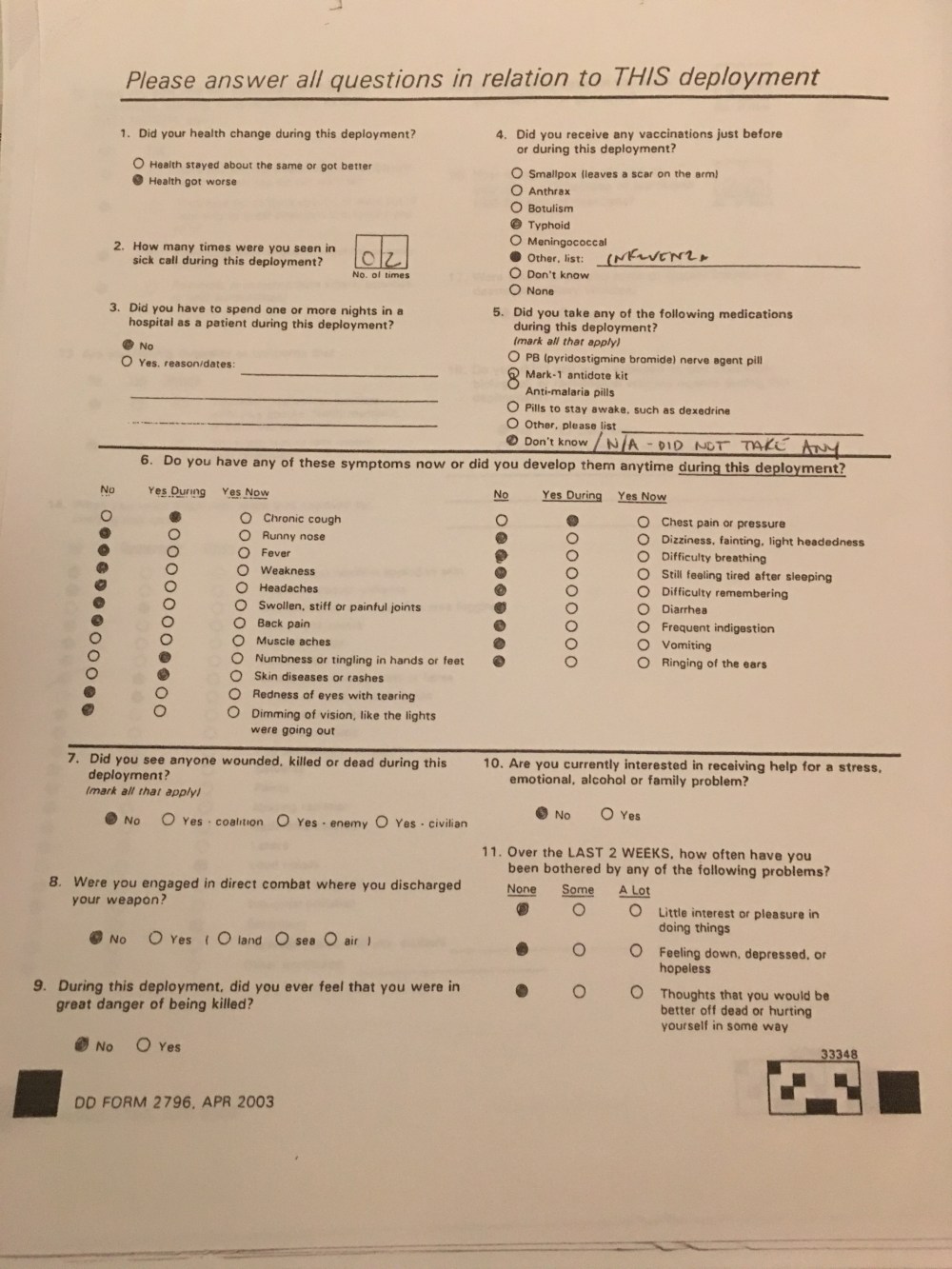
My apologies I currently do not have snapshots of my first deployment paperwork.  eBenefits is being quite a disappointment and again not allowing me access to my military records.  The next time it’s available, I’ll try to download all my copies so I can share those details with you.  For now though, we can press forward using information from my second deployment documentation, the pre-and post-deployment health assessments.
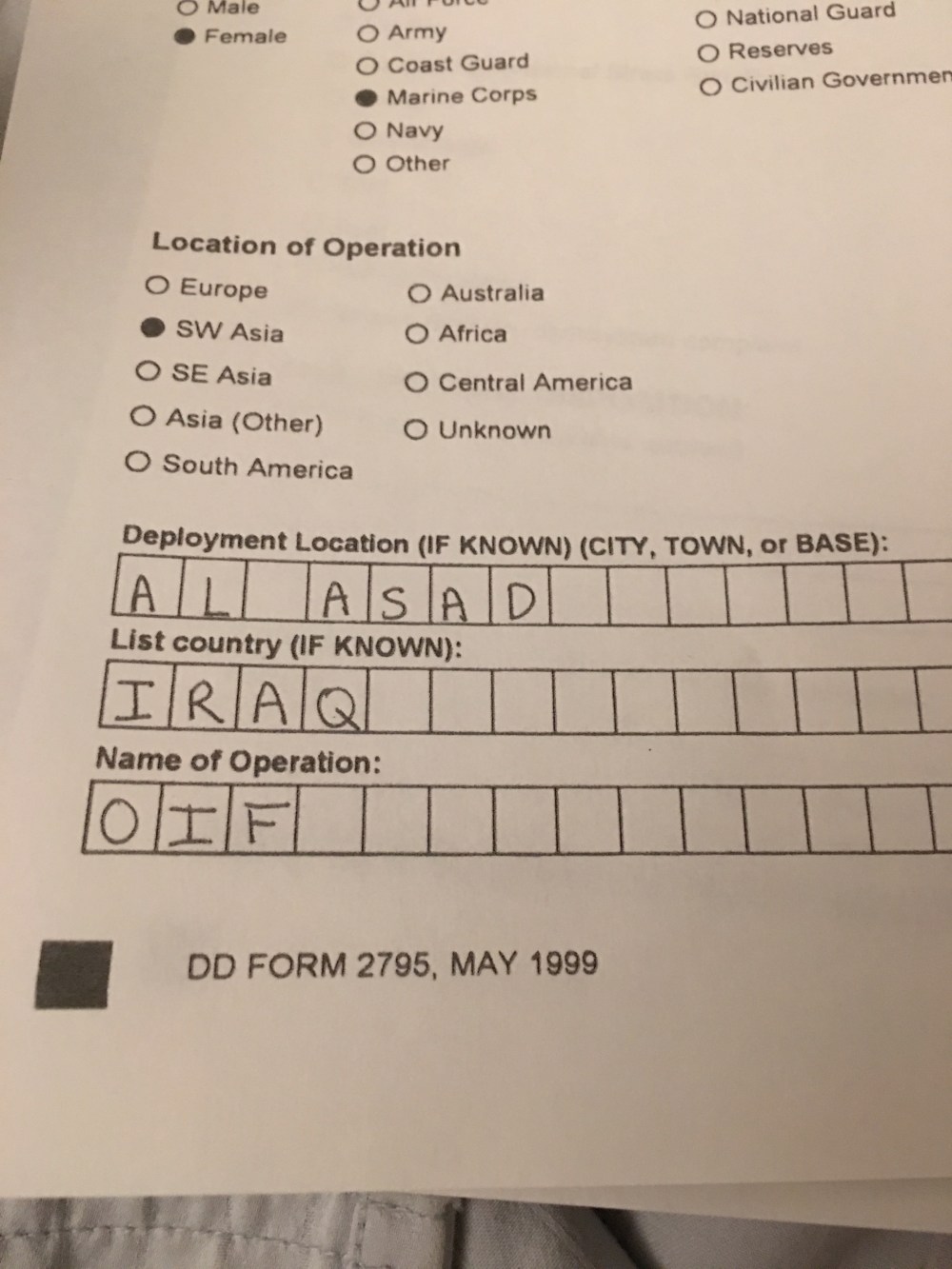
FullSizeRender
This form was filled out on July 11, 2006
FullSizeRender (1)
It’s kind of funny I still had my maiden name on my pre-deployment health assessment.  I was already married by then.

I’ve cut off segments of the documentation as my copies contain my Social Security Number but for greater clarity on this issue, below are fuller snapshots of the pre-deployment health assessment form that existed during my period of service.
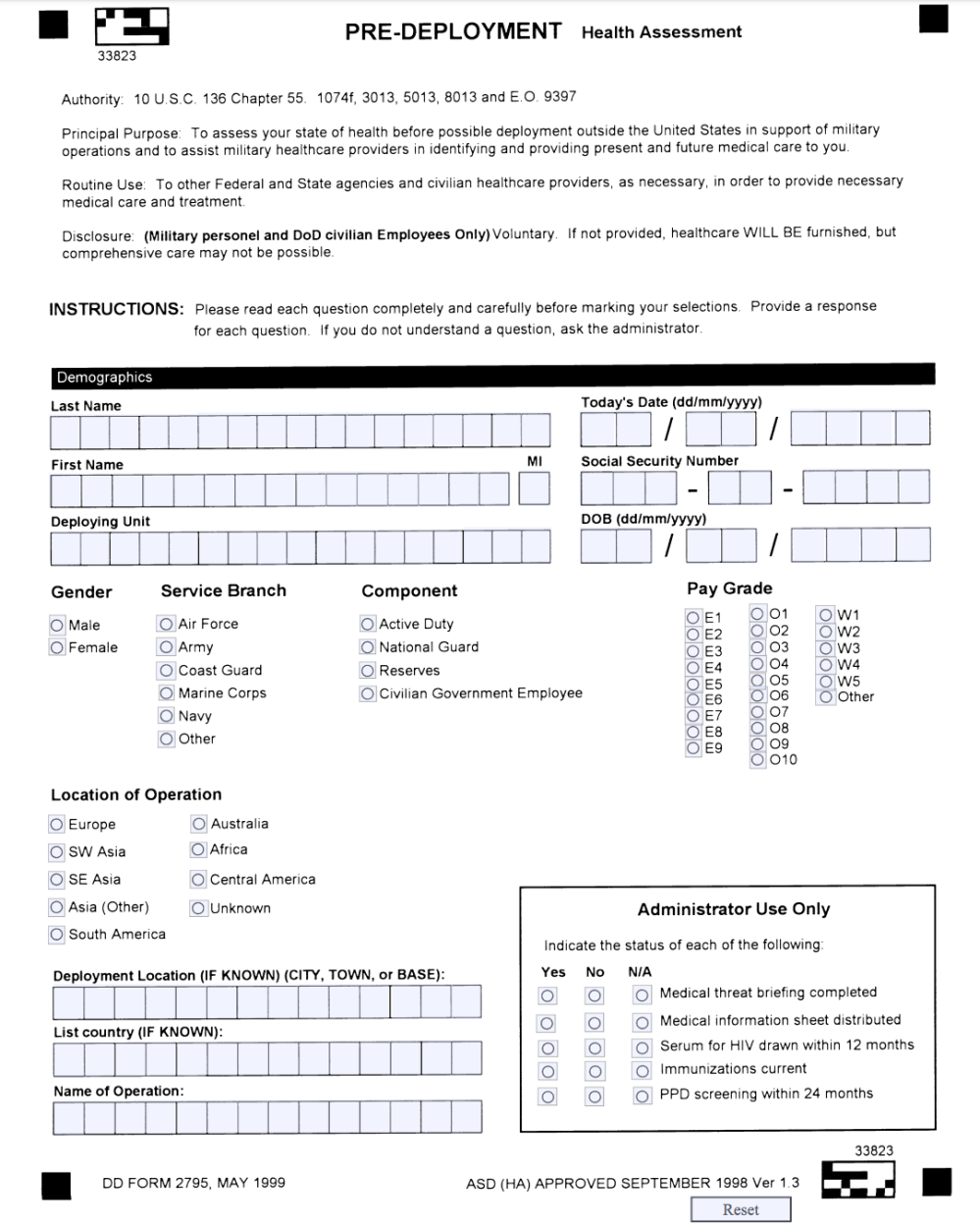
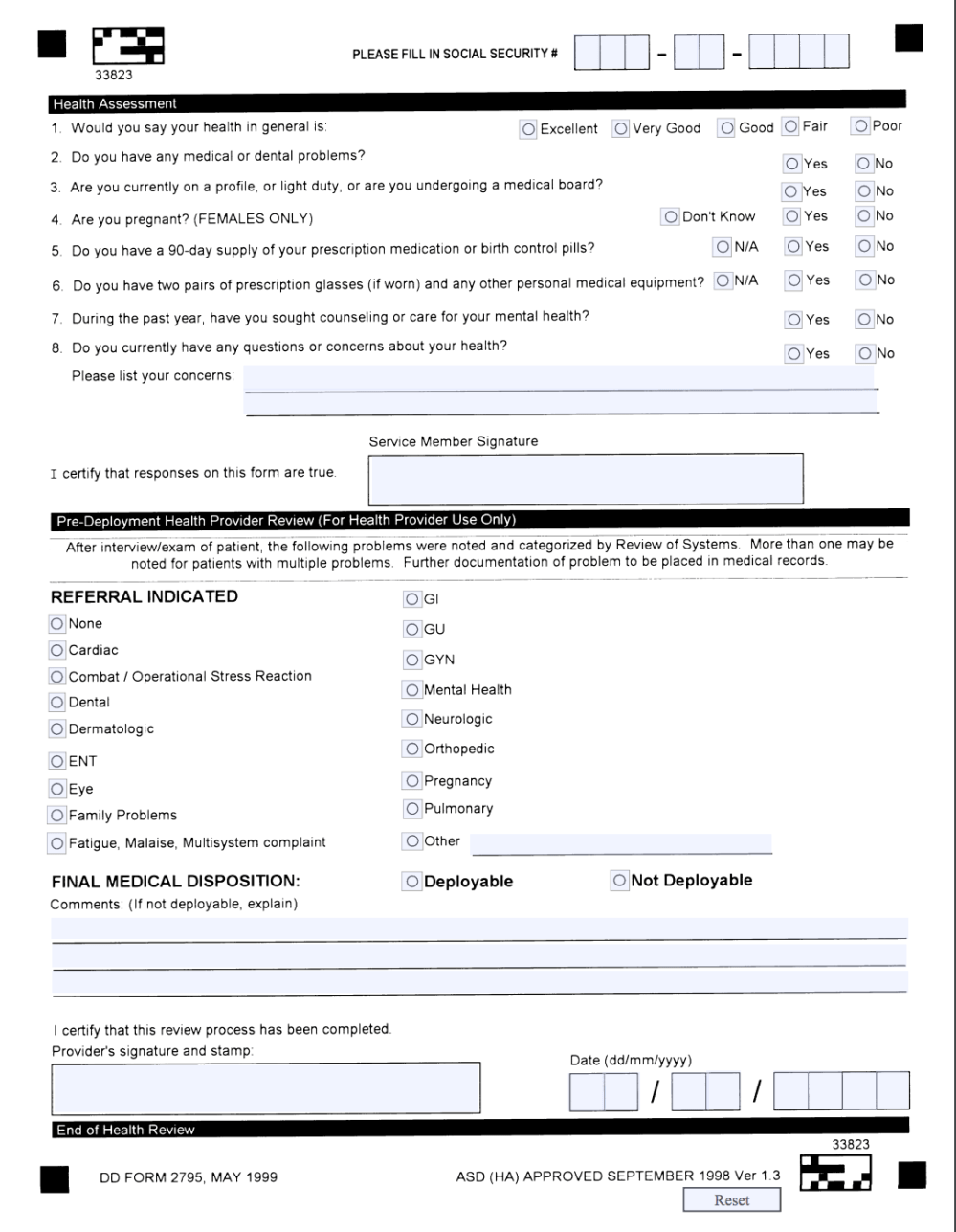
Screen Shot 2017-04-27 at 8.46.00 PMScreen Shot 2017-04-27 at 8.46.18 PM

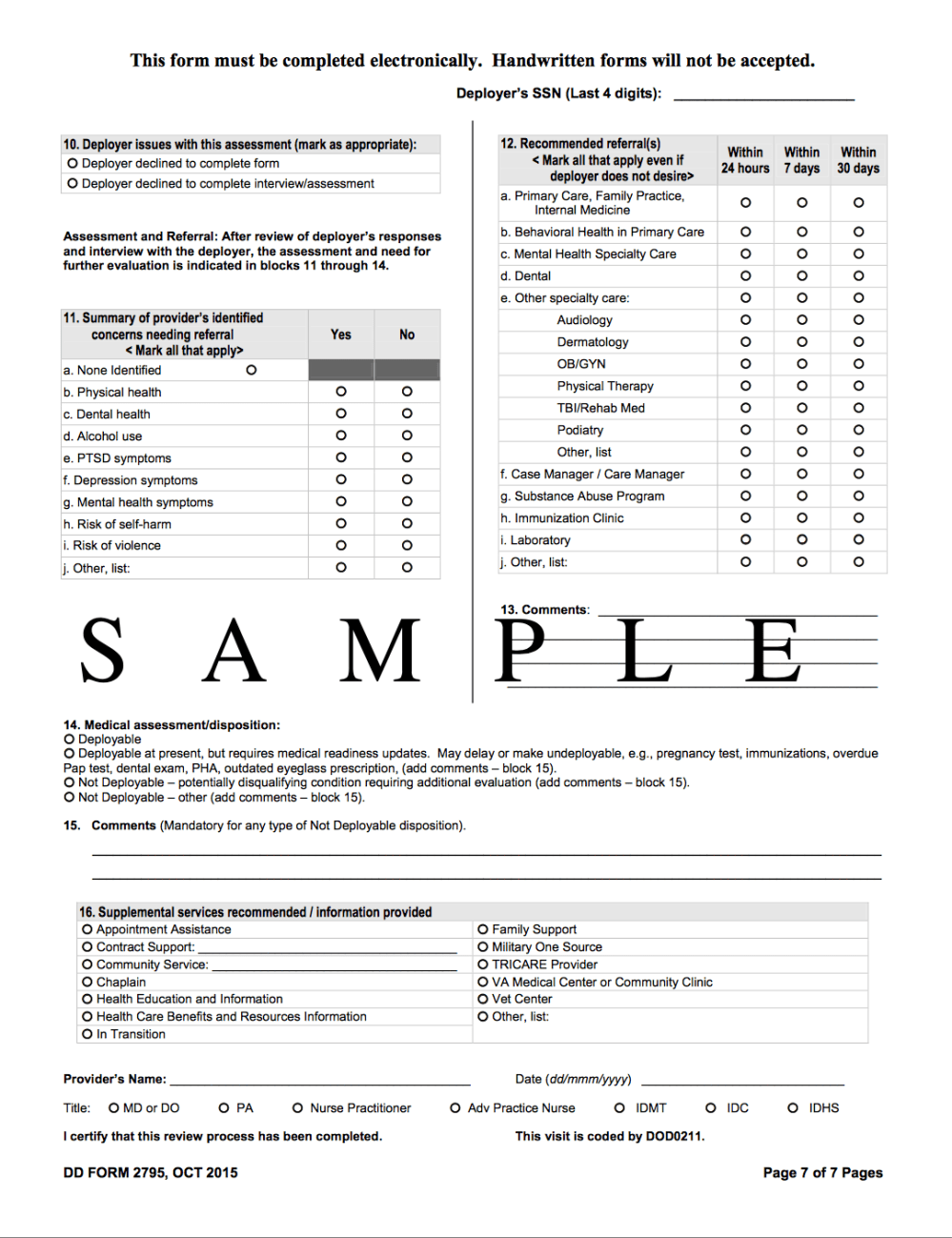
Below is the updated version of the Pre-Deployment Health Assessment Form:
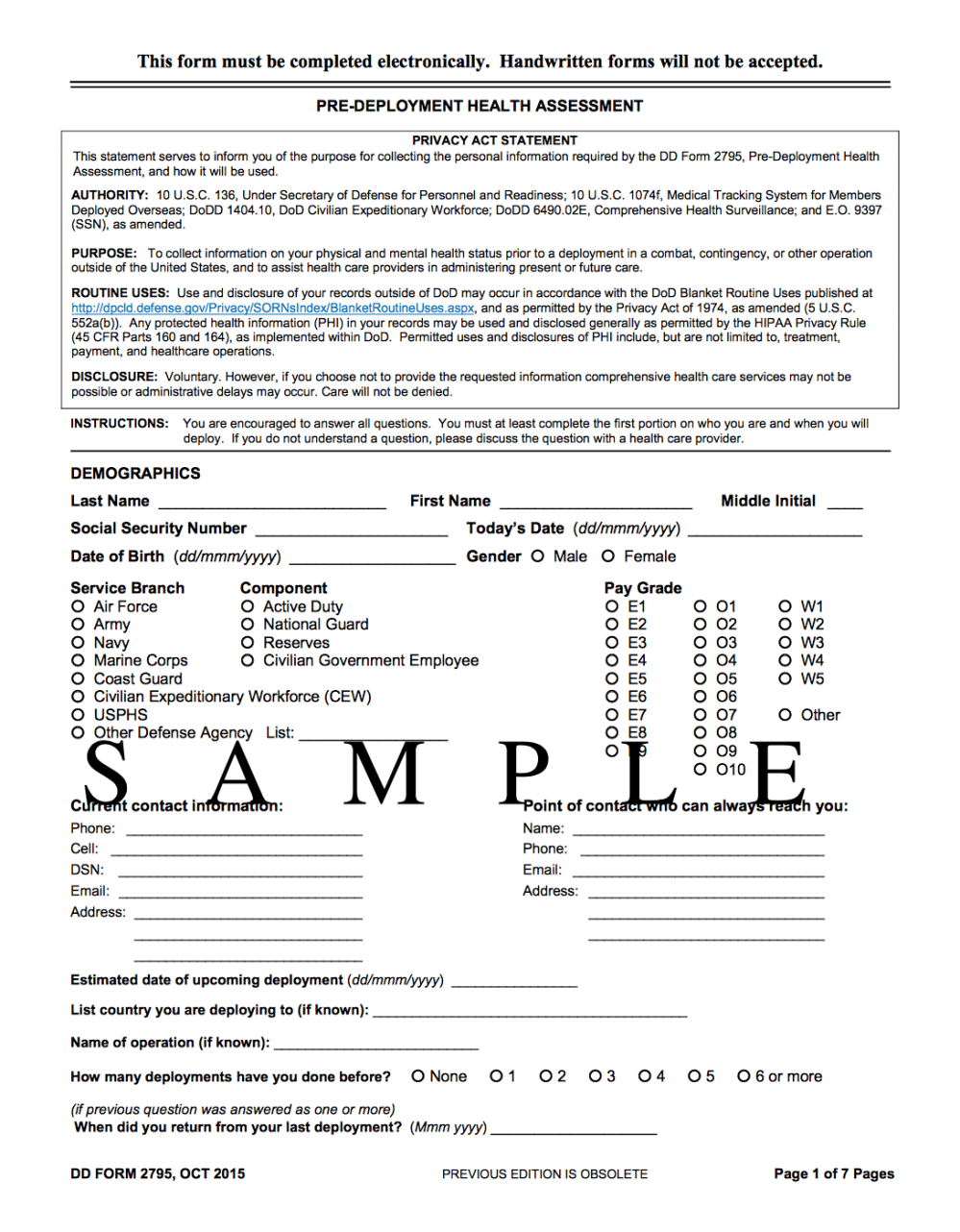
Screen Shot 2017-04-27 at 10.24.08 PM.png

Screen Shot 2017-04-27 at 10.24.40 PM

Screen Shot 2017-04-27 at 10.25.35 PM

Screen Shot 2017-04-27 at 10.26.10 PM.png

Screen Shot 2017-04-27 at 10.27.00 PM.png

Screen Shot 2017-04-27 at 10.27.37 PM

Screen Shot 2017-04-27 at 10.28.03 PM.png


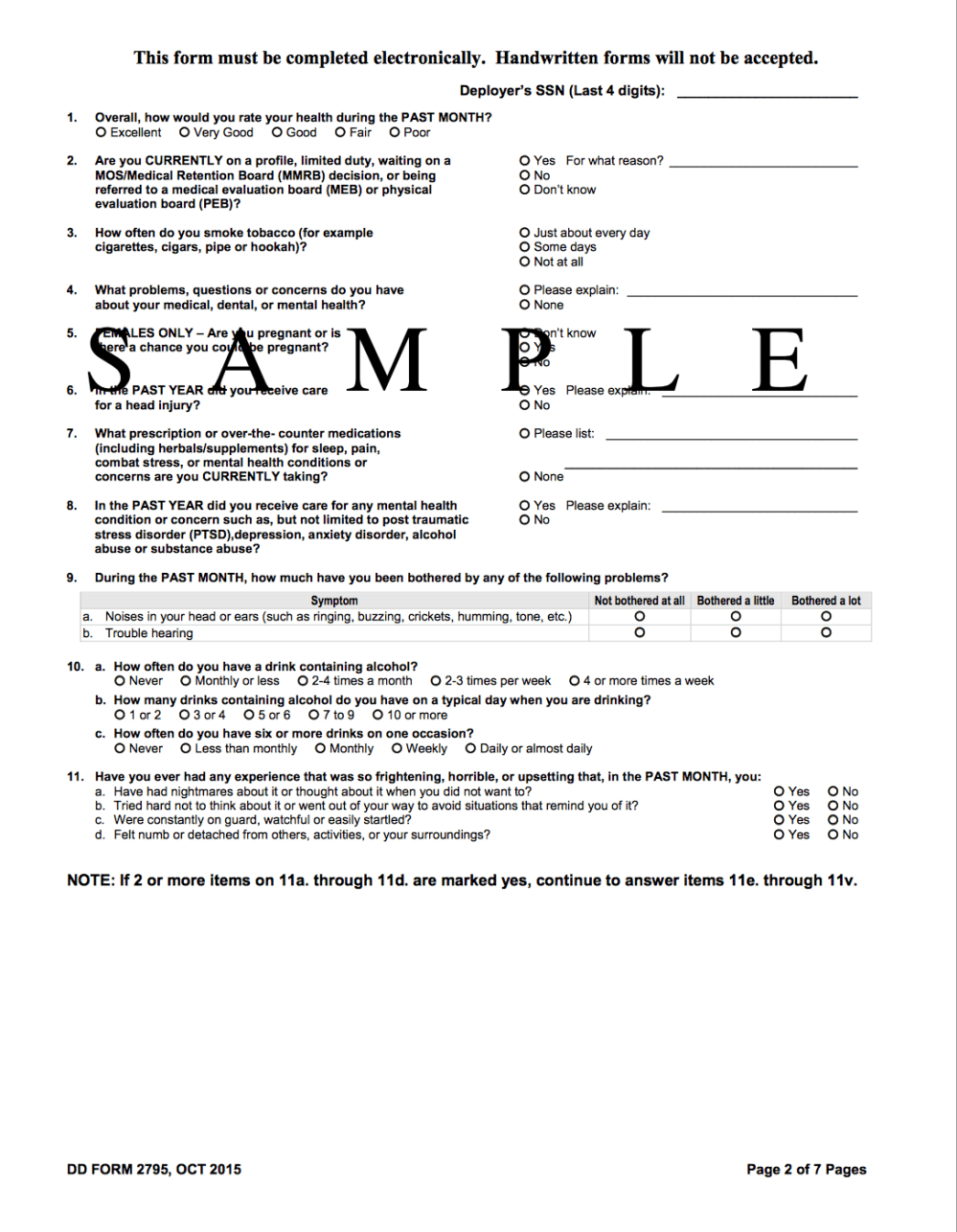
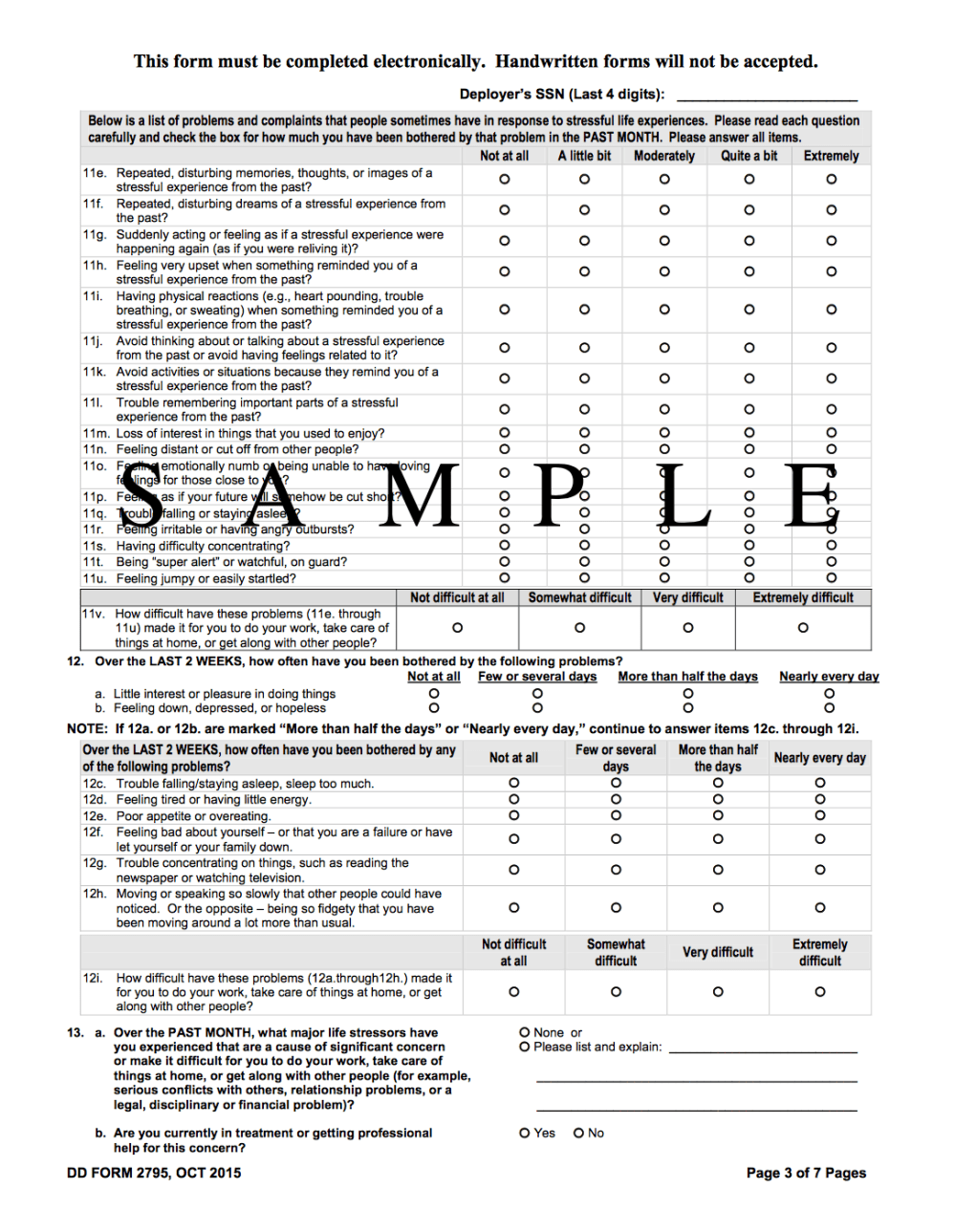
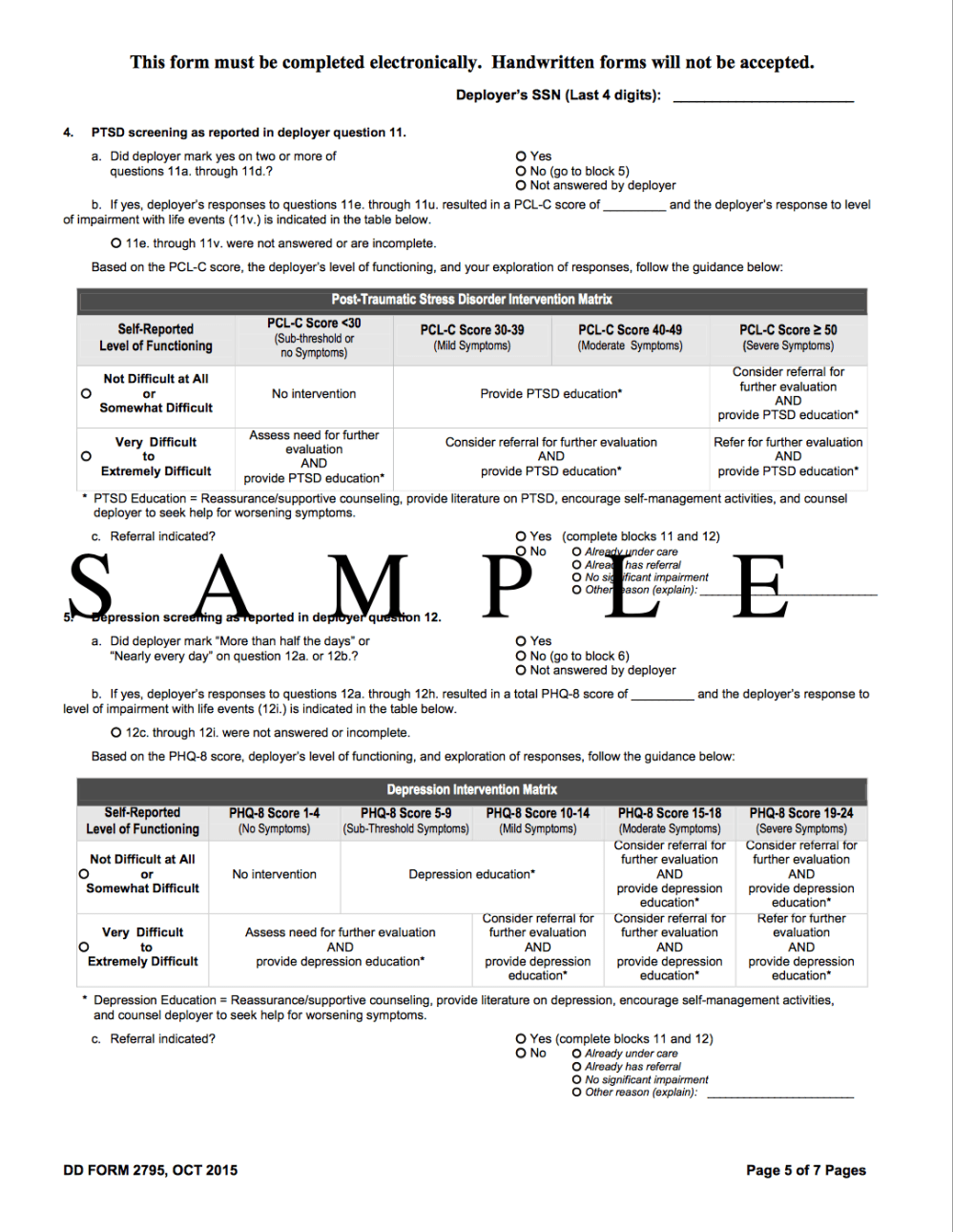
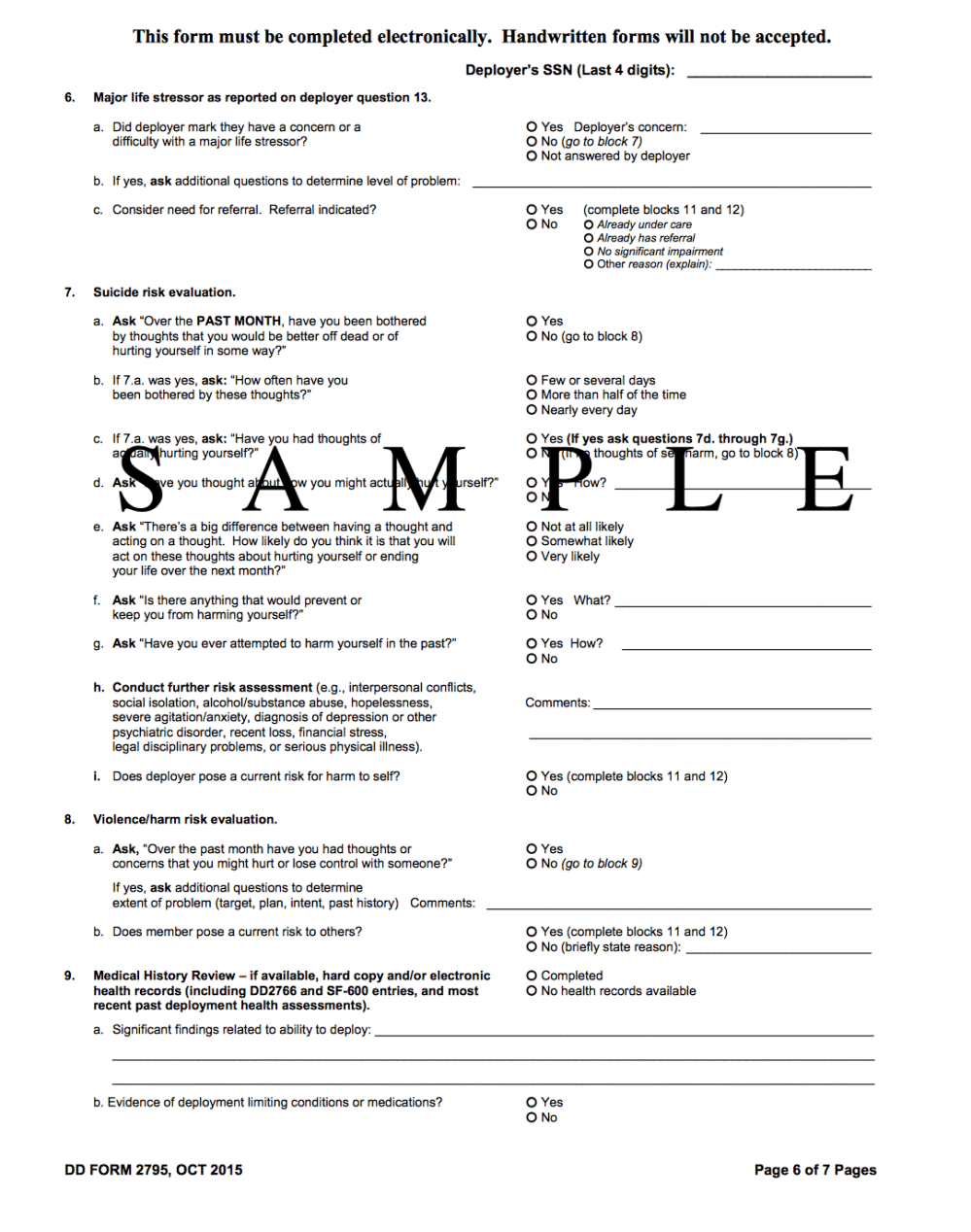
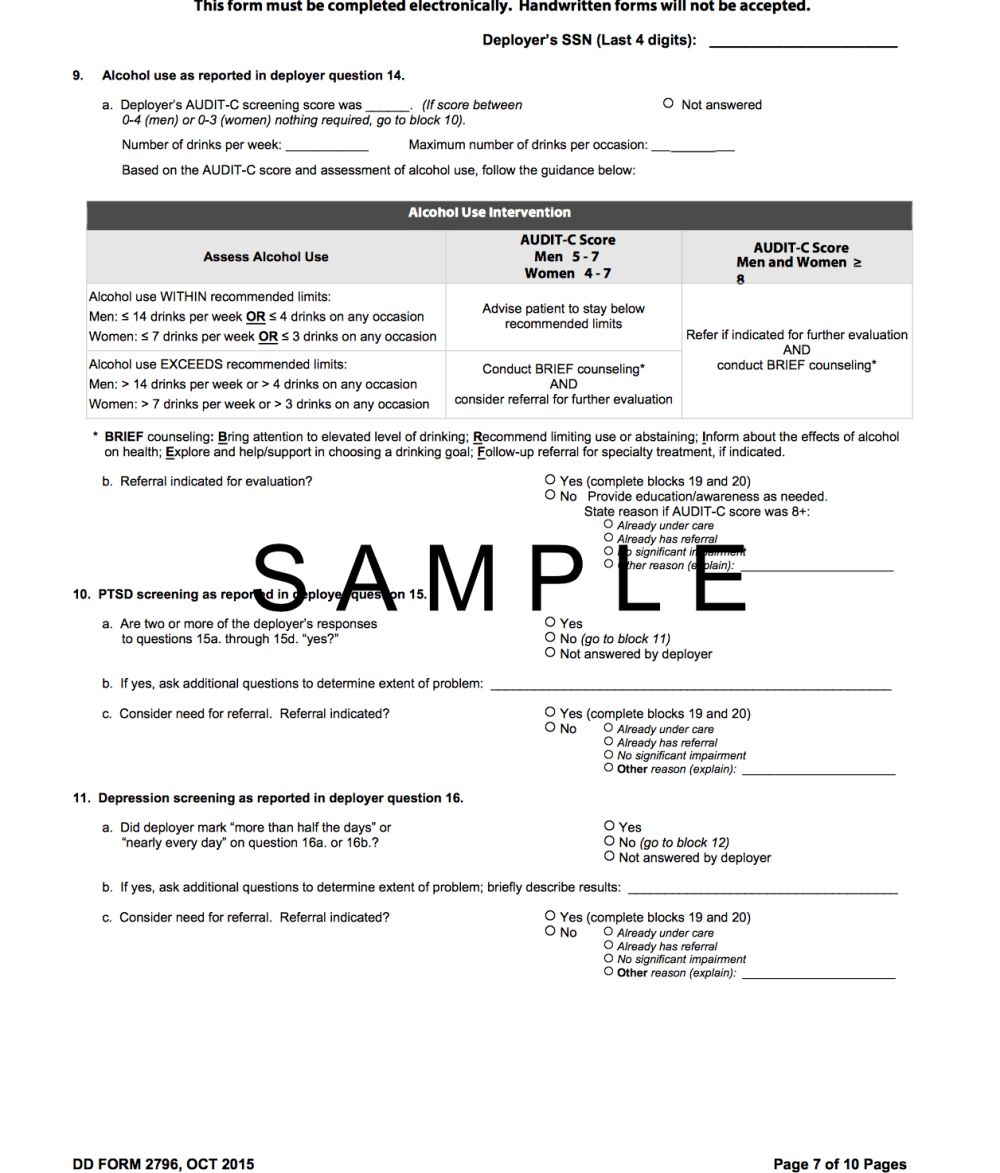
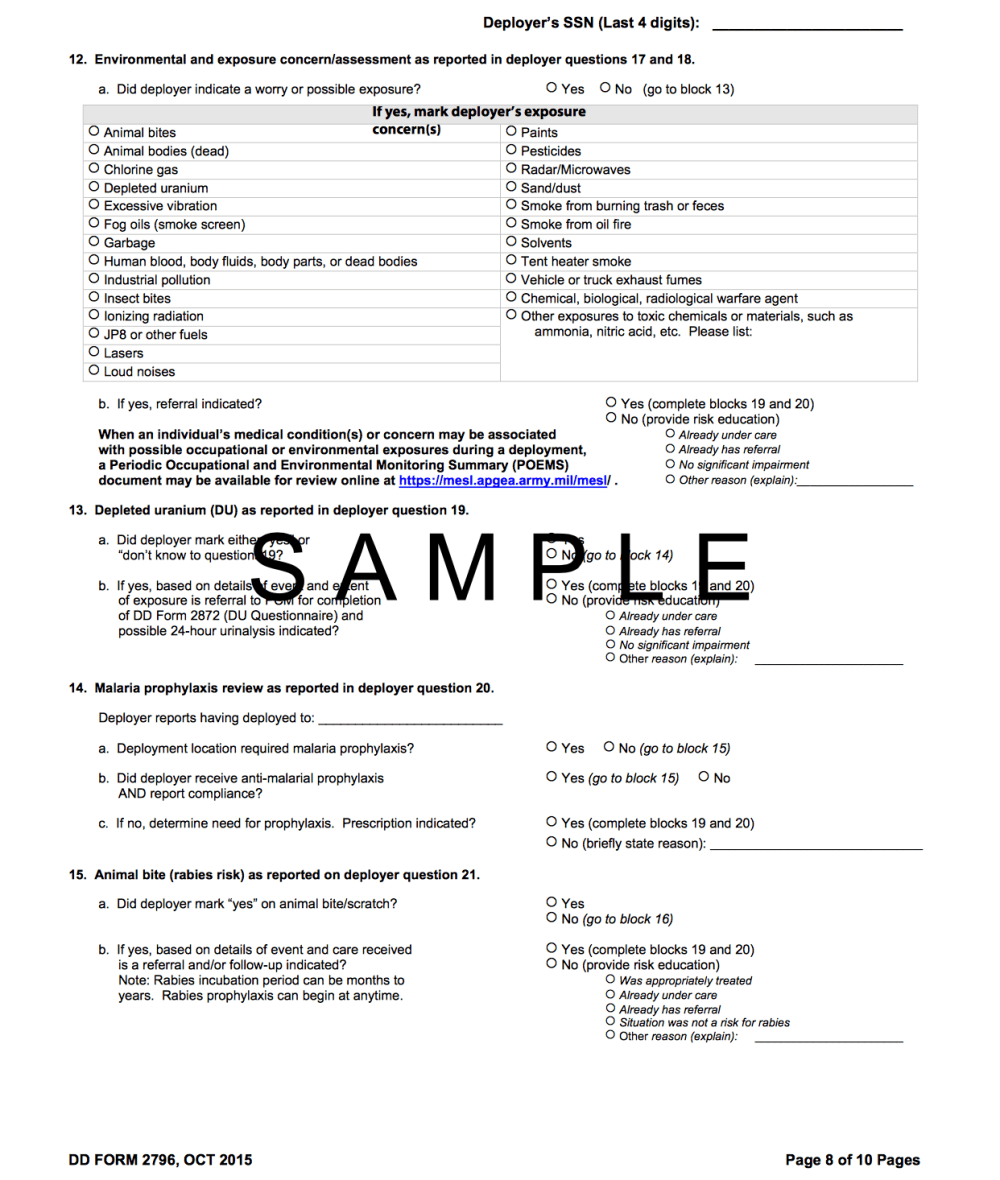
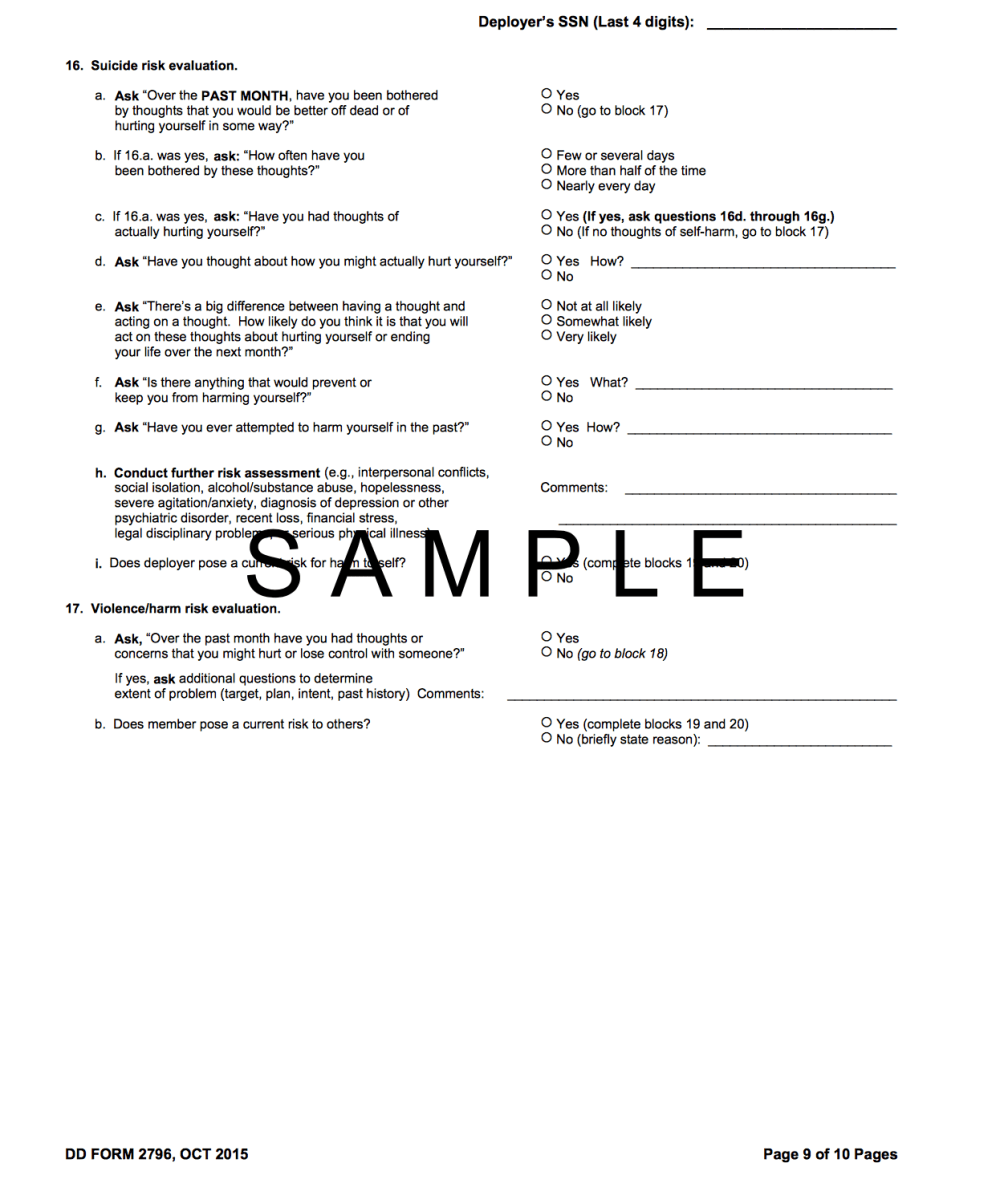
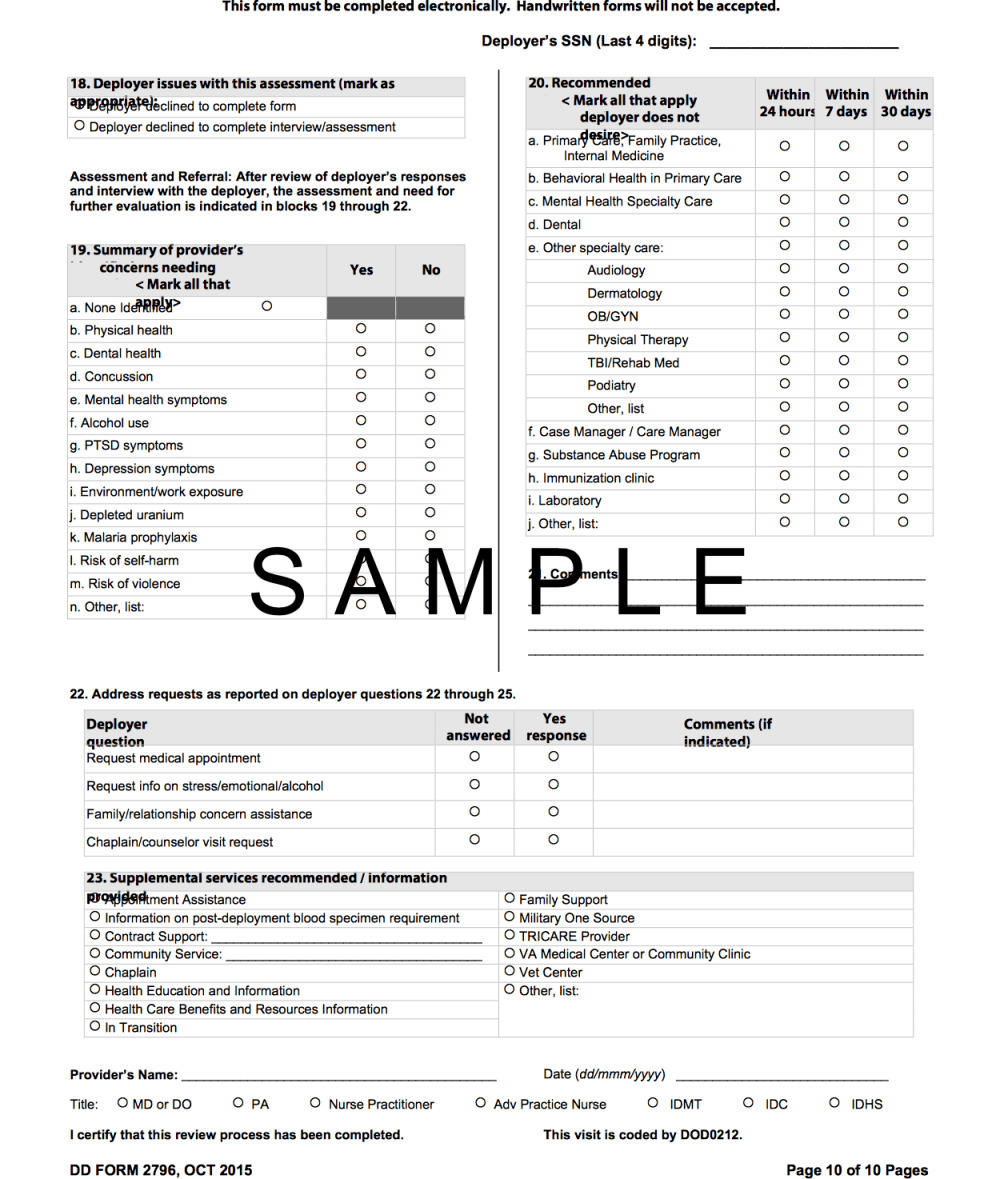
The revamp of the Post-Deployment Health Assessment is also of great concern to me, and I think all veterans of this era should consider how the inadequacies of the earlier form shape what sort of service/deployment experience is considered valuable, dangerous, and potentially traumatic.  The forum in which service members were offered to complete their forms is equally as important.  I can remember completing the first form in a classroom with a number of guys, classroom style as though we were taking an examination for a grade.  It was really a matter of “everyone’s got to do it”.  You fill out your form by hand and turn it back in.  You don’t want to get called out for your answers and you just want to make it back home.

I don’t recall completing the Post-Deployment Health Assessment at the end of my second deployment but most of the handwriting is distinctly mine; there are only a few segments where the medical personnel filled in information.  Coming home was very rushed that time.  I can remember meeting my husband and his mother and sister at the Sheridan, Wyoming airport but I cannot remember who picked me up in California.  I remember having issues with my military gear being stuck on the conveyer belt and an older gentlemen picking up my pack like it was nothing, hoisting it up so I could tuck my arms into the shoulder pads and settle it on my back.  (To everyone who was part of my transition home, I do not make this statement about not remembering your support lightly.  Coming home was that much of a blur.  I didn’t have a moment to catch my breath and will still say that process didn’t start until I left 3rd MAW in late May 2007 for terminal leave.)

My chest pains are the only thing I shared with the VA as a serious issue in 2007 and again, I am making the choice to share so much personal information because I don’t necessarily see our system getting better if there is a significant gap between what people expect their service to be like and the reality of the experience.  I hope by cracking open an issue like poorly constructed pre-and post-deployment health assessments provides a lenses for organizations like the VA to understand where they must also take a step back and learn from veterans what deployments are like.  I also hope current service members look at their needs before the needs of the organization they serve; at some point, we all leave the service and our personal health cannot take a back seat because we didn’t want to look like malingers/didn’t want to lose camaraderie/didn’t want to let down the team when a medical issue should have prevented us from deploying.

When I also decided to share with the VA this go around the fact I’ve dealt with tinnitus in the last few years and for a shorter duration, moments of hearing loss, I expected to have them listen.  I thought it was fairly reasonable to be ‘heard’ since I have recorded mortar exposure in my records but never sought treatment because I didn’t notice anything wrong at the time.

Right now my hearing is not to the point where I’ve lost full functionality and I sincerely hope it doesn’t degrade further but the hearing loss does scare me. (The tinnitus, on the other, is mostly annoying and only occasionally causes pain.)  These issues make me realize I cannot continue to take my hearing for granted and I should plan more for down the road if it degrades to the point where hearing aids might be needed.  For now though, I am pretty good about asking people to repeat themselves when I need them to and I remind my daughter to come into the same room if she wants to talk to me.  (She tries to yell from upstairs but I’m going to miss a lot of what she’s jabbering about so I make her come down and talk to me anyways.)

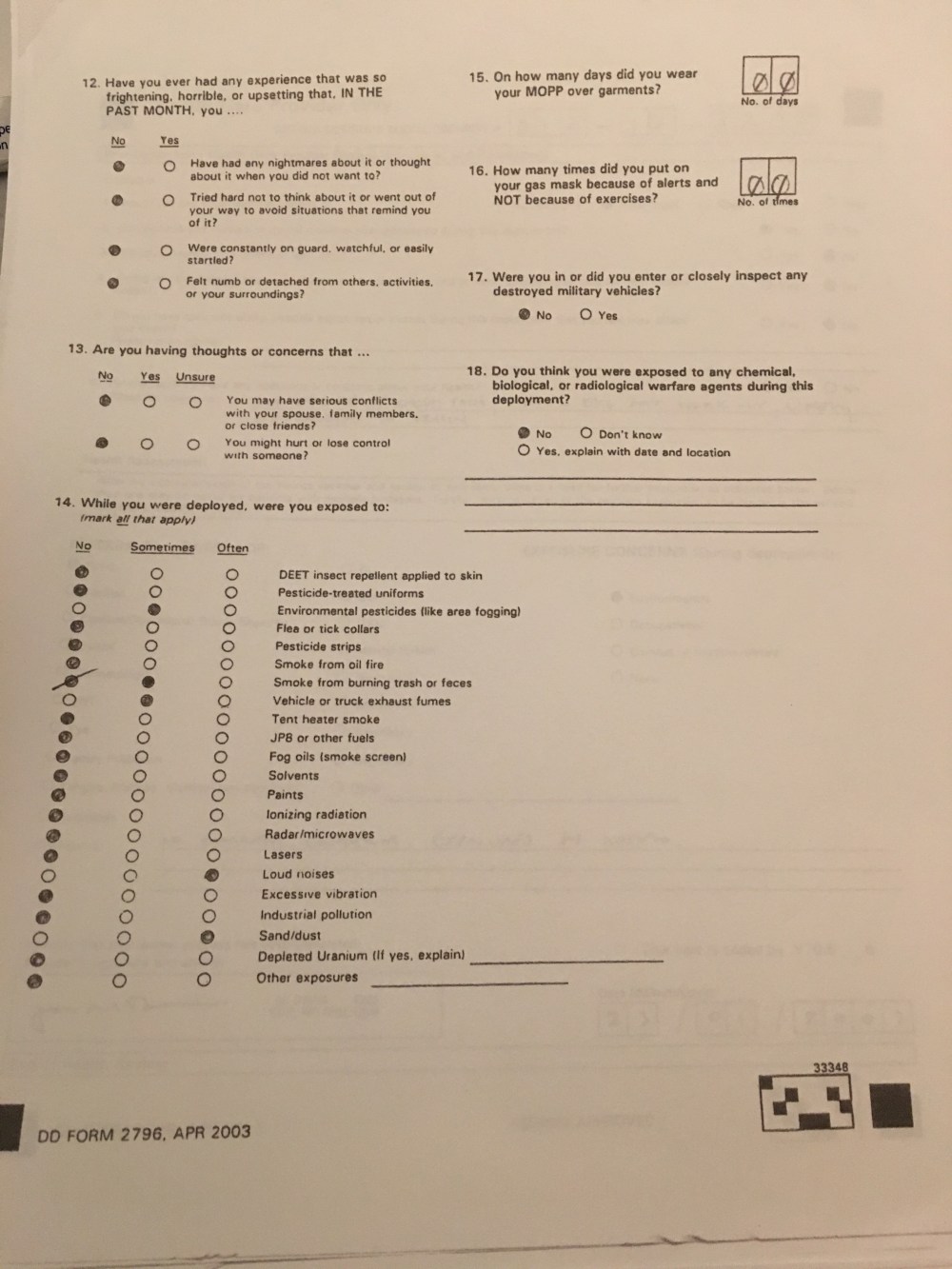
FullSizeRenderFullSizeRender_1IMG_2463IMG_2465

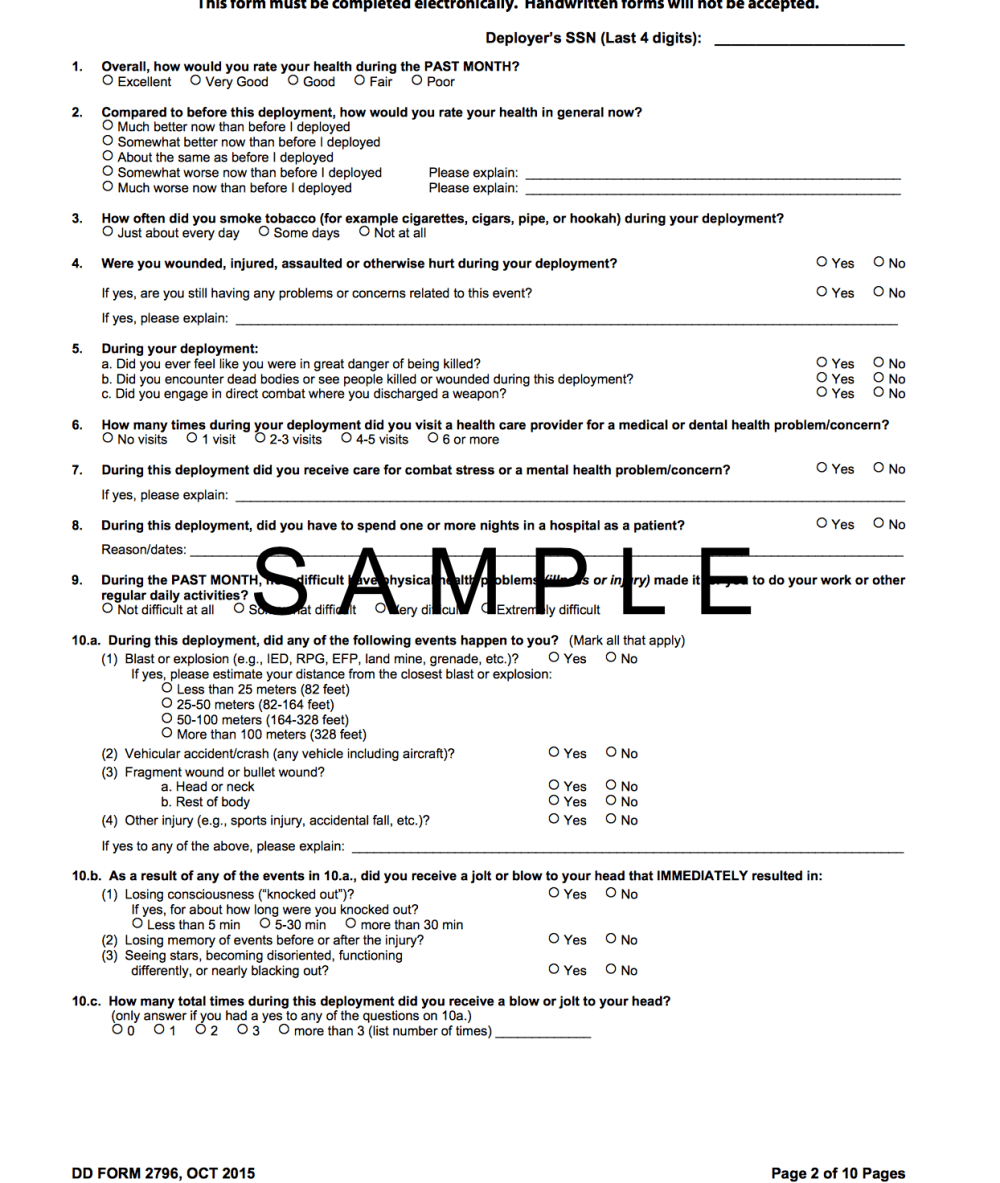
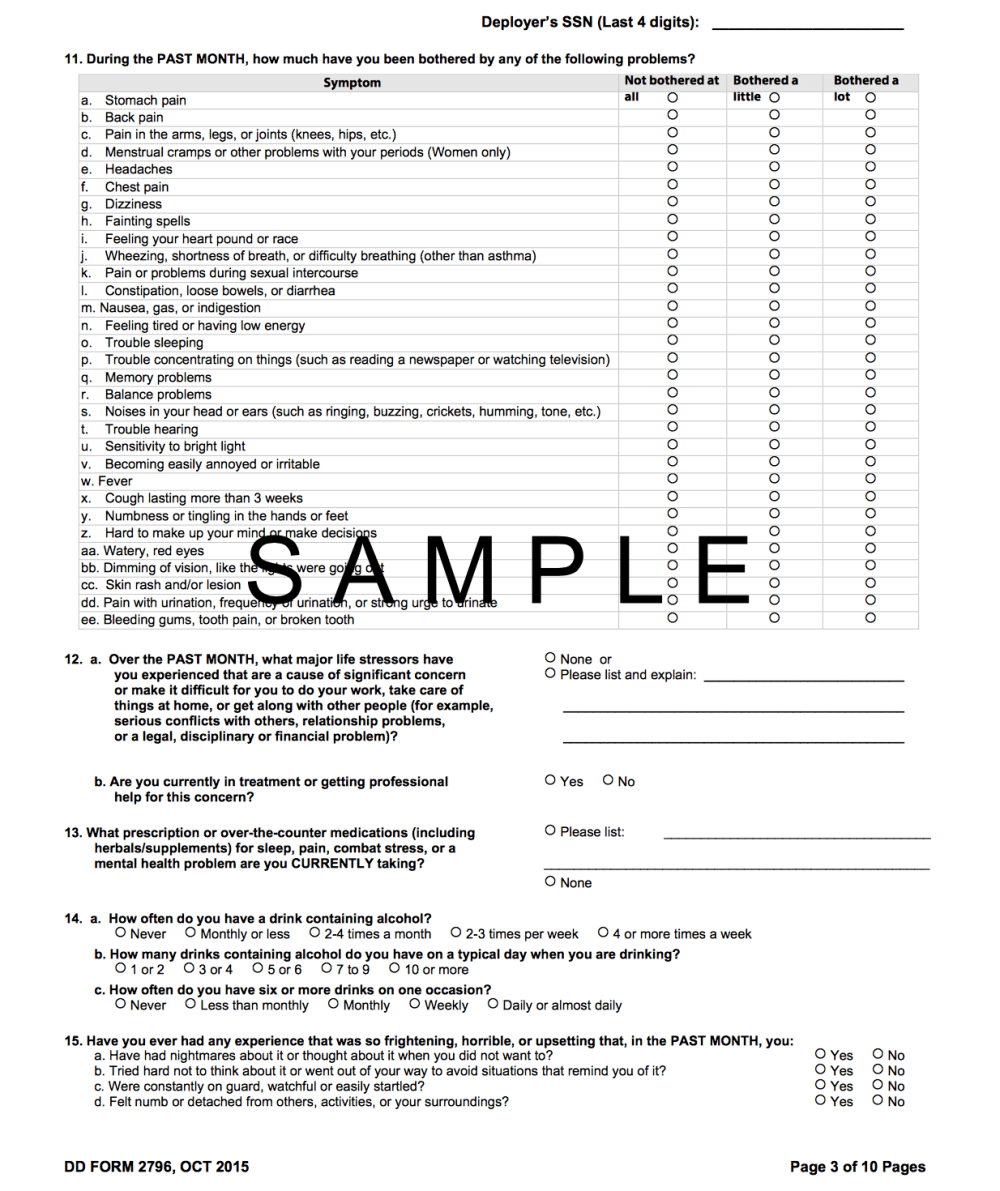
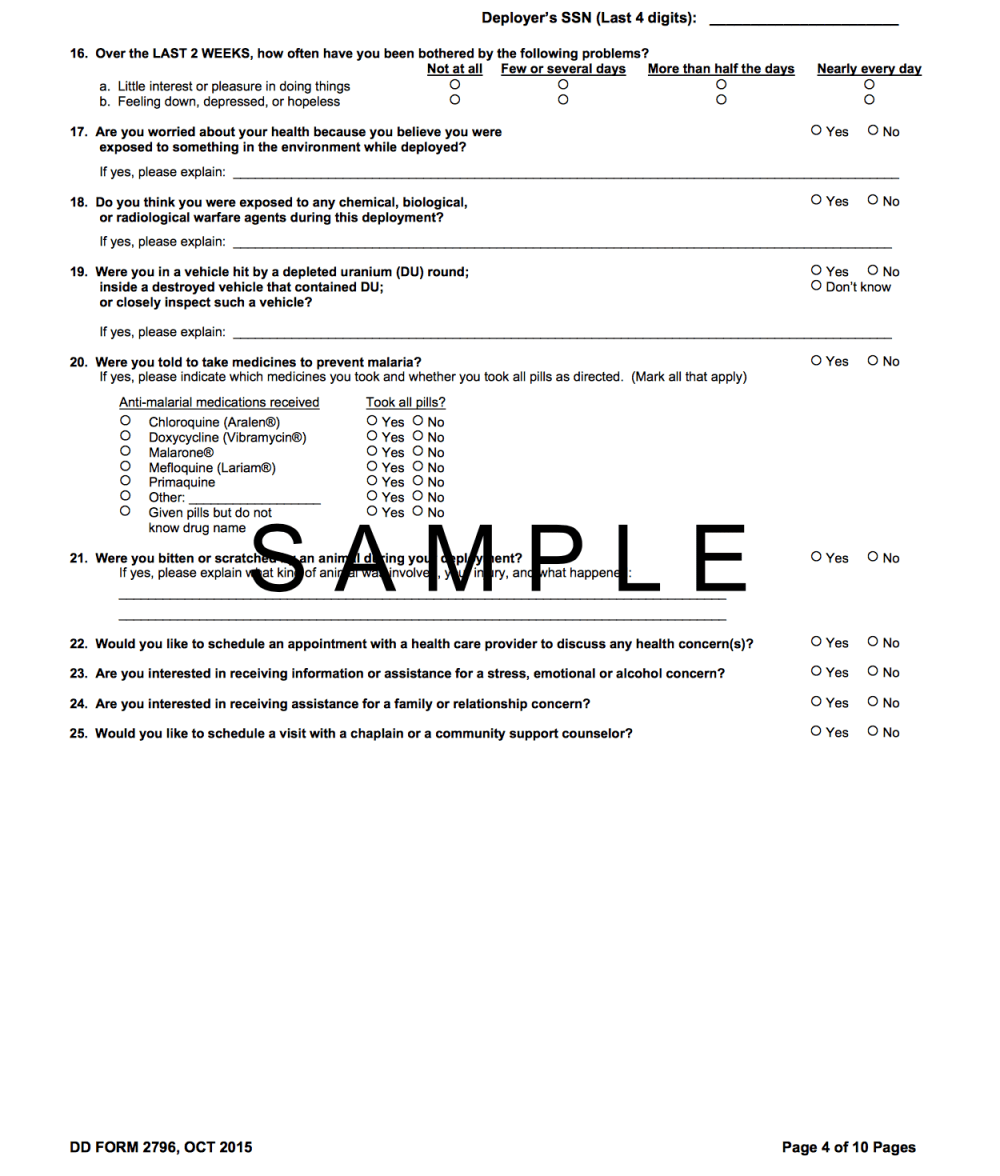
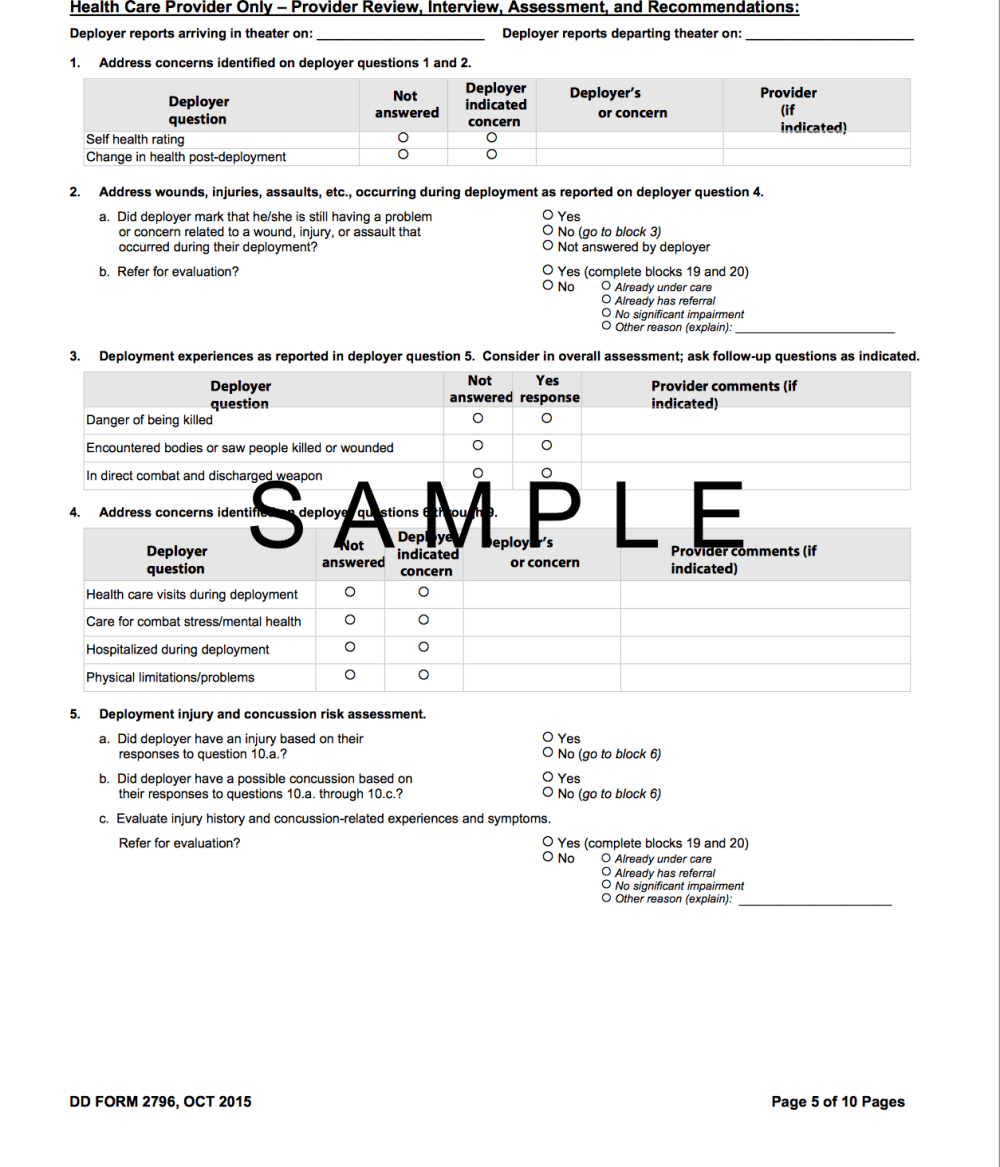
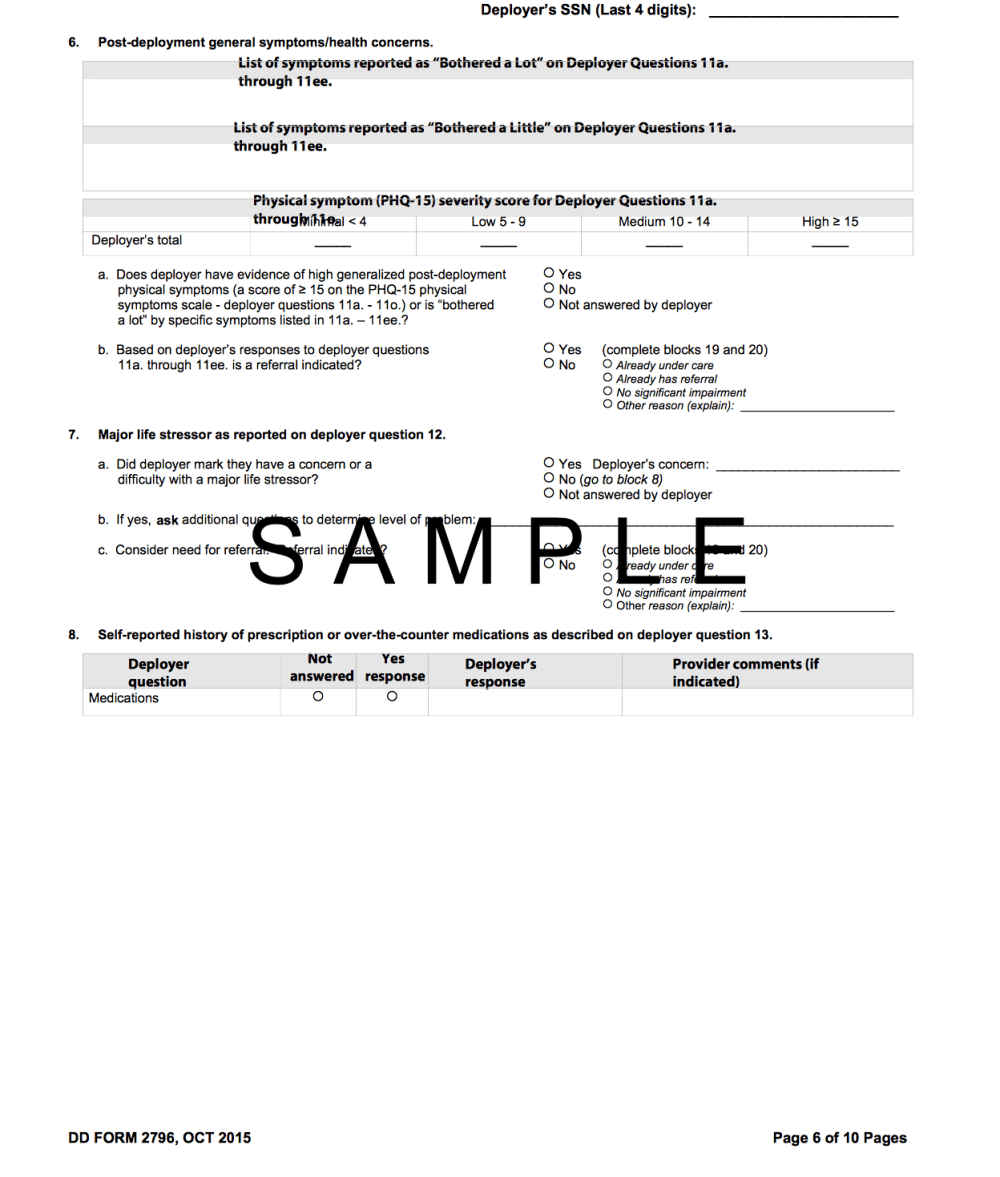
I am already past my bedtime (Seriously, it’s 10:45 pm!!!) but in closing, take a moment to look at the October 2015 form.  It is much more inclusive.  (Please excuse the fact I cannot obtain a good snapshot that shows on each page the form is not to be handwritten.)

I will continue my saga with the VA another day.
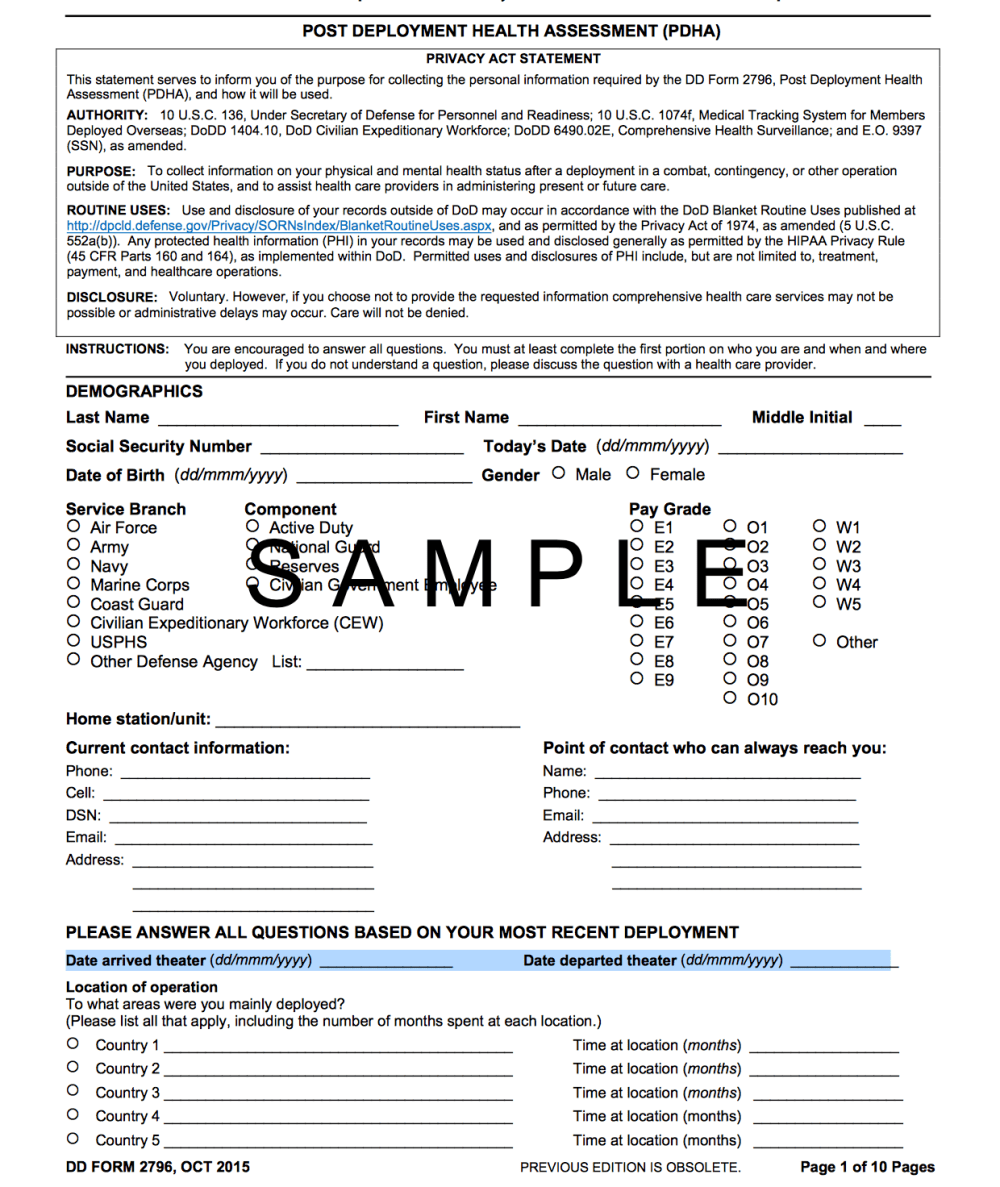
Screen Shot 2017-04-27 at 10.10.34 PM

Screen Shot 2017-04-27 at 10.12.12 PM

Screen Shot 2017-04-27 at 10.13.44 PM

Screen Shot 2017-04-27 at 10.14.46 PM

Screen Shot 2017-04-27 at 10.15.32 PM

Screen Shot 2017-04-27 at 10.16.53 PM

Screen Shot 2017-04-27 at 10.18.08 PM

Screen Shot 2017-04-27 at 10.19.15 PM

Screen Shot 2017-04-27 at 10.20.08 PM.png

Screen Shot 2017-04-27 at 10.20.46 PM


Suicide Prevention Month: The Power of Observation & Reflection

http://www.veteranscrisisline.net/ThePowerof1.aspx

As I begin to touch on the sensitive subject of suicide prevention–and I am not limiting this conversation to our veteran community–please know I am grateful to you all each and every day for being part of my audience. Years ago, I was told not to “write a book” as I prepared for my first deployment.  This unfortunate statement haunted me for years.  It stymied my trust to share–outside my trusted circle of friends and family–what it’s like to serve because I would be subjected to potential trolls just waiting to pounce on my flaws, mistakes, and gender.  This fear creeps in as we draw closer to sharing my Veteran Vision Project photo.  Already I see nasty comments made to other recently shared photos on the Veteran Vision Project Facebook page.

Let’s remember for (hopefully) more than the few seconds it takes to comment that we’re looking at real people.  The individuals portrayed in these photographs are not actors and actresses portraying characters, but living through their own experiences, not ones scripted for them.  They are not models paid for their time but people who may want to send a message to others or people who want nothing more than a family photo that merges the past and present.  Both are perfectly acceptable reasons to participate in Devin’s project.  Devin Mitchell photographs these individuals because it is work he loves doing and yes, his book will sell: he deserves to profit from his work.  I hope it is successful long after we all pass from this earth.

He is uncovering the details of military service tucked in the margins of history: PTSD (Post Traumatic Stress Disorder), MST (military sexual trauma), suicide attempts, and issues of hate geared towards same sex couples and transgendered persons.  He also showcases individuals in their happiest moments: expecting children, their new careers, or donning collegiate graduation attire.  America needs someone like Devin to remind us the gap of understanding between civilians, service members, and veterans is due in part because we choose–quite often–to not see the full picture, to not inquire beyond our perceptions.

On this note, I share two different observations and reflections on the same situation: a Marine committed suicide outside my barracks on Camp Blue Diamond in 2004.  (I made some rash judgements in my initial journal entry and it’s important to share my failings as a person here, too.We all make mistakes, but we have the power to change, and should strive, for the better.)

(Saturday) 18 Sept. 2004  

Another day gone in Iraq.  On a day to day basis, it doesn’t even feel as though I’m in a combat zone and then I’m brought back down to Earth.  Earlier this week, maybe on Tuesday, we had a Marine commit suicide.  He shot himself with his own rifle in one of the portajohns outside my barracks, only nineteen years old, too.  It has been weighing on my mind and I’m disgusted and disappointed that he thought his life wasn’t worth living.  Besides the fact, he was only here two weeks and for the most part we see no action here at Camp Blue Diamond (Ramadi, Iraq).

I have started to shift my focus because I know there’s nothing [anyone] can do now and worrying is only hurting me.  I will never know why he thought his life was so shitty to die (kill) himself.  As Marines, we are just suppose to be better than that.

We also had two mortar impacts on base on separate days.  One day a Corpsman took minor shrapnel to the leg and walked himself to BAS [battalion aid station] and the other attack happened last night. I was on guard outside my work and I heard this loud boom, louder than the sound of thunder.  It impacted on base.  Usually when it’s off base it vibrates the buildings and the sound isn’t as loud.

No Marines got injured last night, which is good.  I do reports all day long and someone is always KIA [killed in action], WIA [wounded in action], and that includes enemies, too.

29 Sep 04

A Life Wasted is Still A Life Remembered

Today is Wednesday, but here in Iraq it is yet again another Monday.  All days are Mondays and typically called “Groundhog’s Day” as well by those that have seen the movie of reliving the same day, day after day.  I consider it Monday as Monday is that dreaded day of the week after a wonderfully nice, rested weekend (or any weekend for that reason) because that feeling is how I feel in Iraq.  Being stateside was the “weekend.”  I [had] so much time that I did not know what to do and most of it was wasted on being lazy, sleeping in, and waiting for the weekend to end.

Although my life was “wasting away” back there because I wasn’t actively involved in trying to better myself, by PT or classes, it wasn’t until here that I truly learned how someone could waste their life away.

Iraq makes you think in ways you may not have thought of before.  Each place is different and luckily I have been blessed here.  I enjoy a relatively safe camp I stay at equipped with solid living quarters [versus] the tent that other service members reside at in other camps, a chow hall where I only have to watch out for spoiled milk instead of consuming the usually, unpalatable MRE [meals ready to eat], and I have a meager gym where I can keep in shape.  These commodities are a rarity in some places and being that we are in the technological age, I also have access to phones and the internet, something unheard of in the days of Vietnam.  Yes I am blessed.  For all the good things in my life, I am still here in a “war” and have seen some of what it can do.

I am sheltered here, as a female, and do not go on patrols where our Marines can encounter any array of weaponry used against them to include IEDs [improvised explosive devices], rpgs [rocket propelled grenades]. mortars, and other such things.  Getting to my camp here, I still faced the possibility of seeing such things, but I lucked out.  No excitement, no casualties.  Sadly boredom has taken on a new role in my life.  It tells me that nothing is happening that can cause harm to Marines or myself.  I can say today that here, bored is what you want to be.

Boredom can cause you to think though and I work too much to do much of it.  The schedule is a twelve hour day, seven days a week, and on top of it all, I spend my mornings running and usually get various odd tasks accomplished at night.  For me, it’s the best way to pas[s] the time and not to think of the fact that I am in Iraq.  I still think of what happens to my Marines here and how some of them never quite will make it home to tell of what they’ve seen, but there will be a flag draped coffin where a Marine should be standing. [Please know, this last sentence is more haunting to me now; I made it months before my watch officer was killed on 2 February 2005.]

Their ages vary and their stories are never the same.  Back home wives and children, siblings, and parents, who have no answers that satisfy why their loved ones were lost, are left behind.  Posthumously honored medals, ribbons, and ranks cannot make up for the life that is lost.  Fellow Marines can piece together memories from Iraq for the family but they are bound to be hesitant as to share the often horrendous details that led to a fellow Marine’s death.

I haven’t yet encountered losing a Marine as KIA and I pray I never will, but here in Iraq we still lose Marines, and in this case, by this Marine’s own hands.  I have heard some people call his action selfish, sad, and others are almost indifferent as it is another death locked into the experience of being in a combat zone.  One could blame his actions on a lack of leadership attention, depression, boredom, hormone imbalance, but we will never know.  It’s what we do know that’s gruesome.

Only a few weeks ago, in the middle of the night this Marine went out by himself, weapon in hand, because our weapons follow us everyone.  This Marine holed himself up in a portajohn, about the only private place one could find here, and decided to end his life.  His age: nineteen years old.

After his rifle went off, Marines rushed out there, from what I was told, to discover a fellow Marine committed suicide.  In the mi[d]st of it all, accountability was being taken to see who it was as the Marine was quite unrecognizable.  I didn’t even know of this incident, which happened several feet outside my barracks, until the next morning.  I feel almost guilty because I slept peacefully through it all.  [Dear audience, please remember, I was pulling 12 hour shifts.]

Hearing about the suicide the next day was strange.  I found it too hard to believe because we had a good camp, tucked away from major violence, and then this happens.  I walked by that portajohn the next morning to find it duct taped up with a sign declaring it secured, a used up chem light still hung on the door, a dried blood trail on the bottom ledge, and a piece of combat camera equipment that was either a lamp or other gear that reflected light.

The details I still remember as two of my roommates are in combat camera, one of whom had to be on scene and took photos of the suicide victim.  She called him unrecognizable, appearing to be “Chinese”, although his ID photo showed he was not of an [Asian] background.  No one could tell at first who he was and the whole scene of it was shocking.  The image that I think of is of Pvt Pile from Full Metal Jacket, but I would never want to see those photos to see if I was correct or not.

I think of the fact that  this Marine that I know only as a “suicide victim” left behind so much in his life.  I would be wrong to say he’s selfish because I don’t know the inner turmoil he dealt with that caused him to take such drastic measures.  He didn’t know the resources he had available, nor the countless Marines that would have gladly taken out a pack [of] cards and played a game with him or smoked a cigarette with him if he smoked.  I don’t even know his name but I will remember someone who had so much to live for if he had only known.  Even if he goes unremembered by many here, I will never forget he was a person.  He was a Marine.

————————————————————————————————-

I don’t know why I went back and wrote further about the Marine’s death, but I’m glad I did.  I didn’t realize then how much power it could have today, eleven years later.  Suicide is still a prevalent problem with veterans (and service members).  Our civilian peers should also not be overlooked.  Their lives mirror many of the same struggles and personal tragedies (bullying, sexual trauma, etc.).  These communities can (and should) work together to prevent the loss of any one person from suicide.  Touching even one life is a monumental difference in this world.