Saying Goodbye to My Federal Employment “Dream Job”

Last month I forgot to check in with you all—my sincerest apologies might not mean much as I’m a stranger to most of you all, but I try to keep my “appointments” with you. A friend date of sorts is how I’ve tried to start treating my writing check-ins.

For those who have also kept up with checking in, you’ve seen me struggle with how the Trump Administration has treated federal employees. The stress since he returned to office runs the spectrum: some people barely notice him and others have had their jobs ripped away from them. Adding to the situation is the complicated feelings within families regarding values. My heart truly goes out to my fellow federal employees who lost their positions only to face the insult of family members cheering on this slash and burn approach to reducing the federal government. Many within the federal government would also tell you there are more efficient ways to do things, but cutting jobs before assessing what they actually contribute to public safety and services puts the public at risk that negates whatever reduction in spending resulted from it.

I was also stunned that the message was “reduce federal government spending” while rolling out the Deferred Resignation Program. These two short-term objectives are directly in opposition to each other and then the mixed messaging associated with DRP added other challenges as agencies sorted out what roles qualified—a kind of reverse sorting hat than the one in the Harry Potter films and books. Instead of asking ourselves what traits suit someone to a particular house (or job), the agencies have had to ask themselves in whittling down their forces per the Reduction in Force guidelines thrust at them what jobs are more valuable to the mission and what has the appearance of redundancy. I won’t say what jobs are redundant, because as our society has grown it was wholly necessary to increase the federal workforce to provide more services and more timely services.

I had a great local team in my current role who have helped enable me to keep my position while navigating my current health challenges. My supervisors never stood in my way of the medical appointments I needed and I had the open door policy to ask any myriad of questions to be better at my job. With choosing to leave, I feel it’s safe to open up about the type of work and why I’m leaving.

For just over two years, I’ve made the Department of Veterans Affairs my home and just last year I became a Rating Veterans Service Representative (RVSR). I would review claims for disability compensation, and I loved a lot of what I was tasked with to serve our nation’s veterans. This is the job I started chasing down years ago. I thought critically about what I’m leaving behind: a supportive coach and assistant coach, coworkers and friends I care about, and a meaningful mission.

So what happened?!

The return to office order added challenges to my quality of life. Although I am continuing a workup for lupus, I have the mental energy to keep working. What I needed was a reasonable accommodation to telework under my old arrangement because the cold of the office environment and extra physical activity increase the severity and frequency of body pain I’m dealing with currently. We occupy GSA-leased buildings and are prohibited from using space heaters at work. We also have limited parking, so the employee parking lot was limited to more senior employees based on service computation date. I found an alternate parking arrangement, but it does mean more physical activity that worsens my symptoms.

I started the reasonable accommodation process back in late February and when it was still lingering close to the return to office date, I even asked for an interim RA at the start of May. The request was still lingering when I inquired about it last week.

I am fortunate my coach and assistant coach were willing to hear me out on my frustrations and understand why I am leaving. The hope is my complaint and departure lights a fire for positive change.

I am working through the background check for a new hybrid position that has employee parking on site that should allow me to better manage my symptoms, allowing me to retain employment on par with my education and career background. For now though, I am working on getting my home and wardrobe in order for the new position and trying to relax a little amid this originally unplanned career departure.

—Cheryl

Starting New Chapters: Personal Expression and Confidence

Good morning, everyone.

I was quite eager to do a “2007 versus 2017” series post and I had the fun surprise of looking back into my old journal entries only to discover I didn’t write a single post in June 2007!

I will give you a comparable 2007 versus 2017 substitute.

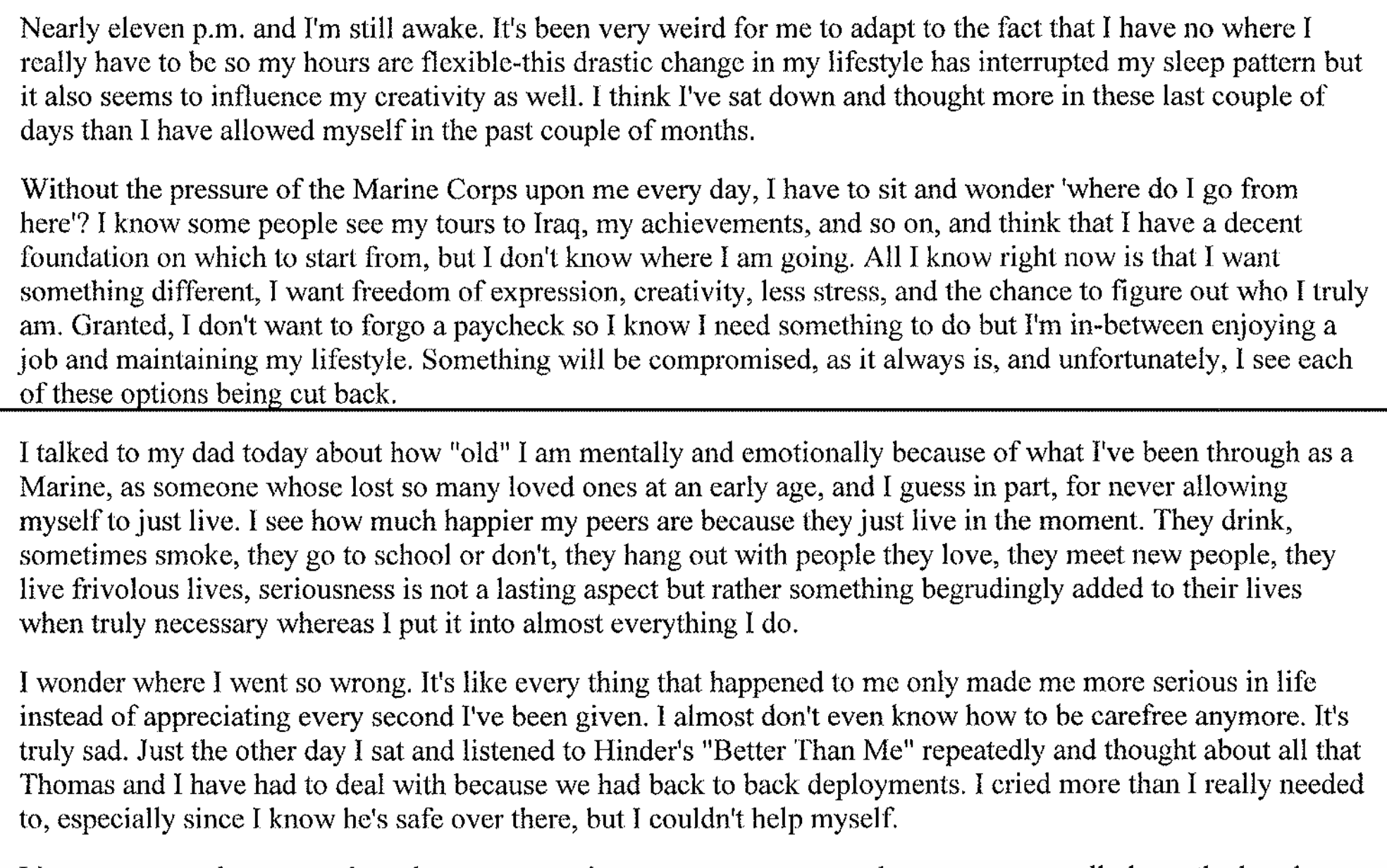
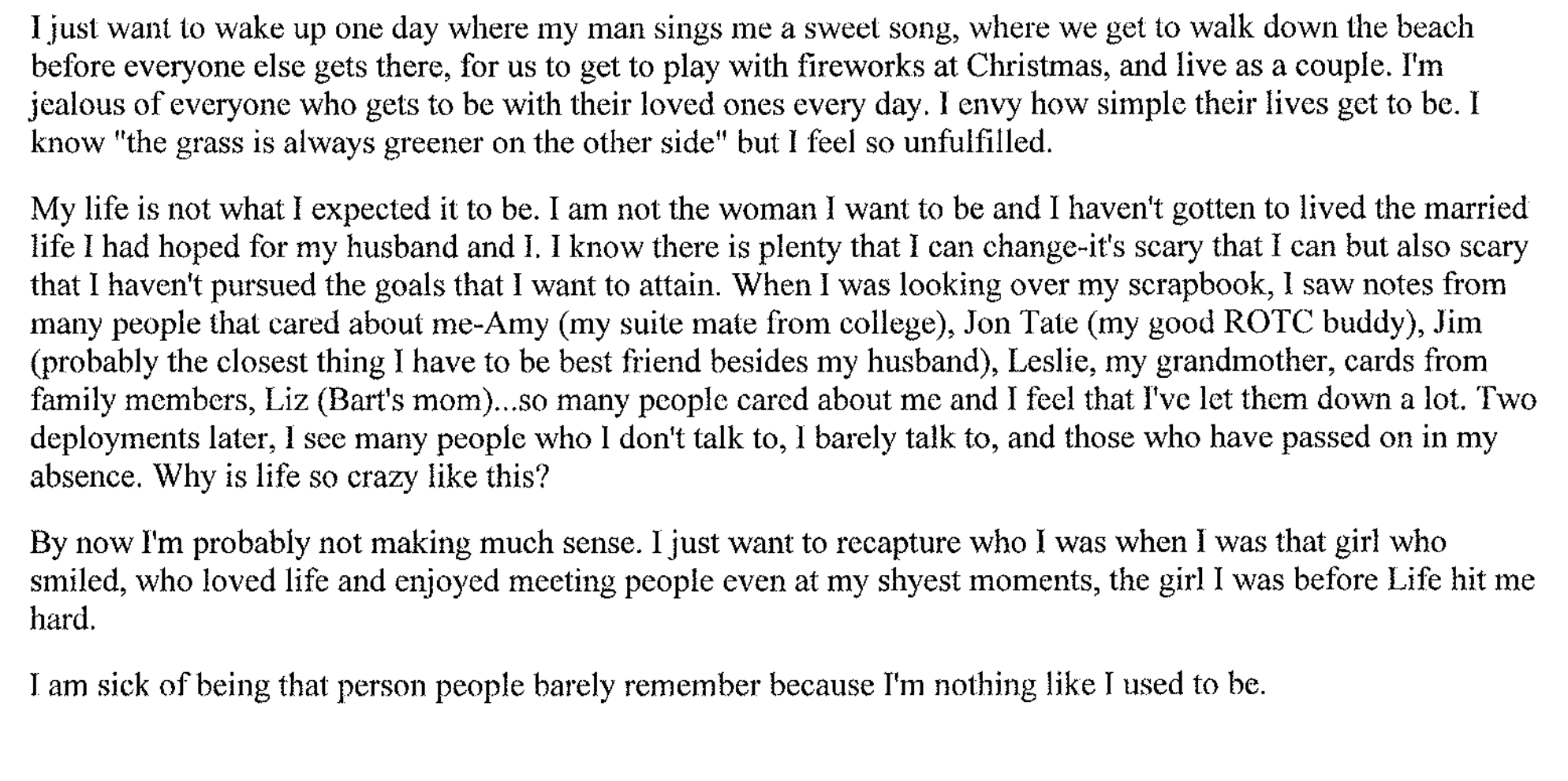
I have a good entry from May 2007 about my feelings regarding leaving the Marine Corps.  The timing works well because I started my new position in higher education.  I still work serving a military affiliated student population but I made the dramatic shift from being student facing to a non student facing opportunity.  Last week was my first week in my new role and I am just floored by the welcoming company culture.  As a veteran, I do find I get somewhat skittish that I’ll be judged for my visible tattoo (although I frequently wear long sleeves since office environments tend to be colder than I like), my preference for ponytails versus fully done up hair, and my sporadic use of makeup.

Society judges women heavily and it hasn’t seemed to matter at what age or in what industry.  The rules are written and unwritten.  The looks for stepping outside those “norms” feel the same.  Any time I’ve changed my working environment I question what will my peer treatment look like, what will my supervisor’s rules look like, and what infringement will the company place on my personal expression.  My desire to be more myself was a key part of leaving the Marine Corps.  Over the years, I’ve come to see pushing and prodding to adhere to desired female beauty standards and thankfully last week I was rewarded by the visual confirmation my new company permits a lot of personal expression.  Some female peers have full sleeve tattoos, others enjoy wearing shorts and jeans (as permitted by their departments), and makeup is worn from the slight touch of lip color and mascara to a fully done face with false lashes.

I feel more at home than I expected I would as a new employee.  I am quite happy and I feel once I get the hang of my work responsibilities this happiness will only magnify.  I don’t feel like the lost person I felt I was in May 2007.

Below is one of two entries I wrote for May 23, 2007.  I am not sharing the earlier one as I  included some personally identifying information for family friends and I don’t want to worry about anyone having that person’s address.  (By the way, anyone who knows how I feel about fireworks might laugh that back then I still thought I’d enjoy them!)

Take care and have a great weekend.

2007 Entry

Screen Shot 2017-06-11 at 7.52.11 AM

Screen Shot 2017-06-11 at 7.53.17 AM

Money Talks & The Good Life: Part 2 of 2

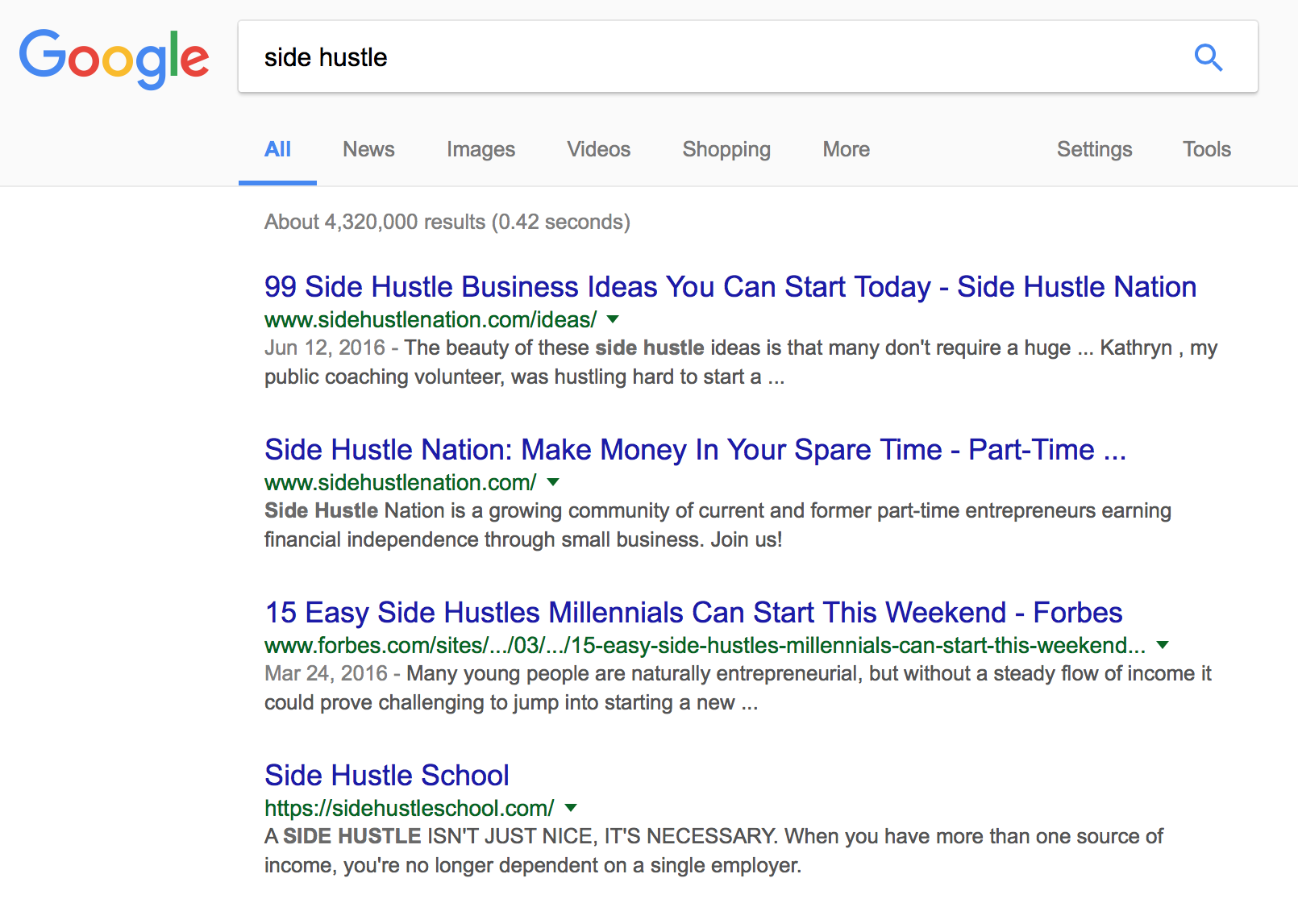
In probably the last year or two I’ve started to recognize the term “side hustle” on a number of the sites I frequent.  It’s become quite popular, in fact.

Screen Shot 2017-05-19 at 7.22.36 AM.png

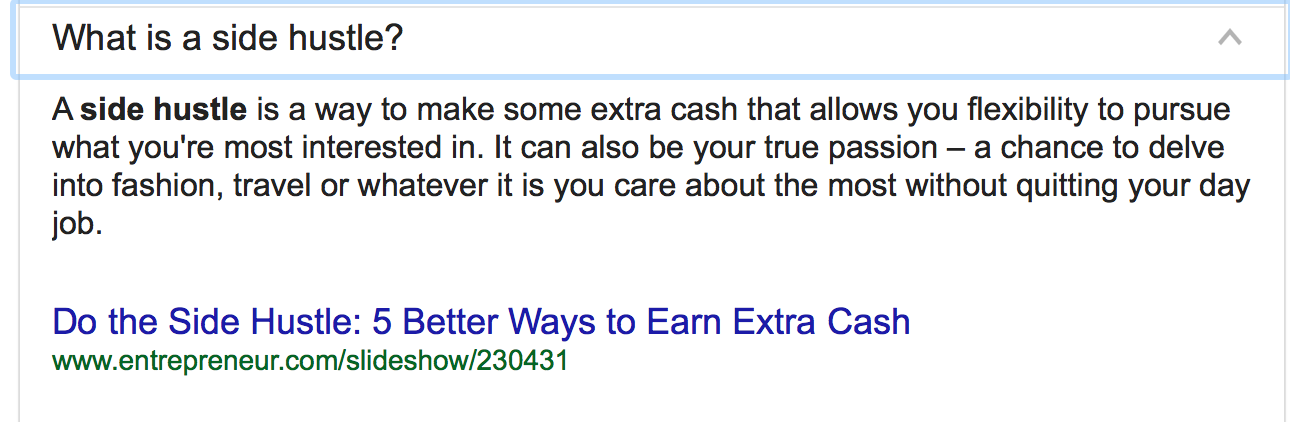
So what exactly are we talking about when we say ‘side hustle’?

Screen Shot 2017-05-19 at 7.25.01 AM

A side hustle is a fancy term for a [insert whatever amount of time commitment] job.  My top frustration with the talk of a ‘side hustle’ is how it’s being toted, in some places, as an easy commitment of your time to make additional money.  I think this misunderstanding drives a lot of people away from the idea of taking on additional work because they think it must be boring, unskilled tasks that no one would otherwise want to take on for ‘real work.’  (Note: Again, not everyone sells a side hustle as this sort of labor, but I see it and I’m sure I’m not the only one.)

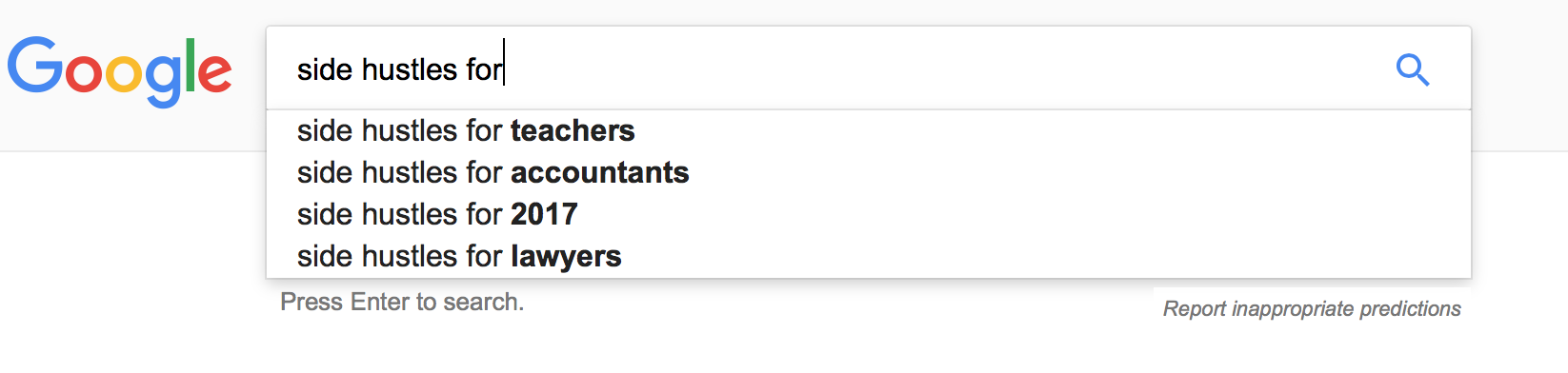
There are some stories of pretty great side hustles.  The ones I notice most are when people take on a side job that interests them (writing, baking, etc.).  There also doesn’t seem to be a limit on available side job opportunities.  If you are lost for ideas you can do what I did and Google “Side jobs for [insert an interest, profession, or skill].”

Screen Shot 2017-05-19 at 7.35.00 AM

If you need or want to make extra money, opportunities are out there but it will take a commitment of your time and energy.

Yesterday, I spoke about my relatively low income and how it’s become more of a frustration for me.  Like Erin Lowry and her article How I Went From Making $23K to $100K in Just 4 Years I, too, get sick of scrapping by.  For this reason, I wanted to share the end results of my “side hustle” aka getting paid to go to school to compensate for the low pay at my current position.  However, before delving into my current finances, I know it helps to share my background as well.  Different areas of employment offer different incentives and pay; those occupations also require different educational backgrounds and skills.  These factors cannot be overlooked in any conversation regarding money.

2003 to 2007: United States Marine Corps

I’m using numbers from the DFAS website as I cannot get Marine Online to view my historical pay and I no longer have the bank accounts I had back then.  There are numerous allowances one can receive: basic allowance for subsistence, basic allowance for housing, clothing allowance, hazardous duty pay, etc. which is why I just wanted to focus on just basic pay numbers.

  • 2003 E-1 w/less than 4 months of service= $1,064.70/month
    • Joined in July: Approximate basic pay for 5.5 months $5,855.85
  • 2007 E-4 over 3 years of service=$1,883.10/month
    • Left the Marine Corps in July: Approximate pay for 6.5 $12,240.50

2007-2009: Kay Jewelers

  • $10.50 an hour/typical hours worked: 30
    • Annual pay $16,000

2011: Unpaid internship with the Naval Criminal Investigative Service

  • $0.00 (16 hour a week commitment/10 weeks)

2013: Working for Public Health

  • $48,942 is the listed annual salary
  • I worked there for 6 months so my salary was $24,471 (40 hr week commitment)

2013-2017: Working at a 4-yr Institution of Higher Learning

  • 2013 ($15.63 hour/$32,500 annual)
    • Approximate 2 months worked=$5,000
  • 1st pay increase ($15.94 hour/$33,155 annual)
  • 2nd pay increase ($16.31 hour/$33,924 annual)

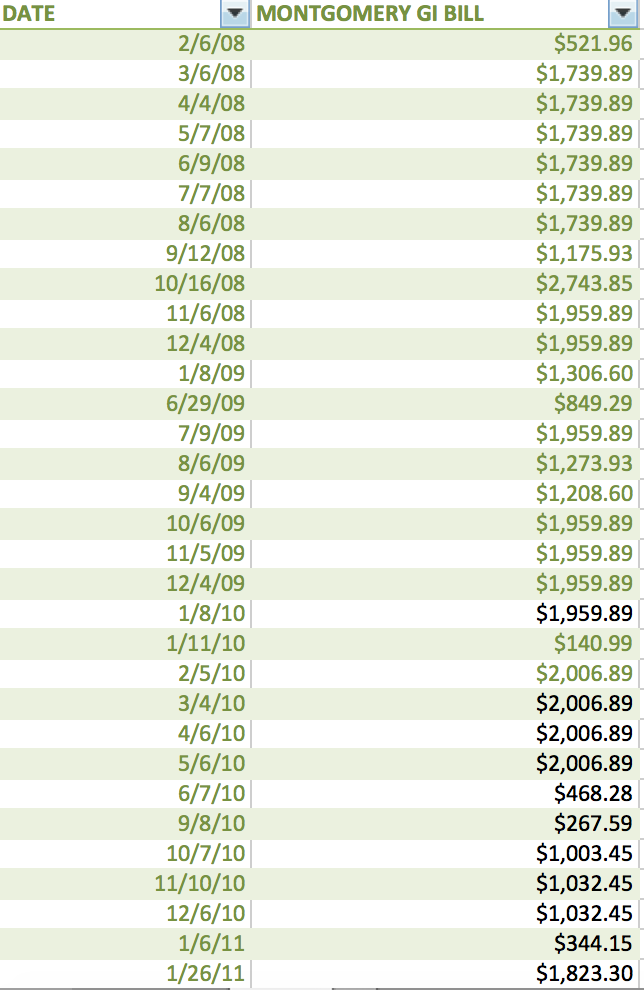
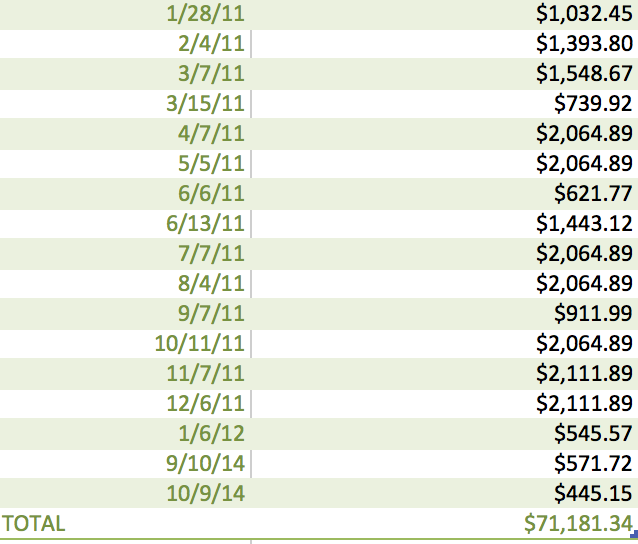
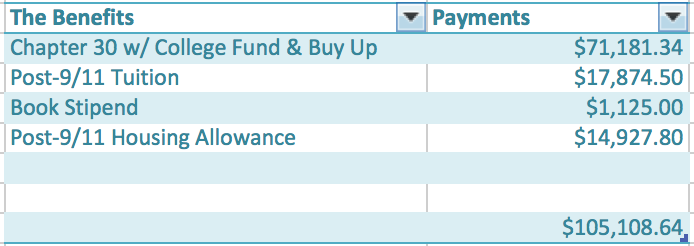
As you can see my pay has not been substantial.  My side hustle of using GI Bill benefits, by comparison, has greatly provided for my family and I.  Below are the numbers from my direct payments.  I received 36 months of the Montgomery GI Bill that was enhanced by paying into the $600 Buy Up program and having the Marine Corps College Fund.  I’ve also already received most of my 12 months of the Post-9/11 GI Bill.

It’s important to keep in mind the Montgomery GI Bill is paid to students and students still make their tuition payments to their respective institutions.  The Post-9/11 GI Bill pays out tuition and fees, a book stipend, and a housing allowance for eligible persons.  Percentages vary from 40% to 100%.  (By the way, if I made a mistake about the two January 2011 payments my apologies.  I cannot open up eBenefits to ensure I didn’t make a transcribing error when I downloaded information from the site and entered it into Excel. It’s quite a long time ago and I no longer have the same bank account my GI Bill benefits went to at that time.)

Screen Shot 2017-05-19 at 9.58.39 PM.png

Screen Shot 2017-05-19 at 10.02.02 PM

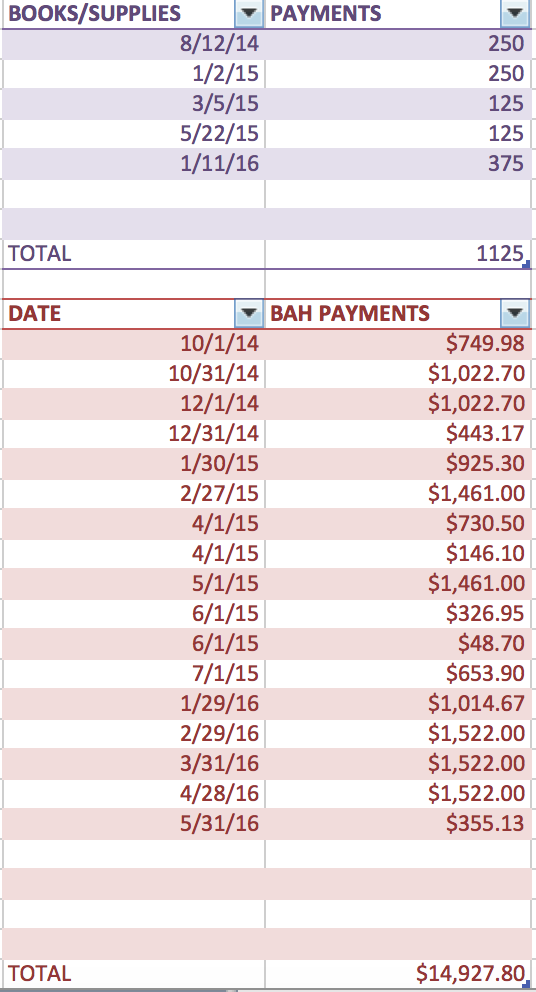
My Post-9/11 GI Bill provided greatly for me.  The amount of housing I’ve received alone make a monumental difference in allowing me to stay in my current place of employment as long as I have.

Screen Shot 2017-05-19 at 10.04.37 PM

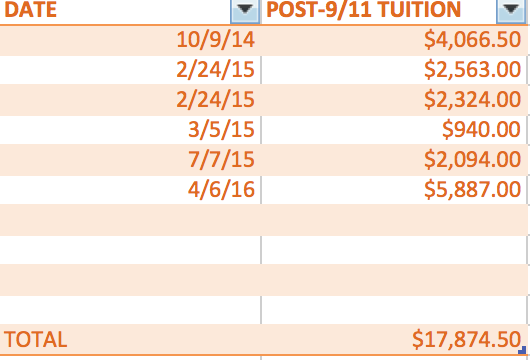
The amount paid to Arizona State University is as follows:

Screen Shot 2017-05-19 at 10.06.43 PM

To make it easier to consume together, here’s my significant “side hustle” from 2008 to 2012 and 2014 to 2016.

Screen Shot 2017-05-19 at 10.09.34 PM

The reason I’m ok calling my education a side hustle is there are plenty of service members and veterans who end up not using their GI Bill entitlement.  It’s the same thing from a payment perspective as not taking any other sort of odd job you are qualified to do but choose not to do.  You are not taking advantageous of an opportunity to get paid for your time and effort.  (For my veterans reading this article, you have 15 years from separating from active duty to use your Post-9/11 GI Bill.  Do not let it go to waste.)

The money I’ve received from my paycheck versus my GI Bill entitlement is more important in the fact I pay into the Arizona State Retirement System.  Over 11% of my income is taken out for retirement and while my employer also pays the same amount, it’s hard to have this much money taken out as the only regular income my family receives.  When I worked for the Public Health and was later not offered full-time employment, I had to make the hard decision to withdraw my money and pay the penalties for early withdrawal.  At the time, the state’s unemployment system was three months behind and after already coping with a yearlong deployment my savings account was not sufficient to survive the second bout of unemployment.  Ironically, I gained employment again at the time I was finally eligible for unemployment benefits.

In a short while, I will find myself ending my journey in my current place of employment.  At this time, I need more freedom in my take home pay which can only be offered by a company that utilizes a 401(k) and I also want a work environment that lets me be more flexible in my hours.  My daughter is still young so working around her school commitment is a high priority in my life.   The reality of our family situation is also why I’m being a bit more honest about my pay.  I recognized the hard way your traditional job does not easily pay the bills (and for the wants that naturally we all have as people).  I used a great tool available to me and was paid to attend school.  Thankfully, I enjoy learning so my side hustle wasn’t a chore although completing papers late into the night after working all day wasn’t fun.

My diligence paid off.  My side hustle earned me a total of three degrees and gave me extra money in the bank at the times I needed it most.  The best part is my GI Bill benefits, as opposed to my income, is also non-taxable.

Down the road I know I will become better at advocating for myself and hopefully in sharing my story today, others feel inspired to assess their current situation and future goals.  Money is an important part of that personal assessment.

We shouldn’t be afraid to ask for financial compensation but also be willing to take steps to accomplish our end goals when traditional routes just don’t cut it.

~Cheryl