It’s 10:30p.m. but I wanted to sneak in a little hello to everyone. We took my daughter to seeAlphain theaters today and one of the previews that caught my eye is for a sequel toUnbroken. My husband and I watched Unbroken when it was in theaters and I was surprised today to learn there was a sequel,Unbroken: Path to Redemption, coming out in September. Based on seeing the first movie, I have no doubt this movie will likely do well in theaters. More importantly, I hope it does well for expanding conversations about trauma, post-traumatic stress, and resiliency.
I realize I’m not always great at sharing my reactions–in a timely manner–regarding the military genre films and shows I’ve seen, but there are some I truly care for. To give you a sense of my (sometimes) poor follow through, I started a blog entry on watchingMegan LeaveySeptember 5, 2017 and I never posted it! I liked the movie but I am glad I made the decision to not see it in theaters due to the explosion scenes. The reason I never finished my post about seeing the movie had more to do with researching comparable war genre films than discussing how it felt to see Iraq come alive on the screen again. Sometimes, the worst thing I do is go down a rabbit hole of researching something so I feel I can talk about a subject with some authority, and I struggle to find what point of researching is a good stopping point.
I know trauma is something we all go through at some point, although not all of us will face trauma related to combat experiences. This issue is part of why I wanted to look at the popularity of different recently produced war movies and my unfinished draft was intended a starting point for a conversation about what Americans look for in war movies and what conversations and representations we really need regarding war and resiliency after traumatic events. So diving in, here’s what I wrote, without any editing:
This past Labor Day weekend my husband and I sat down to watch ‘Megan Leavey.’ Anyone who has followed my writing for awhile knows I wanted to watch this film but I also recognized–given my background–watching it in a movie theater would be stressful. What follows is a very simple reflection regarding the movie. I am not a film critic, but I am hopeful in sharing my sentiments others can see why I see the film has significant value as an education tool regarding alternative deployment experiences.
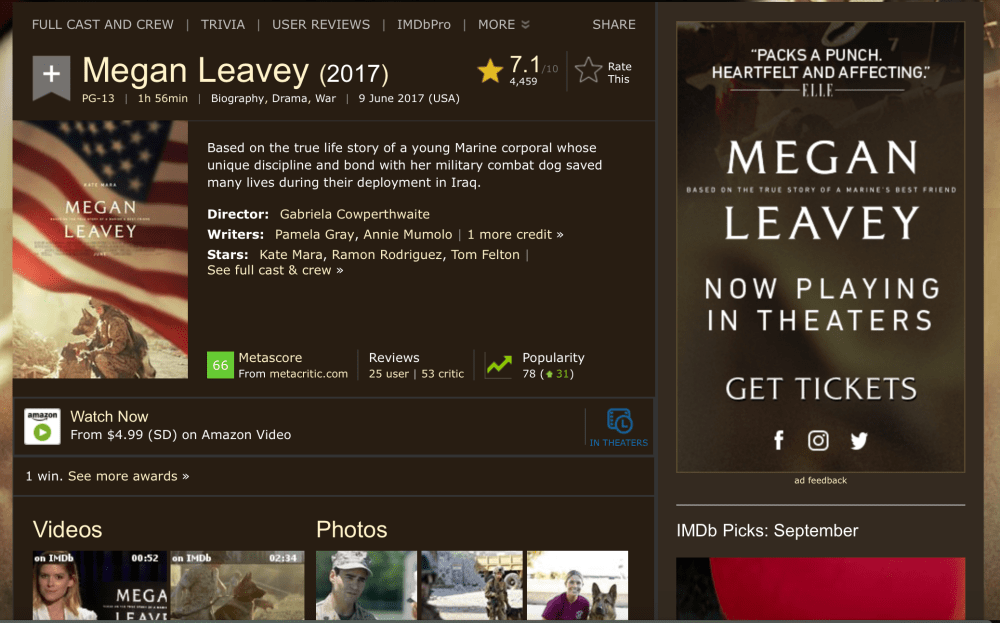
War films are not new as a film genre but the growing divide between those who served and others, through choice or circumstances, who haven’t makes the type of film more worthy of elevated discussion. I am fairly certain the movie does not attract the same kind of audience as drawn to American Sniper and Lone Survivor but it is important to look at some data before I continue my conversation (all pieces of information and visuals are taken directly from IMBD’s website).
Money
Here’s some updated info on Megan Leavey (again straight from IMDb)
I was very disappointed to see the movie error “Al Ambar” by the way.
IMDb lists $350,126,372 comparatively as the Gross USA for “American Sniper” and $125,095,601 for “Lone Survivor.” I think it’s important to notice the male centric movies are both rated “R” and labeled as “Action, Biography, Drama” while “Megan Leavey” is labeled “Biography, Drama, War” with a PG-13 rating. Hopefully, the latter movie will creep up in popularity with American viewers.
I truly enjoyed seeing how Megan’s life pre-Marine Corps, deployment, and transition out of active duty was handled on-screen. I haven’t seen the movie since to have better notes on hand, but there are details that stuck with me. We learn why she joined, always an important factor in my mind. We see this moment on deployment (spoiler alert if you haven’t seen the movie) where she receives criticism for sharing her MP dog’s name to Iraqis during a vehicle search. We see her in group therapy post separation that is invaluable to reducing the stigma regarding mental health. There is this trauma shown in the film that created individual brokenness on a physical, mental, and emotional level but more importantly, there is a representation that empowerment is critical. Empowerment helps forge resiliency. I don’t think that reality can be stressed enough.
Lastly, it was truly important to me for a female Marine (and her struggles) to receive such public recognition in film. Our nation needs to see women serving–and the trials of their service and veteran transition–as a normal life experience like it does for the men that join our military service branches. It opens doors for understanding war, camaraderie, traumatic events, and recovery. It allows women to be formally recognized for their sacrifices and achievements. That representation is crucial.
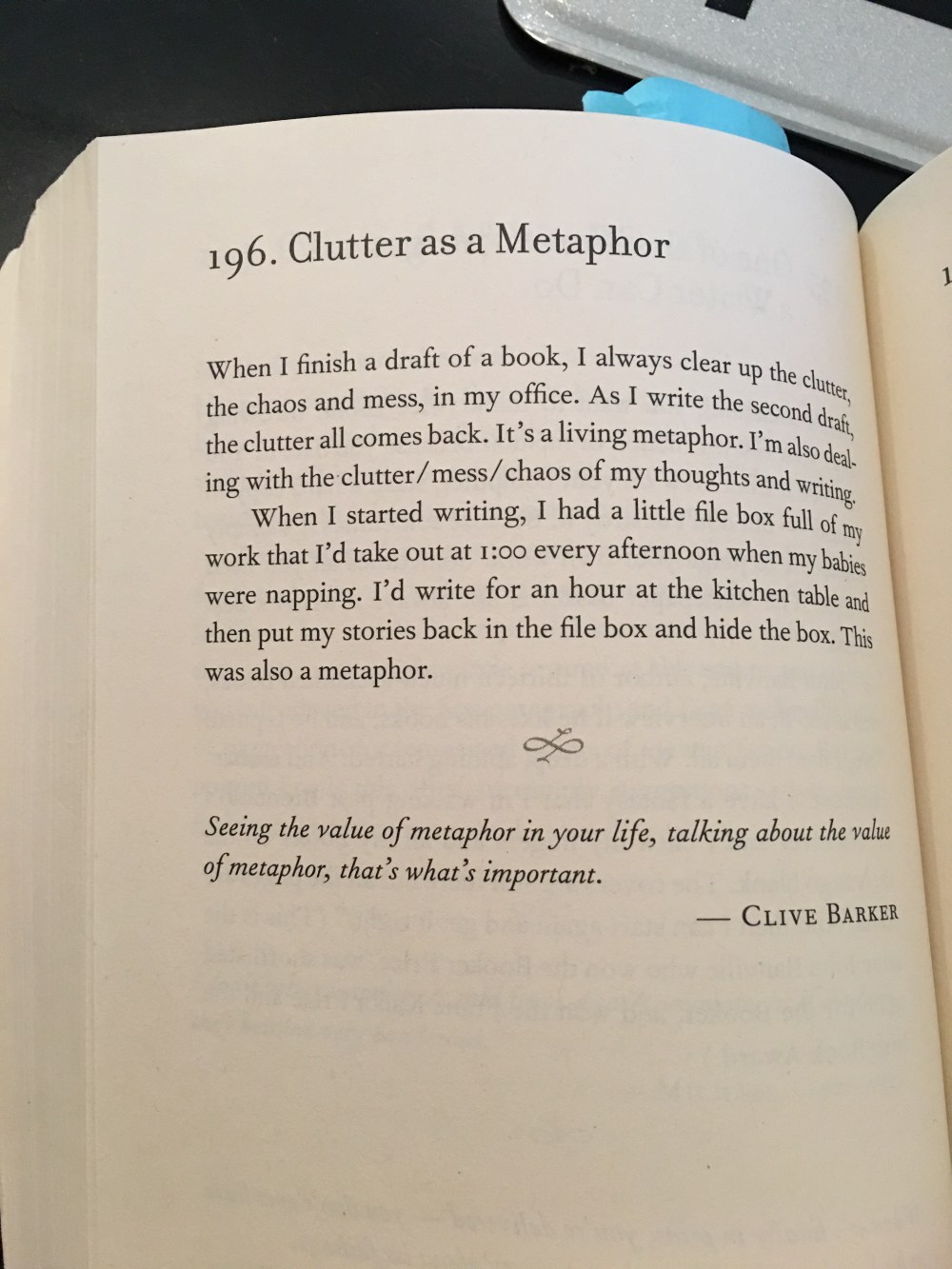
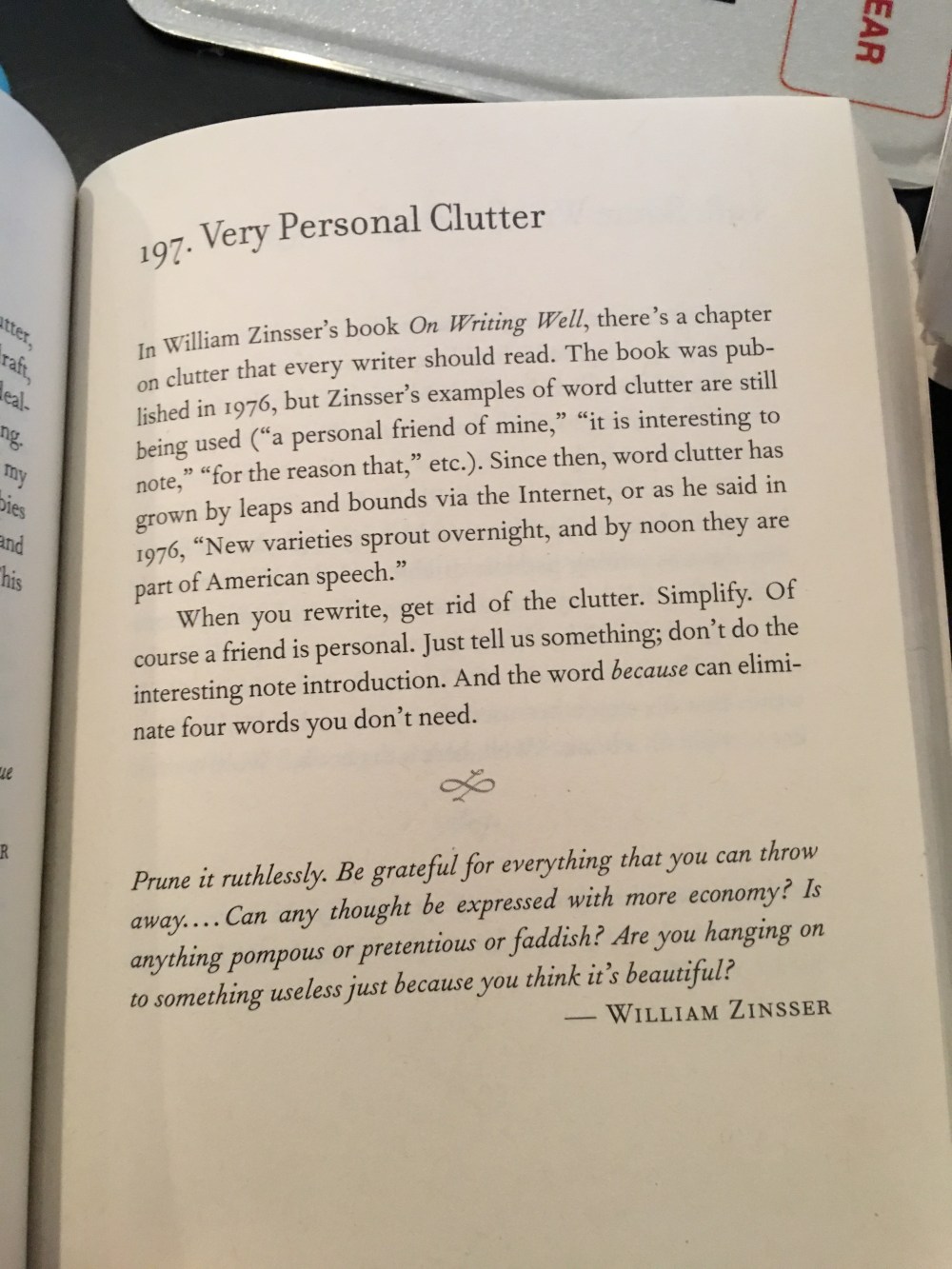
From A Year of Writing Dangerously by Barbara AbercrombieFrom A Year of Writing Dangerously by Barbara Abercrombie
The endeavor I set for myself to write a memoir about Iraq conflicts with a lot of life responsibilities. I work 40 hours a week. I am a wife. I am a mom. I am (also) a dog mom. I am a graduate student (again). I am a friend, daughter, and sibling. I am a coworker. I am a homeowner. I write in an often cluttered workspace that signifies my relationships with others. There are dishes, laundry, bills, phone calls (or text messages, Facebook notifications, etc.), and regular house cleaning silently screaming for my attention along with the bodies that reside in the same house as me.
When I write, I constantly cross two worlds. I face Iraq and stateside life circa 2004 to 2005 as it exists in preserved packages (photo album, journal entries, and souvenirs). I also navigate over my current life, a house cluttered with dog toys and empty or partially filled coffee mugs. I might get a hundred words on the page reconstructing my deployment before I realize some nagging household responsibility gnawing at me. I must try and ignore household responsibilities that infringe on my writing time and space. I am not a full-time writer who can send everyone away off to school and/or work all the time nor can I afford a hotel stay for uninterrupted writing time. I am creative though with my resources.
Yesterday I took a PTO day and used almost 2.5 hours strictly for writing. I set the stove timer in hour increments. My goal was to write about my most difficult feelings after returning home from Iraq in 2005; in fact, I confided to a close friend recently I’ve contemplated this writing assignment at least ten times in the past three years. The trajectory of this memoir originally was to only focus on the deployment, but now I feel doing so robs the reader of seeing the experience full-circle. I owe the reader a sneak peek at life back stateside.
I have a plethora of Myspace entries from back then chronicling my return and the whirlwind first few months home. My life was a mess and it’s not surprising, I was also a mess. I was bitter and heartbroken. I was exhausted from constantly switching gears. I was academically competitive and frustrated when I couldn’t outperform others. I returned home in March but by sometime in June, I was on a break from drinking alcohol. My journal entries went from happy to angry to grateful in a cyclical pattern and I wasn’t too shy to name names on who pissed me off on certain days. Mostly, I was lonely. Homecoming was a short-lived happy experience and a lot of days after were empty.
I’m not sure yet I can fully encapsulate the social isolation, but it explains why I desired returning to Iraq. I felt needed in Iraq and at home, I no longer felt that way. I was just there because the deployment was over. I made the rounds seeing family and college friends before jumping back into training schools (Technical Escort followed by Corporals’ Course) when the logical thing would have been to slow down. It’s probably most important to mention I didn’t have a best friend the way I expected I would when I returned home. I think that’s why I’ve changed a lot in how I treat others.
It’s not as though I ever felt I had to take First Marine Division’s “No Better Friend” to heart; I loved having close connections with my friends growing up, but I didn’t have a consistent confidante in my life after returning home. The Myspace entries make that issue evident. Yesterday’s writing session also made me realize much of those journal entries are too “in the moment” to share. My thoughts are messy. I had moments of high school drama. I rambled for the sake of filling my time. As much as I wish I wrote more yesterday, I know it’s important to discover my sense of loss was connected not just to the deployment but going through a period in my life where “best friend” friendship was lacking. I cannot think of any other time in my life where I felt I was missing a best friend.
I am not one to share pieces of the memoir in progress, but I’ll close with just a few things on how I’m building this part of the book. I recognize some parts will be rewritten a lot but at this point, I do not feel I could use anything directly from the May 2005 to July 2005 journal entries concerning a failed relationship. The hot and cold “He loves me, he loves me not.” sentiments I felt at the time can be spelled out better if shared from a teaching perspective. There are three journal entries (June 23, 2005; June 24, 2005; and one from July 5th, 2005) worth folding into the memoir as my raw conversational voice covering this time period. Lastly, I am on the fence about how much I want my audience to see me as alone during this part of homecoming.
Today’s post is not entirely related to my usual writing but for probably the past year I’ve had a string of recurring dreams that I feel might be important to share. Dreams are not something I talk about too often and looking back I think there are only two entries where I’ve laid out what dreaming has been like for me after my first tour in Iraq. In December 2015, I decided to share the nightmaresI had during the Fall 2015 semester of my first graduate program. In the other entry from June 2017 I decided to talk about the other dreamsto include those I’ve experienced about losing teeth.
Dreams aren’t something I remember very often. As I mentioned in the past for several years I dreamt about losing a mouthful of teeth all at one time; these were the dreams I’d remember. I know people sometimes say dreams of losing teeth are related to fears about death, and maybe they are right. Occasionally, I might dream of seeing my mother or maternal grandmother–both deceased–but by and large, I didn’t recall any dream outside of those losing teeth until I started my first graduate program. The stress of school responsibilities triggered a series of dreams from the first semester through the last about something service connected (although not from my actual deployments) and/or close people in my life.
This issue made me exceptionally nervous to begin a second graduate program. I did not want to fall back into terrible dreams and I shared this concern with a dear friend of mine who encouraged me to not let that way of thinking prevent me from pursuing an educational goal. Thankfully, she was right that it wasn’t likely to be the same. Although I have dealt with some service related (again, not directly my military service) dreams, they do take a different form.
The self-care routine I started in late 2015 is paying off in that department. The dreams I’ve had, instead of being violent and exceptionally stressful, tend to be more confusing about choices before me. In one, I had to explain to a fellow Marine some of my triggers so I wasn’t unnecessarily startled. In another, I was completing physical fitness tests to see if I was qualified to serve as a Marine officer while (in the dream) expressing doubt about whether that’s what I wanted to do in life. The dream I had last night is not like either of those scenarios.
In last night’s dream I found myself in a home I realized my parents purchased and I was upstairs in a young woman’s bedroom; her possessions revealed she was maybe late teens to early twenties. While I cannot see it, I know the entire home is devoid of furniture save for this one room. What’s particularly odd is the two other similar versions of this dream I find I am in the same scenario but the room is switched. In one, it’s a playroom full of unused childhood toys and in the other, it’s a formal family living room complete with the usual furniture. In all three dreams, the other rooms are bare. Somehow, I’ve comprehended the original tenants sold the home this way to my parents and the furnished room–whether it’s the young woman’s bedroom, the living room, or the children’s playroom–signifies some sort of trauma to the other family. The room is left, shrine-like, for me to explore.
That’s what creeps me out.
As an adult, I am walking through this home with no real concept of where it is or why I am the only one there, but my task is to get through these spaces. It feels eerie in the dream. I’ve recognized many times I walk through other parts of the home intentionally avoiding these spaces. It is apparent each time that the rooms have been abandoned for years, but I’ve gone out of my way to not touch the furnishings and I don’t pick up the clutter I find in the children’s room or the woman’s bedroom. Until last night.
In this version of the dream, I notice a series of cupboards and some light shining into the room. The cupboards have been covering up a series of windows. While I take notice of this information, I make a mental note to remove them at a later time and look at the room in its current state. There are new objects that shouldn’t be there. My mind recognizes my daughter and my sister-in-law’s kids were playing here. I can’t remember everything new that I saw, but I do recall an open five gallon bucket of paint and I fear the kids will destroy something valuable in the room. Now I cannot avoid cleaning up the room because the kids have been here.
I start by assessing the room. The bed is made and carefully layers with sheets and what might be a crocheted blanket. The blanket is a warm almost mustard yellow color and one of the most noticeable items in the room. There are books everywhere dominating the room. Some are paperbacks and others hardbound. A collection of posters and hand drawn artwork line the walls. There honestly isn’t much for empty space anywhere, but it is not a hoarding situation. This room was a happy space.
The first thing I do is start removing the personal artwork from the walls. The pencil drawings are family portraits I’m guessing by the way the people look and the writing scribbled across them that I cannot read. I’m struck by the sensation of pulling the paper off the wall, the feel of the construction paper in my hands. (I had to look at Office Depot’s website to share with you the items securing the paper to the walls are silver T-pins like the kind teachers use in their classrooms.) As I start to disassemble this woman’s room by going through her personal effects, I am struck by how emotional this process is and I no longer focus on the new items in the space. I find a hardbound book with recent water damage to its dust cover. I am relieved upon removing the dust cover the book underneath is undamaged.
This is where the dream ends. I notice a flash of light and wake up.
I woke up because there is a thunderstorm in progress. The lightning was real and it is quickly followed by thunder. As hard as I try to go back to sleep–while I don’t want to enter back into the dream that just ended–I can’t. The sound of thunder often startles me like mortar attacks so I lay in bed waiting to go back to sleep, but I can’t get this dream out of my head. It’s more upsetting to me than it should be and I don’t know how to explain the sense of loss cleaning up this room.
Originally, I was planning on sharing the dream only with friends and family but I think others might relate. I don’t know if this dream is haunting me because I’ve been working on my memoir or made a lot of changes this past year. I recognize the dream, compared to the past ones, is more important because something changed in the pattern of the dream. I wanted to save something of value before it got destroyed by the carelessness of children. Looking back on the dream, I didn’t look to scold the kids for being in the room and return to my habit of avoiding the space. I also didn’t search for anyone to help me go through the items to sort through what could be donated, trashed, or kept for sentimental reasons.
I realized I just needed to go through the room and I started to tackle that project last night.
A friend opened up to me recently about her admiration towards me putting my life out there for others to learn from and her sentiments make me happy. It is not an easy thing to open up my heart, talking about the good and the bad, knowing that others may misunderstand my words and/or criticize my life or life choices. When I speak of my experiences, I am also telling stories about my family, past boyfriends, former coworkers, or supervisors. Each person has a right to be angry, indifferent, or pleased by being included, but I worry about being judged and sometimes I worry about the risk to my professional non-writing career.
The thing is I love to write. It is my release in this world. It is my quiet time to contemplate. For this reason, don’t find it odd I kept a journal during my recent Huts for Vets trip. The organization provided us with some small stapled journals, a handful of lined and unlined pages to unclutter our minds at our discretion. I was not hesitant to pick one up and found space to write at bedtime, in the morning before others joined me at the large dining table, and after meals. There is a joy in the social norm others do not open up personal journals. In this setting, I made my identifiably mine by leaving my pen or phone sitting on top; it’s a simple gesture to ensure it was not mistakenly picked up and read.
I didn’t write real complex observations. I did not want to attach an academic research mentality towards this hiking trip, but I wanted to reflect on the shaping of the community. Everywhere I’ve been the food, language, clothing, etc. says something about our location, needs, group values, and so forth. The details cement us in a particular space and time. Frequently throughout our trip we talked about “our tribe.” I love that feeling. We adopted each other from the very beginning and it’s an important quality we can all bring to other aspects of our lives. We can always “adopt” people into our close circle of contacts. We do not owe it to others to say why we bring others closer to us–why we cherish them. We just bring them in, as though they’ve always been a part of us.
This week has brought with it a variety of conversations requiring me to reflect on my connectedness with others. I found some people I don’t know as well as I thought, and their actions also indicated the same. In other interactions, I found people still know me well and remember conversations I spoke from the heart and the words remain valuable to their lives. That makes me happy. I want my friends to feel I’m someone who is here for all their days, not just the good ones. I also found this week I can show others a side of me I don’t let everyone see and I did so through sharing some of my musical tastes. The thing is we are always under constant transformation, and some people want to be part of that process and some don’t.
Those closest to me recognize how hard building my memoir has been as a matter of reopening old wounds, an investment of my time, and as a matter of representing the Marine Corps and American society. I’ve started and stopped this process so many times. In particular, I found myself struggling building one vignette because I had to see myself and the other person in that moment and how we couldn’t talk properly to each other and how that conversation tore down some trust we had with each other; writing that scene meant finding the right writing space. I sat outside two summers ago, knowing the triple digit Arizona temperatures would keep others outside my “writing bubble” so if I cried thinking about that loss I had time to compose myself before returning to work. As much as I don’t like to be embarrassed publicly, I really hate to let others see me cry. I don’t like being that vulnerable.
The thing is I needed another break from memoir writing. For all the healthy aspects of confronting the past and saying I survived it, I repeatedly have had to look at my personal failings, how trauma radiates out in multiple directions, and how isolated I was after my first deployment. My life was falling apart the first six months I was home. I don’t like talking about how self-destructive I was back then, but I was actively killing myself one bad decision after another. It’s a difficult thing to talk about how much I hated myself. I blamed myself a lot for my life falling apart and I wanted to go back to Iraq to escape it all.
With writing, I have to find a way to tell the story without beating myself up all over again. I have the life I have now because I had to say “no” to certain people, things, and professional opportunities. That being said, I’ve spent time this week also realizing it’s not entirely fair of me to just write about my first deployment. By doing so, I sell this idea I’ve only grown from that first tour in Iraq. The thing is I grew a lot from the second tour in Iraq. I was dreadfully unhappy with my time in the Marine Corps and I walked alone, literally, so much around Camp Al Asad being alone with my thoughts. If I wasn’t working, I spent as much time away from my peer group as possible. I went to the gym and I walked to the command computer center (or the internet cafe used by everyone in our area) to work on classwork and to email home. I was bidding my time until I could leave the Marine Corps. That story needs highlighting, too.
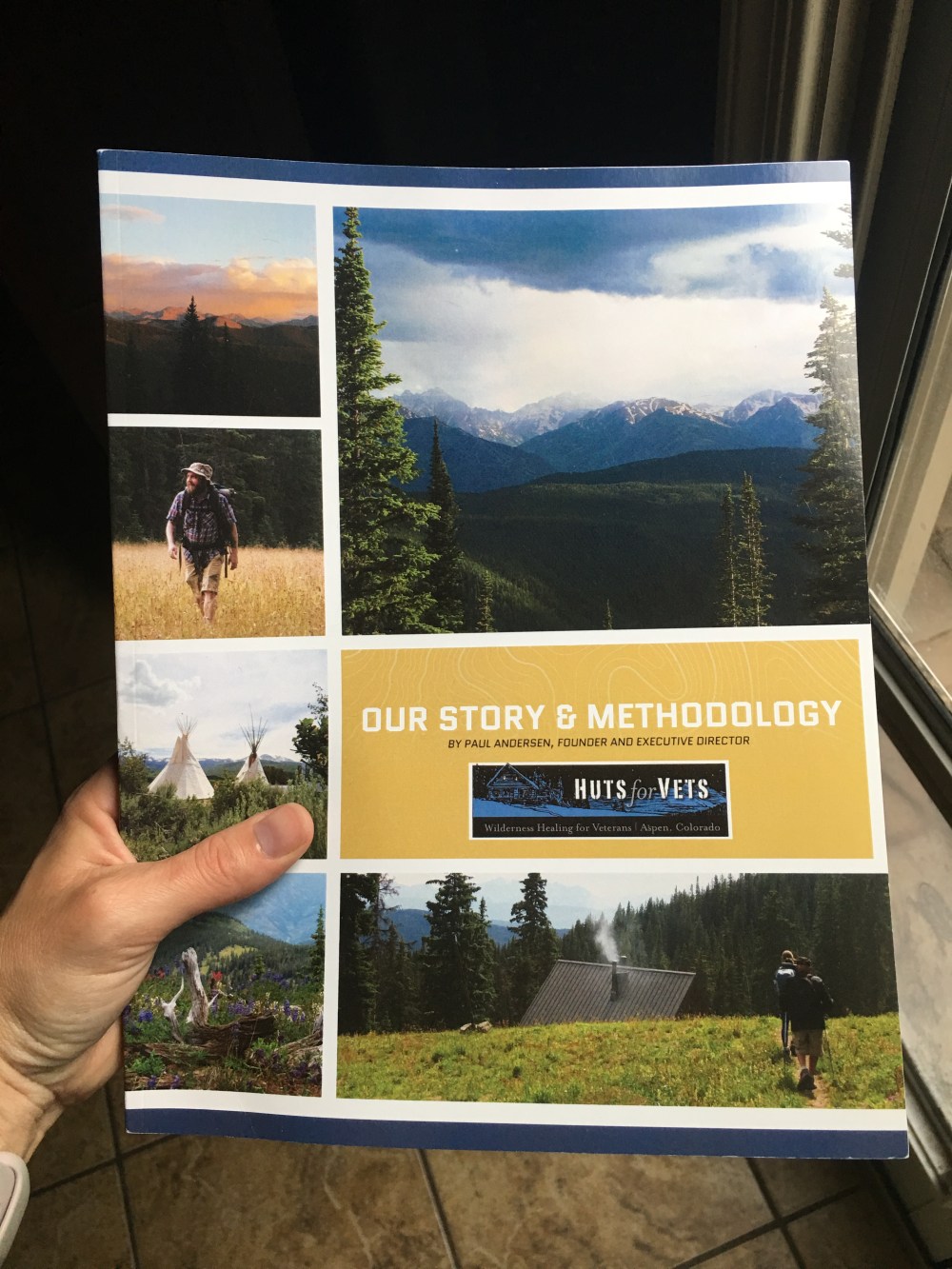
For now though, I will be returning to weekly memoir writing to cover my time at Camp Blue Diamond. The demands of this process will mean I might not check back in here for a month or two other than to mention how the memoir writing is going. I am finding time to look over Letters From Vietnam edited by Bill Adler and yesterday, I received a manual from Huts for Vets that I also think will be valuable to help me trudge through writing the big emotional parts of the deployment and homecoming process.
My desire to participate with Huts for Vets grew less out of a desire to connect with nature, but an awareness I needed a new challenge in my life. Not too long ago, I learned about an amazing female Marine veteran, Kirstie Ennis. Her story of resilience after enduring a helicopter crash in Afghanistan and undergoing multiple surgeries including a below the knee and above the knee amputation inspired me to question why I retreated back to my own comfort zone. I could not recall any significant challenge I set before myself other than to complete a Spartan race in 2014. I knew in my heart if she could literally and figuratively climb mountains after enduring her amputation surgeries, I could find the motivation to push through what amounted to a marathon of hiking and walking over a period of four days.
The timing of the trip also served me well. I live in Gilbert, Arizona and from June 24th to July 6th, my community permits local residents to use fireworks. Although the idea is for them to use ground-based fireworks and sparklers, many people continue to shoot fireworks that explode in the air. I encountered mortar attacks at a small base, Camp Blue Diamond, in Iraq from August 2004 to February 2005. Currently, fireworks with report in close proximity to my home (around a mile or less) still remind me of mortar attacks from that deployment.
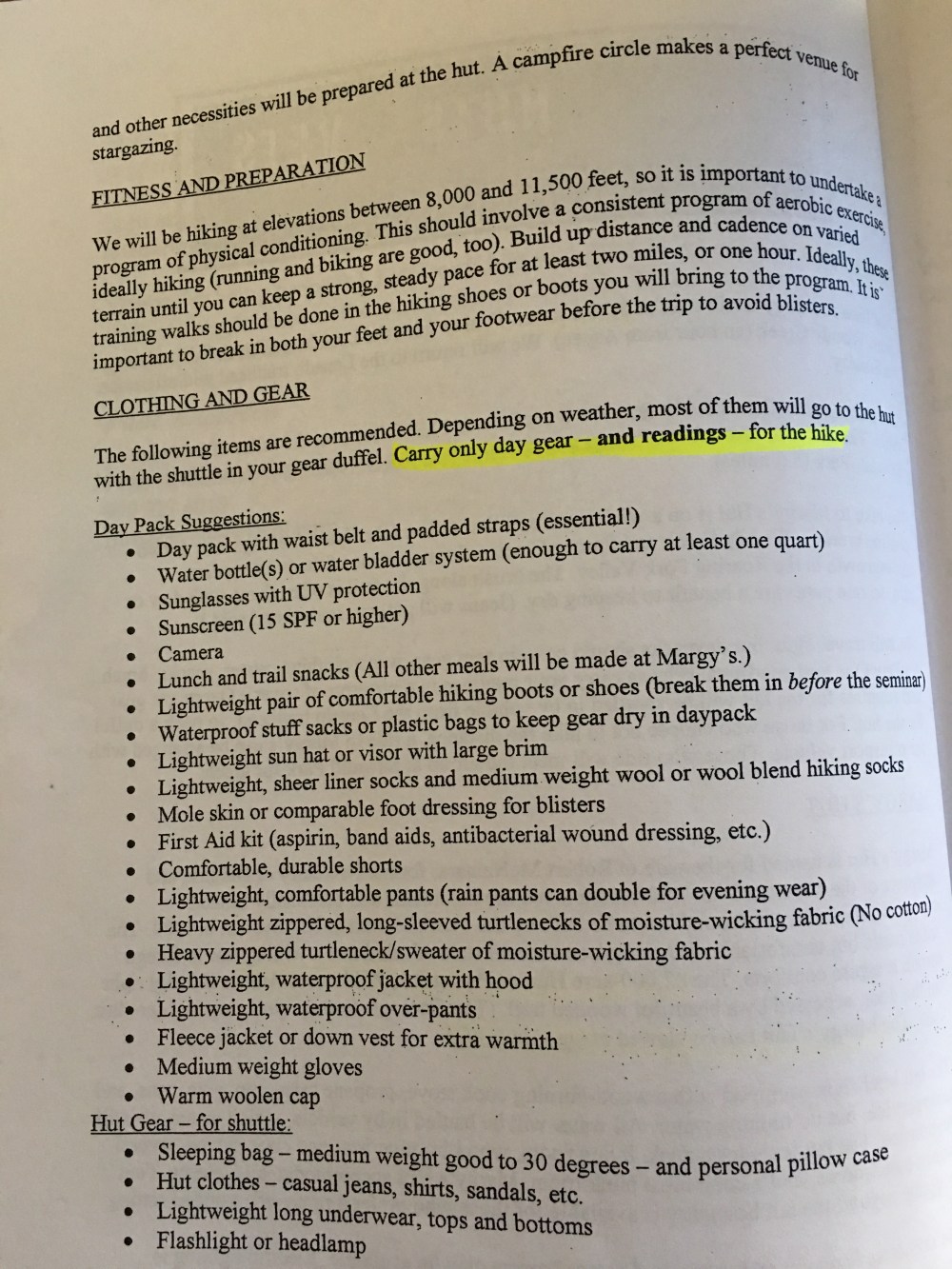
After being selected as a participant, my mission included upgrading my physical fitness routine, picking up needed supplies, and reading the packet Founder and Executive Director of Huts For Vets, Paul Andersen, sent to each of us for our literature discussions. Our meals, transportation needs, and shelter accommodations were covered in full, but I think it is important to share everyone’s individual cost varies greatly based on what hiking clothing and gear one already possesses and/or is willing to borrow from others. Those details are not to be overlooked in the planning process. Our team, in particular, was dealing with triple digit temperatures days prior to our Aspen flight; the night before our flight, my weather check indicated Aspen would be 88 degrees when we landed. With such a temperature difference, I brought more warming layers than someone who lives in a cooler climate might bring along for summer clothing.
Teepee Base Camp
People close to me–and readers who follow my blog, shewearsdogtags.com–know there are certain triggers related to my first deployment. I am not as shy to talk about those matters as I once was, and of equal importance, I did not realize some things were issues when I was still on active duty in the Marine Corps. The past few years, thanks to lessons learned in my graduate program at Arizona State University and some close colleagues there, I began unpacking my service experiences. This year’s journey with Huts for Vets is a continuation of that process. During this trip, I discovered Huts for Vets focuses on empowerment, nourishment, and companionship in its offering of wilderness therapy to veterans like me.
Empowerment
One of the best things to encounter upfront in this experience was the sense none of us were “broken” in the eyes of Paul and the rest of the HFV team. A common problem veterans encounter in media representation is the depiction of the broken veteran, and this idea is largely focused on war veterans. Trauma is not a dirty word in the HFV realm. The team embraced us and added us to their large family without hesitation. From the warm greeting at the airport to a relaxing picnic and walking tour around Aspen before starting our evening at the newly established teepee base camp, everyone greeted us sincerely and ensured we were empowered to maximize the effects of our time in nature away from technological distractions.
No details were overlooked. The team had oxygen, trekking poles, a large supply of potable water, and even a steripen so water collected from local streams could be sterilized during our hikes. As a novice hiker, and someone unfamiliar being in such a high elevation, I found myself in the role of a student. On more than one occasion, I was at the back of the group. I slowed down to catch my breath often. Instead of being embarrassed at my lack of expertise and slow pace, I had the opportunity to listen to and watch the natural world unfold around me. The calming roar of the stream. The buzz of bees lured to flowers. Paul encouraged us as well to touch the trees and dip our fingers in the water to fully embrace our settings. The world was ours to explore.
Nourishment
The physical intensity of our trip’s three hikes required proper nutrition. This area of life is something I lean heavily on others for assistance. I learned to cook and bake after leaving the Marine Corps, but I still tend to eat poorly at times out of laziness. The trip offered me the opportunity to see we can still eat well (i.e. not relying on MRE type meals) while on an outdoor adventure and utilizing less resources than I have in my home kitchen. The food prepared for us by Frances, Wendy, Tait, and Jake demonstrated an attention to using a combination of local foods with health in mind. Some new things I tried for the first time included a small bit of non-spicy kimchi, chickpea miso soup, and peach-apricot juice.
Coming together to eat family style is an important part of the experience. We ate breakfast, lunch, snacks, and dinner together. For brevity’s sake, I will not include all our meal photos in this blog entry, but I am including a number of photos. Everything we encountered was quite unexpected. I am amazed by the food knowledge shared during this trip and the combinations of foods I would not naturally think to try at my kitchen table.
1st Dinner at Base Camp: Mexican chicken, quinoa salad, blueberry and jalapeño salad with a side of artisan bread
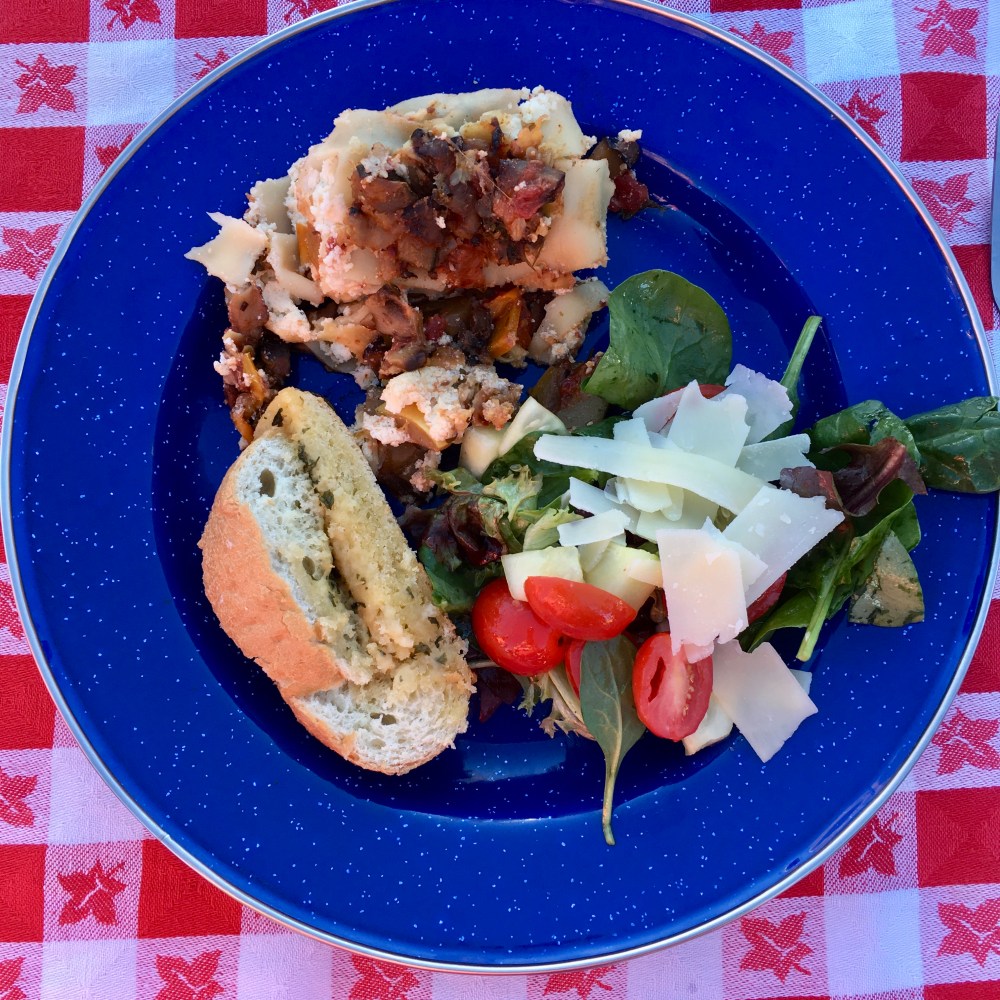
Dinner at the Hut: Chicken, amaranth & shiitake mushrooms with snow peas, one slice tofu, and a kale salad with a cherry balsamic vinaigretteLast Dinner with HFV: Wendy’s amazing vegetable lasagna, green salad with shaved Parmesan, and garlic bread
Companionship
I noticed early in this adventure we are a group of avid readers. Some people would rattle off their favorite writers during our nightly conversations and a number of participants brought books with their other possessions. Gathering for our literature readings, we found valuable insights that (sorry) I cannot share as the discussions as meant to stay with our group. The consideration extended to each other during our talks is something I think we need more of in our society; in spite of serving at different times, in different capacities, and in different areas, no one argued his or her service was more valuable than another’s. It was far cry from our very competitive society, to include inter- and intra-service branch rivalries.
HFV Board Member Retired Col. Merrit blowing out the candle for his birthday cookies. He turned 83 on June 29th, and he hiked ten miles with us! What a day.
This trip also showed me there is an opportunity aside from building new personal connections to continue working on improving pre-existing relationships. Three participants were familiar to me prior to this trip although we haven’t seen each other in a while. I thought we knew each other well enough prior to the start of this trip, but I started to open up to them more as the weekend trip unfolded. While I find it easier to write about my deployment and some of the ways it’s continued to impact my life, a difficult area has been talking about how it impacts my work with student veterans. The time afforded to me on this trip to talk about my work with my peers in such a casual setting was something I didn’t realize I needed.
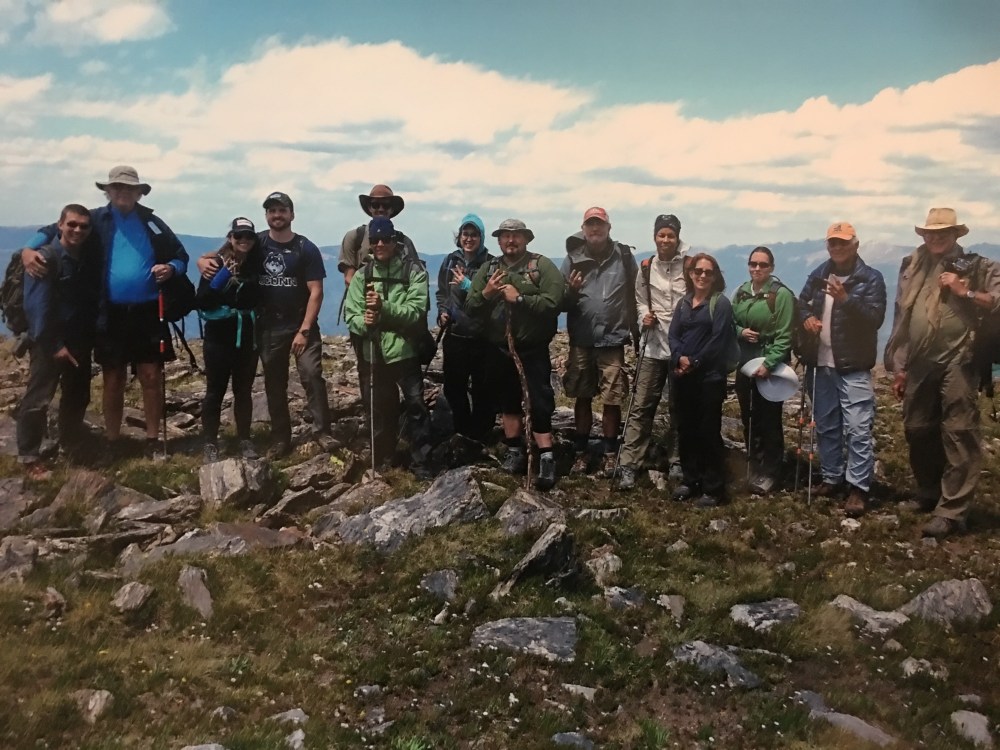
Most of our tribe out and about during our second hike.
One of the most important experiences I didn’t expect was the opportunity to spend part of my hike down from Margy’s Hut alone. Again, I would not describe myself as a nature person. I worry about bears. I worry about bee stings. I worry about getting lost. After stopping to photograph a few flowers (and ironically, a bee given my fear), I fell behind others in the group. Paul and I hiked down for a bit before he stopped to dawdle, as he indicated later to our group it’s something he likes to do, forcing me to go a stretch by myself. For that short stretch, I had to work on my confidence and along the way, I appreciated the little bits nature shared of herself. The air was perfect. I experienced quiet I haven’t known in years. The trail was overgrown in one area by flowers forcing me, against all logic, to walk through an area covered by at least a dozen bees. I powered through, giving them their space, and none attacked me. I was merely a visitor in their space except to the one bee who landed on my hand and I returned him or her safely back to a flower. The bees let me safely pass until I was reunited with my peers at the end of the trail, and we ended our ten mile hike down with a surprise visit by a doe eagerly eating clover along the edge of the parking lot.
This experience was an escape unlike any other.
The trip would not be the amazing experience it was without the contributions of my fellow veteran participants; Nancy Dallett (Assistant Director of the Office for Veteran and Military Academic Engagement at Arizona State University) for her efforts to bring the opportunity to us all; and everyone involved with Huts for Vets that I met on this trip (Paul Andersen, Erin Wilkinson, Tait Andersen, Jake Sakson, Col. Merrit, Dan Glidden, and Don Stuber). A special shout out also goes to our videographer, Krysia Carter-Giez. To watch her in action lugging her camera around during the hikes, standing on her feet for hours at a time, and her patience covering our interview sessions was incredible. I am a nervous interviewee, but she helped make this entire experience more comfortable. She is an invaluable part of the team whose presence behind camera probably does not afford her as much recognition as she deserves.
I will not forget the adventure I was afforded, and I hope by sharing a small bit of my experience, other veterans who could benefit from Huts for Vets would embrace the same opportunity to wander through the wilderness. Oddly enough, it was less wild than I expected; I (almost) felt right at home.
Things are going well on my end. I received my Huts for Vets reading packet maybe two weeks ago or so and with my readings complete, I am one step closer to this new adventure.
I was asked recently, why participate now?
I learned of Huts for Vets last year and as intriguing as it sounded, I knew 2017 wasn’t the right opportunity for me. There were some planned and unexpected events in my life going on around that time and I wasn’t sure the timing was right. This year, I had less obstacles in my way and I realized I didn’t want to say ‘no’ this time and come to regret it.
I follow Kirstie Ennis on Instagram and through watching her journey (She is a Marine OEF veteran with an above the knee amputation whose recovery has entailed numerous surgeries and setbacks.) I’ve been struck by the way I embrace challenges with a lot more hesitation. While I don’t desire to climb mountains (literally) the way she does, she inspires me to question my hesitation to step outside my comfort zone.
I love writing and there is a certain freedom to throw my heart and emotions out there behind the scenes, but I have a hard time in-person being the center of attention, even in group settings. I often feel challenged with the fact I don’t have a more substantial amount of time to pull together my thoughts in front of others. I don’t want my words taken out of context or to feel like I don’t hold my own in the group. Public speaking is not my forte; thankfully though, any discussions we have during the Huts for Vets are to be kept private. For this reason, I am more willing to go out there and take up this new challenge.
Although I’ve done hikes with my units in the Marine Corps, I haven’t hiked at elevation or combined a hiking experience with a literature discussion.
For me, there are two big pieces worth talking about prior to this journey: physical preparation and packing.
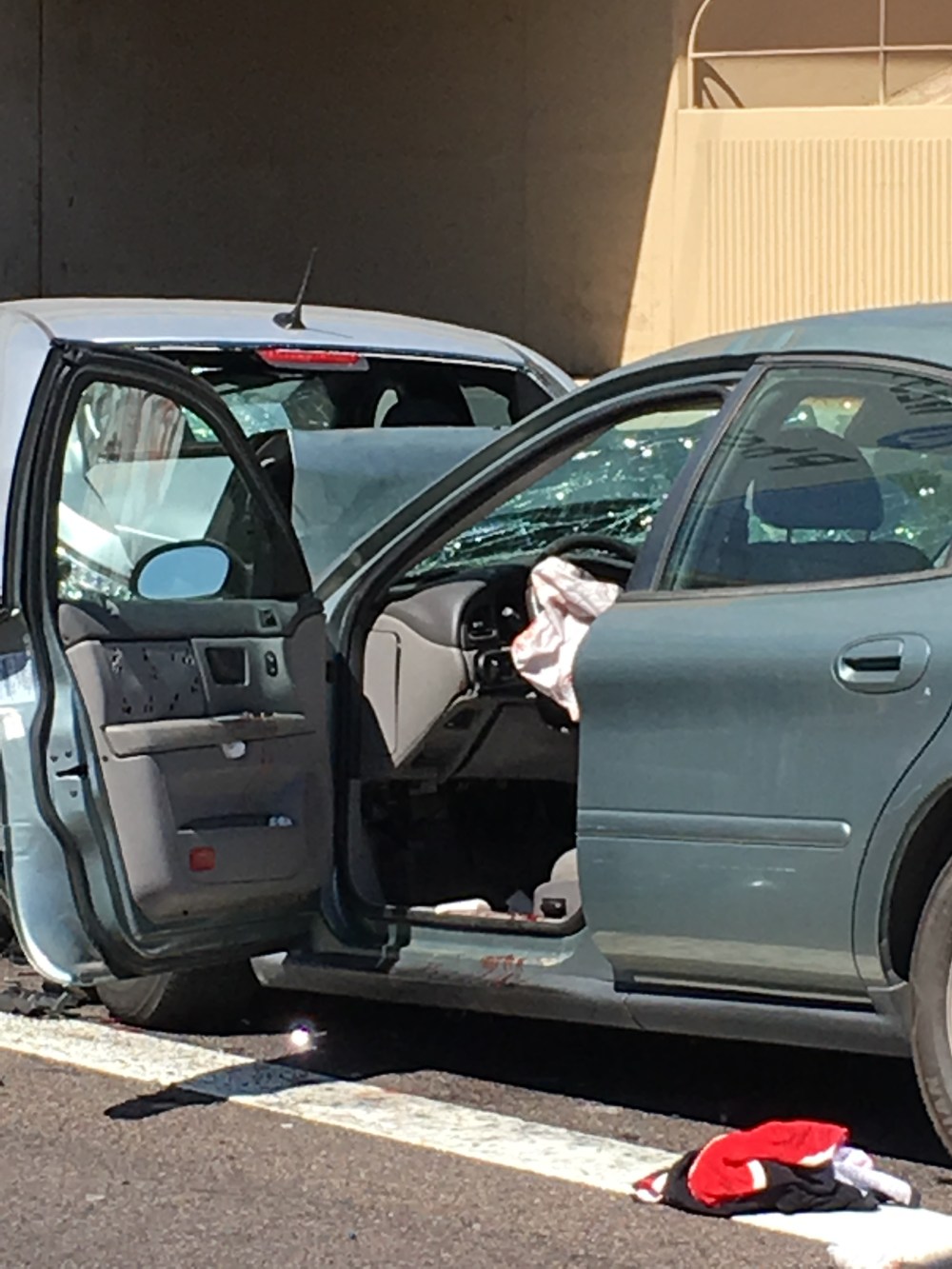
On September 24th, 2016, my family and I were involved in a five car pile up here in Arizona. I am grateful we were the fourth of the five vehicles, but this incident is a good reminder of why my service trauma is something to work on.
My view after we moved off to the shoulder and waited for assistance.The vehicle on the far left of the photo is the one we hit.The object on the ground used to be the rear windshield of the first vehicle hit.Close-up of the driver’s vehicle that started the pile up
I heard the sudden impact and tensed up prior to our car being hit by the vehicle behind us. My husband and daughter were more relaxed so thankfully they did not have any lasting issues from the car accident. I’m not surprised I tensed up; after dealing with mortar attacks on deployment, I find myself still unsettled by sudden unexpected noises.
My response during the impact has left with my back pain that continues to this day. (Don’t worry, this isn’t a pity me post.) It is improving, but it’s been a bit of a journey to get to where I am today. I had a lot of soreness the first week and fire-like pain throughout my back. The issue was made worse when I tried to carry my daypack with my laptop from the parking garage at ASU just south of my old office. Sitting or standing for long hours drove me nuts because it would exacerbate the back pain.
While I looked to resolve the issue without medical assistance, I started physical therapy November 2016 and it continued into December. January 2017 I started working out again but I lost of a lot of strength I had prior to the accident since I wasn’t working out. I was happy I could resume working out but it has been a process to monitor my actions. I still dealt with back pain every day and I was pretty concerned it might be something I was left with for the rest of my life (not so sound dramatic).
Earlier this year, I spoke to my nurse practioner about how a lot of the things I do to cope with my deployment-related anxiety are helping, but my back pain wasn’t resolving on its own. She recommended a chiropractor to me and I discussed with him my goal of completing this hiking trip with Huts for Vets. I knew it might not be realistic for it to be gone prior to the trip, but I was willing to try chiropractic visits to see if it helped.
I’m at the point now where I only go in once every two weeks. The back pain is no longer throughout my whole back and easily over the last month it has gone down from every other day to every few days. Today’s a bit of an exception since I started carrying boots and a 2.5 lb. weight in my pack to test out carrying some gear. I took some Tylenol earlier today and it brought the pain back down, so I added 9 assisted pull-ups into my “workout routine” across my 15 minute morning and afternoon breaks during my work shift.
Aside from getting my back pain under control for the trip, I also had the necessary task of acquiring hiking gear.
My new hiking boots were the single most expensive item. I picked up a pair of Oboz waterproof boots for $150 at REI. (NOTE: This post is not sponsored by anyone; I just thought others might inquire so I decided to share some details of what I purchased.) My husband thought with my ankle issues a mid-height shoe would work better and since the packing discusses it being a wet area, we opted to spend more for a waterproof shoe.
Most of my wardrobe is cotton-based fabrics so I picked up some performance fabric shirts on sale from Eddie Bauer and some items from REI. In particular, I love that REI has convertible pants in petite sizes. My main objective with the purchases was to find things good enough for hiking that I could incorporate into my everyday wardrobe as well so they didn’t sit in my closet like unused ball gowns.
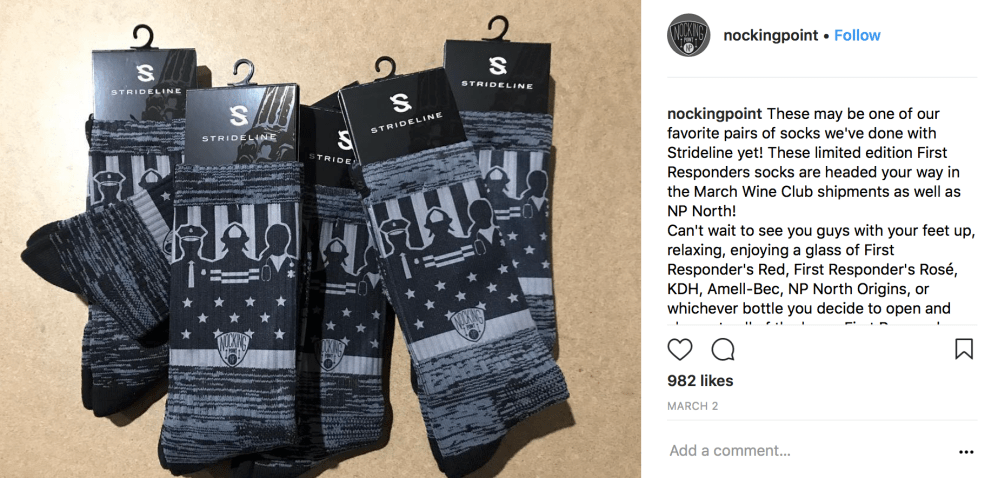
I was most set with socks. My husband and I are part of Nocking Point’s Wine Club and thankfully some of the boxes come with great Strideline socks. I had hopes I would still have some Smartwool mid crew hiking socks from my two deployments, but I didn’t. I think I may have given them away to family members that live in Wyoming because those socks really hold up.
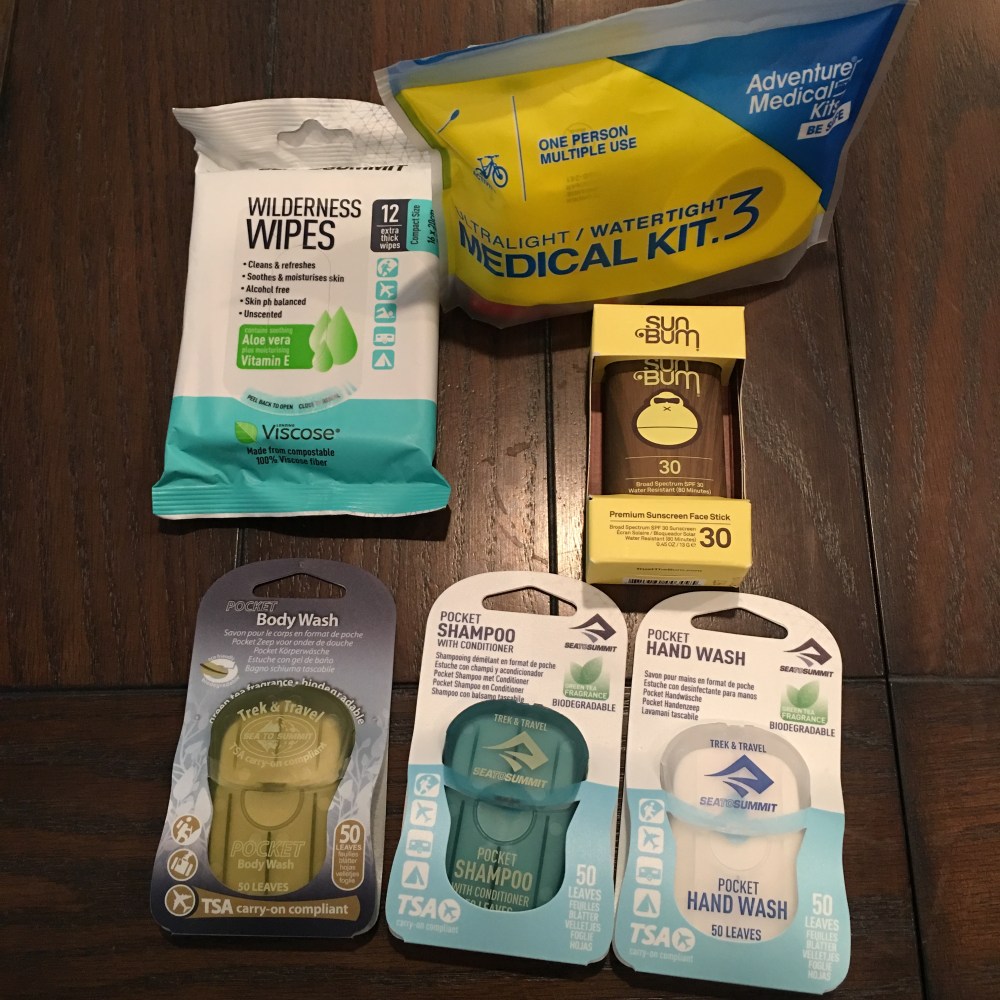
Anyways, aside from my love of the Strideline socks, there are a few other practical things I am bringing with me. I like that these items are a bit better for the environment and should make TSA checks easier at the airport. (I’m all for easier times flying.)
I’ll get you all updated as we get closer to the trip. My goal is to fit everything between an Osprey hydration pack and a small Osprey carry-on. I will not be bringing along a personal tent as I’m sure at the end of the day my back will feel better if I sleep in a real bed.
If you want to learn more about Huts for Vets, check them out here.
This entry is the conclusion of my “Boot Camp” series of entries and I hope you all enjoyed my behind the scenes sentiments.
I am glad I completed this journey as a way to honor my friend Bart after his passing. His mother sent the photo below to me while at recruit training. I know my experience does not make up for losing him, but it is important his dream came full circle. He wanted to go to Iraq, and by serving, I made that dream real.
Lance Corporal Barton J. Carroll
There’s not much I planned to write today, but I do have some photos to share. We had recruit liberty which lasted, if I’m recalling correctly, four hours. I know I should talk more about other things like the Crucible, but it doesn’t stand out in my mind as much as other things do. After being under the scrutiny of drill instructors constantly, recruit liberty felt awkward, but exciting at the same time. It was a small opportunity to explore the base. I think of things like this experience and the Warriors Breakfast and having makeup classes (yes, we learn how to wear makeup to complement our skin and uniforms!) that are worth discussing more than being frustrated, exhausted, and annoyed during the Crucible.
My apologies the photos are not dated, but I took them with a 35mm camera and never wrote any captions in my scrapbook to better contextualize the experience.
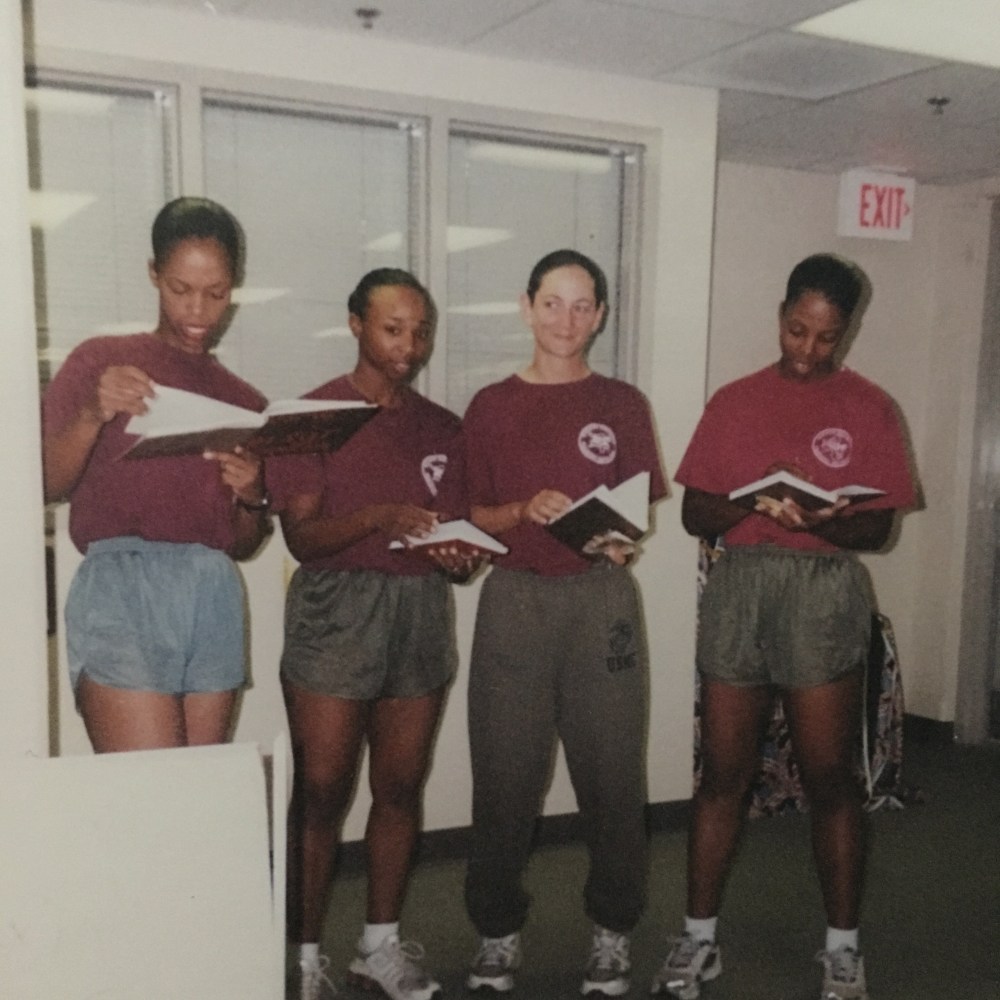
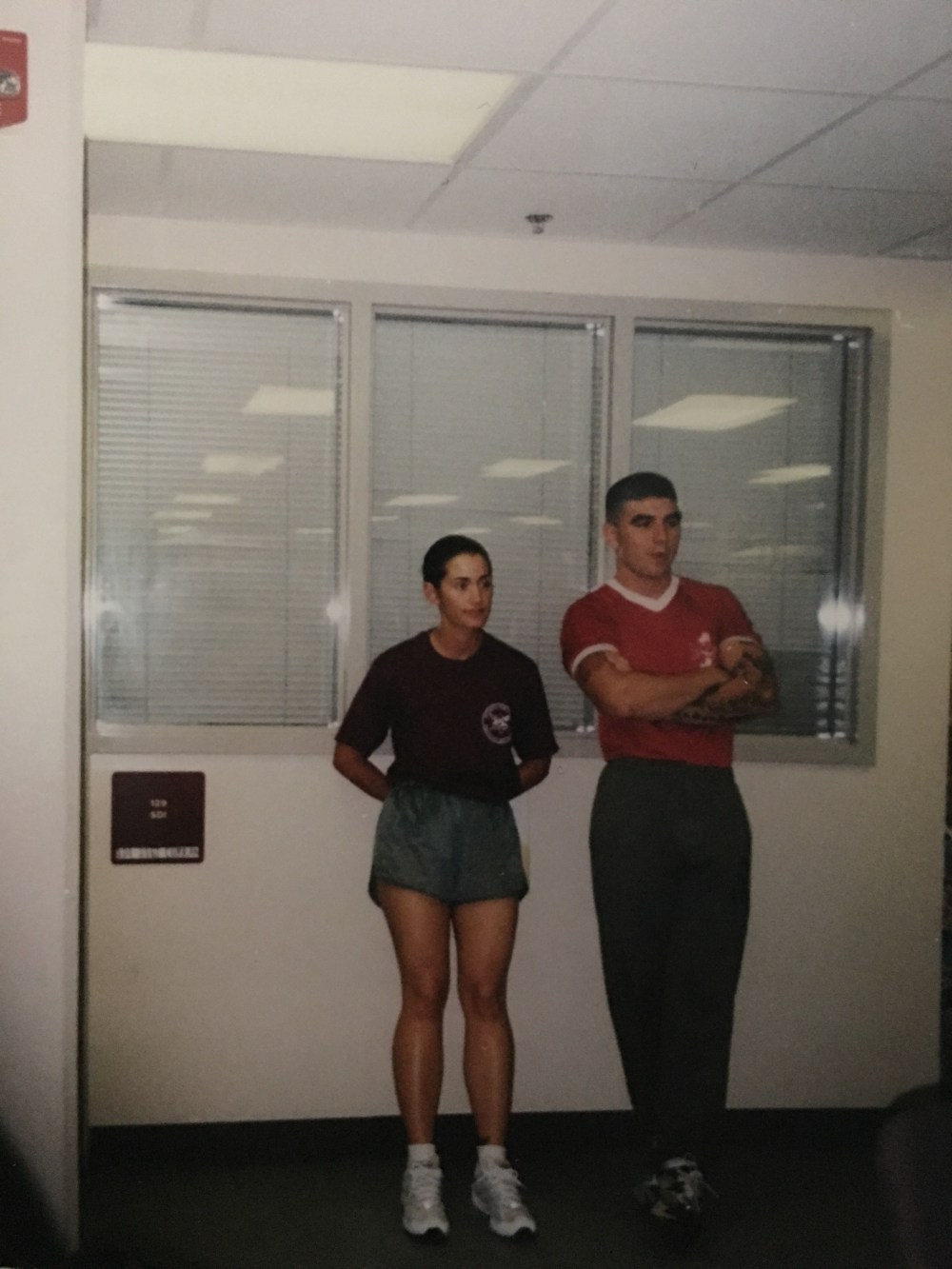
Our Senior Drill Instructor SSgt CurranThese women did not have an easy job as drill instructors. Their billet is one of the hardest (and most coveted) assignments in the Marine Corps.Tucked in the middle and super serious in this group photo.Our Senior and her husband, also a drill instructorI’m on the far right and as you can see the footlocker at the end of my bed is not very big. Nearly everything I owned at boot camp fit into the locker.
When we had our weapons, they were slung over the end of our bunk beds with a cable through them and secured by a combination lock. In one of my letters home, I discussed my combination lock being taken away; this event happened because I failed to double check my combination lock was secure. Small mistakes like these are things you pay for and I learned to be better about checking my items.
4th Battalion, Oscar Company, Platoon 4030
After recruit training, I went on to Marine Corps Combat Training and later my Military Occupational Specialty (MOS) school at Fort Leonard Wood, Missouri. Of my fellow recruits, one was also at Camp Blue Diamond with me. I ran into another during my second tour in Iraq at Camp Al Asad. The third worked at the mail room at Marine Corps Air Station Miramar.
I was very proud to graduate even if it was as a Marksman (that “pizza box” on my uniform), not a Rifle Expert.
That large smile on my face is less about leaving recruit training but everything to do with being surprised to see my dad. My maternal grandmother and her boyfriend came to my graduation but my dad had let on he was at court during my graduation. Back then, he served as a police officer so the reason sounded pretty valid.
Earning the right to be called Marine is something I’ve never regretted. The events that came later weren’t all great, but becoming a Marine is one of the best life decisions I ever made.
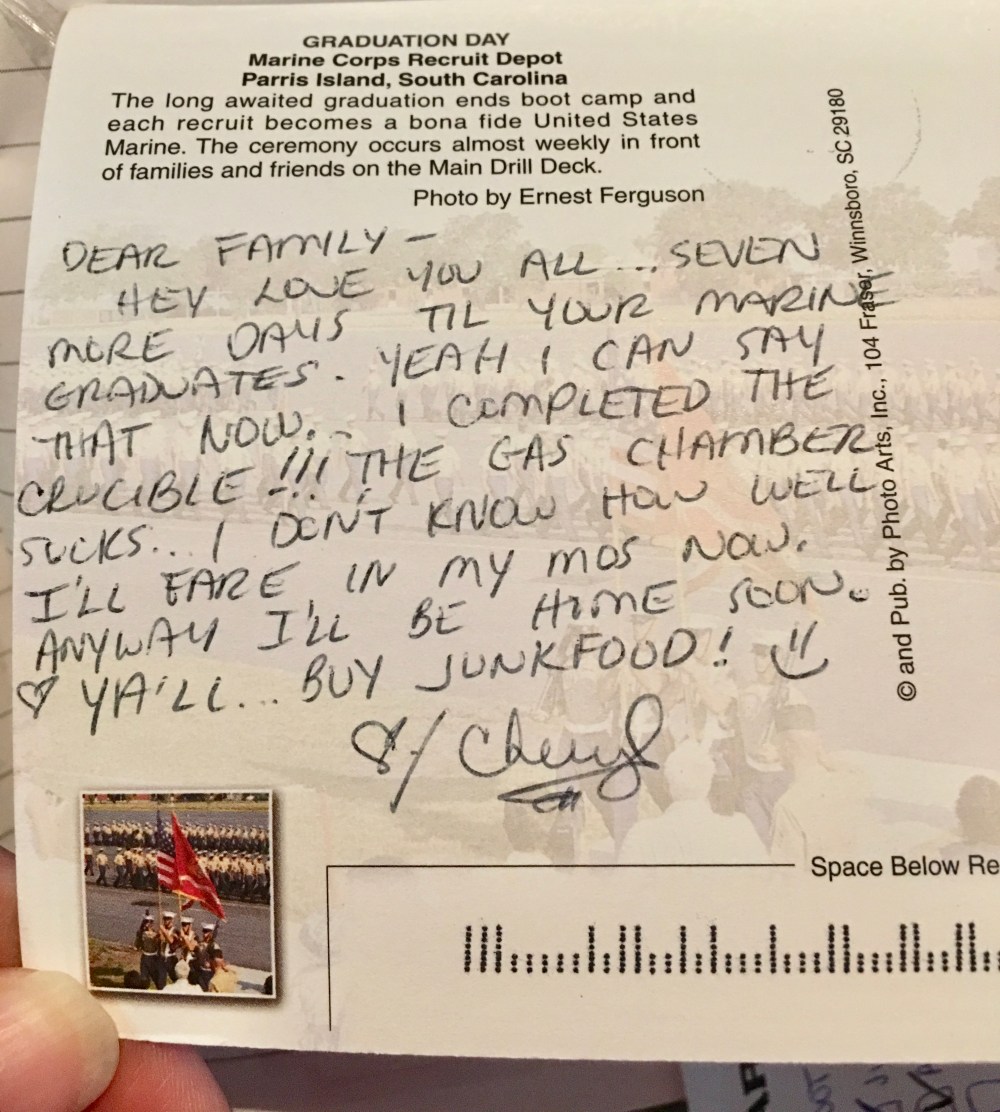
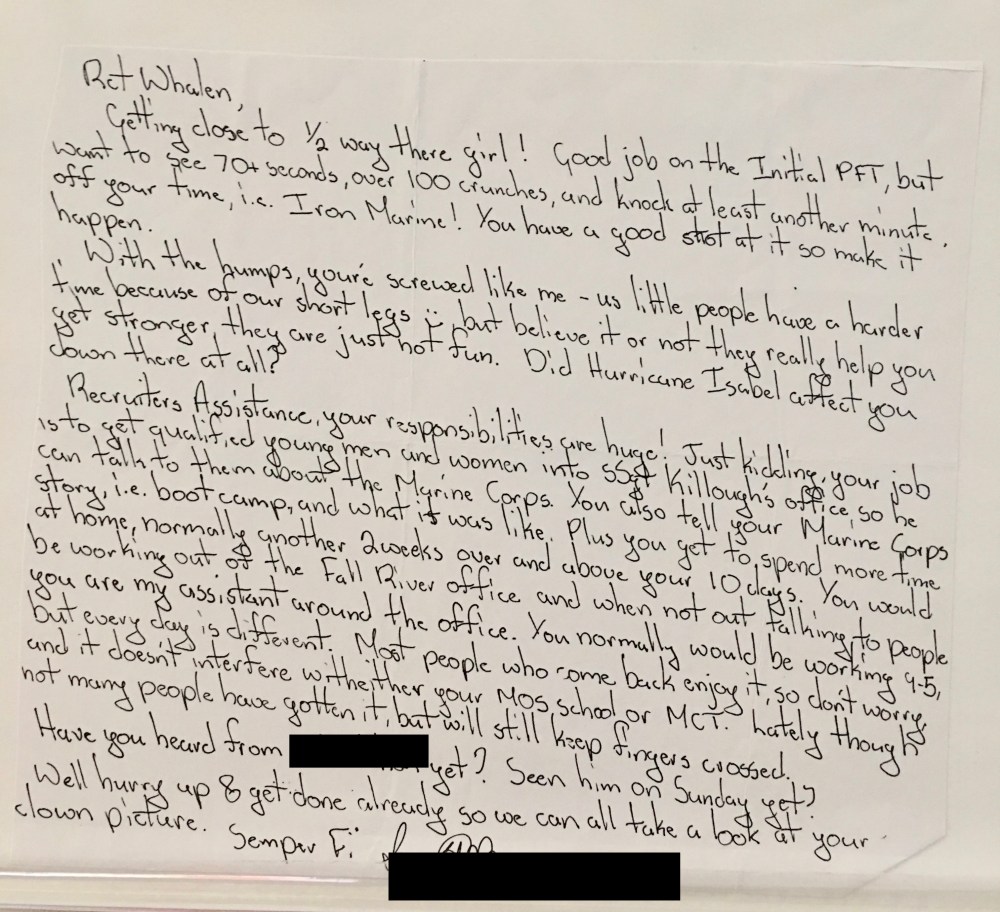
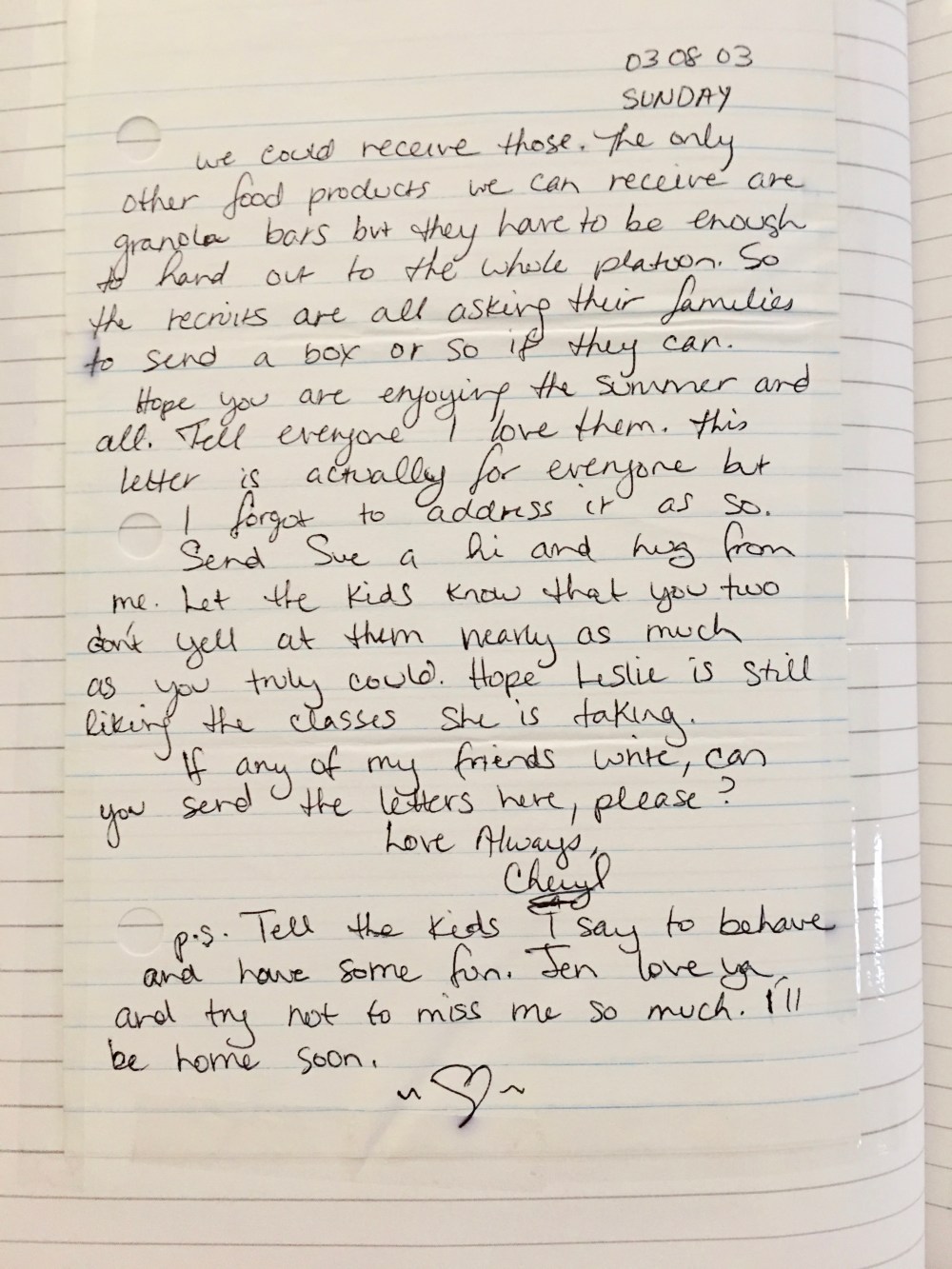
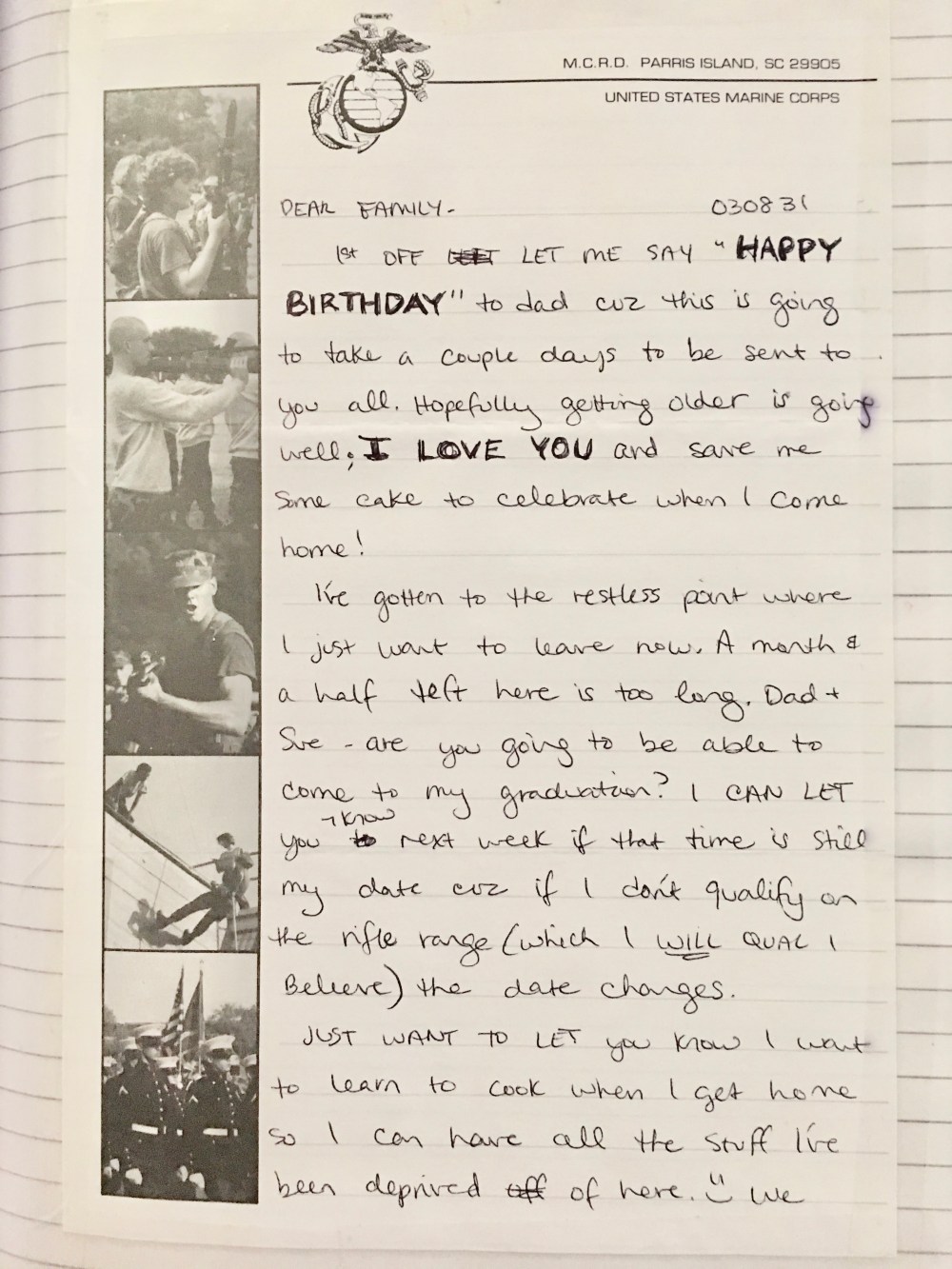
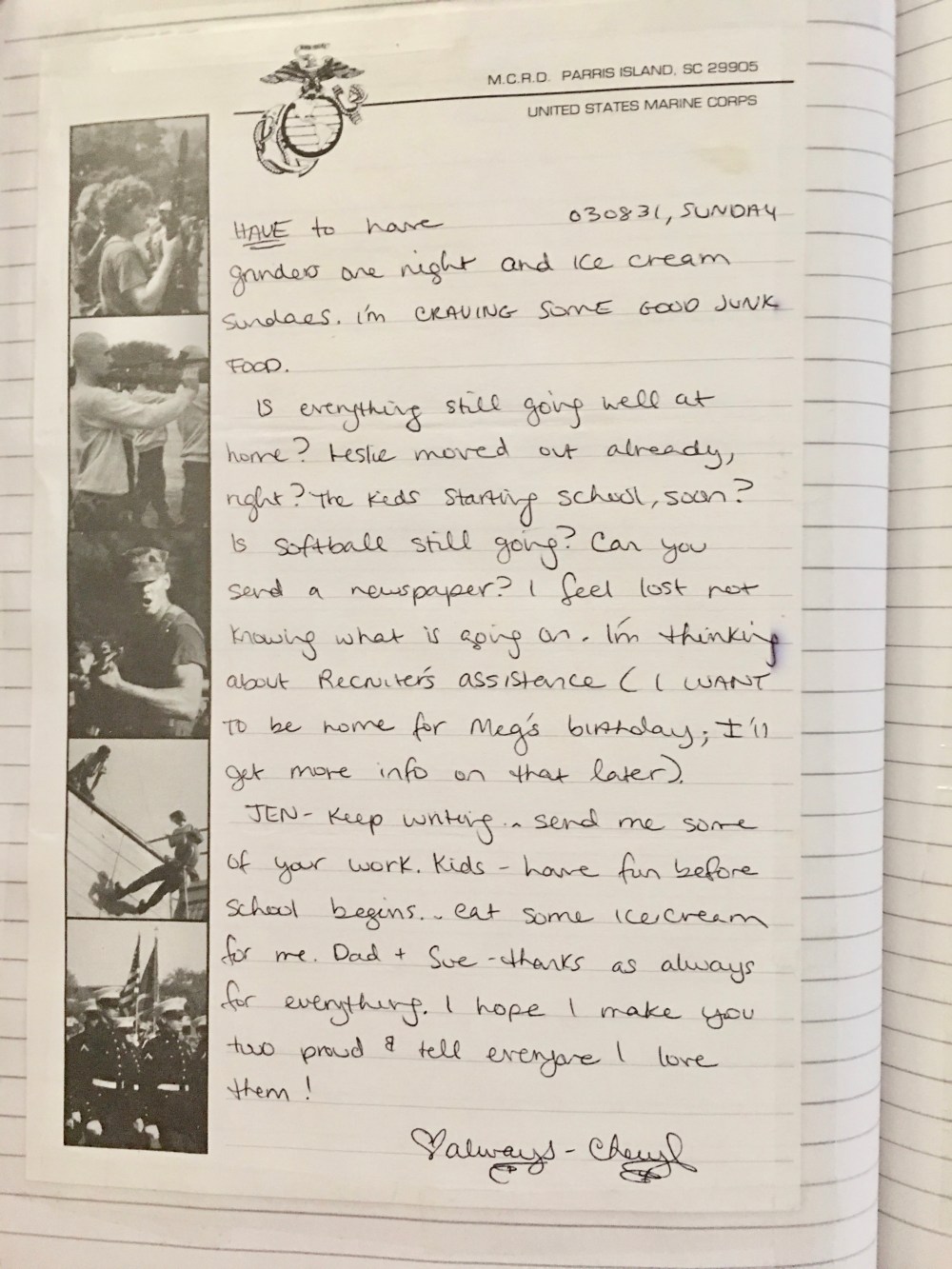
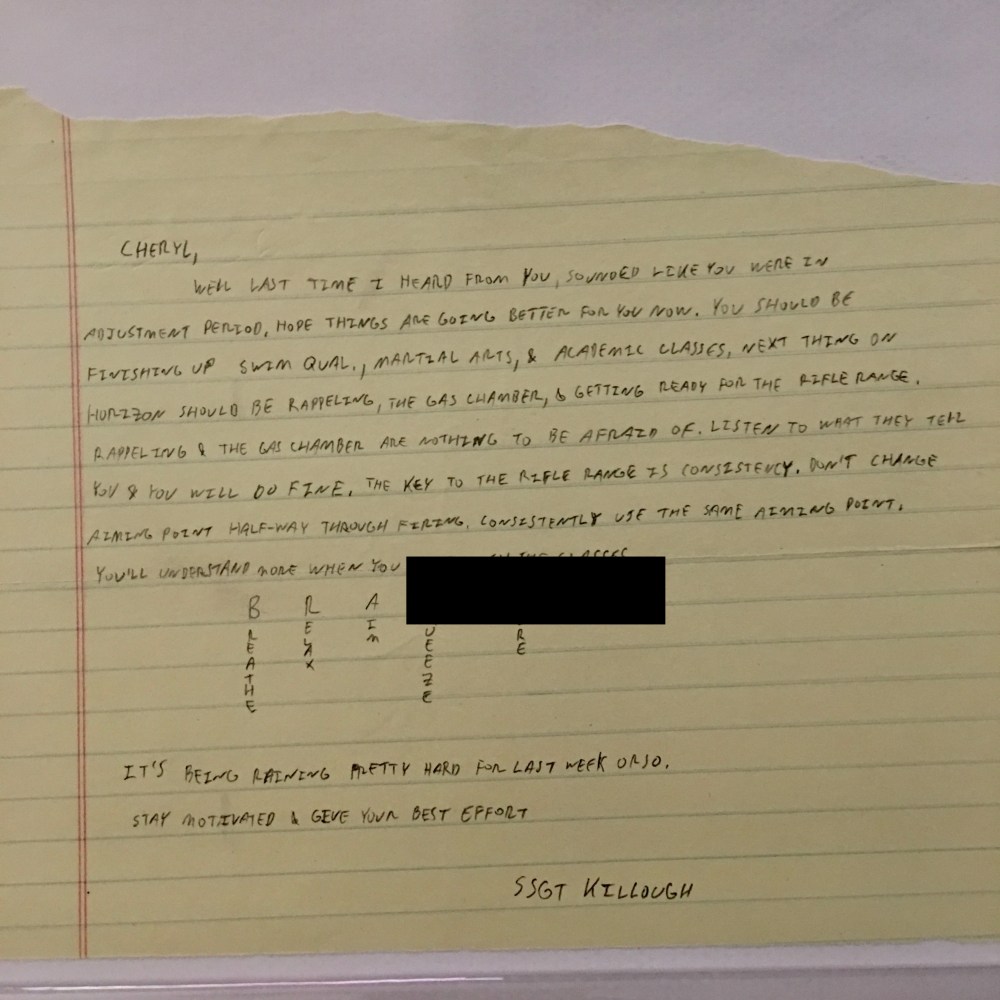
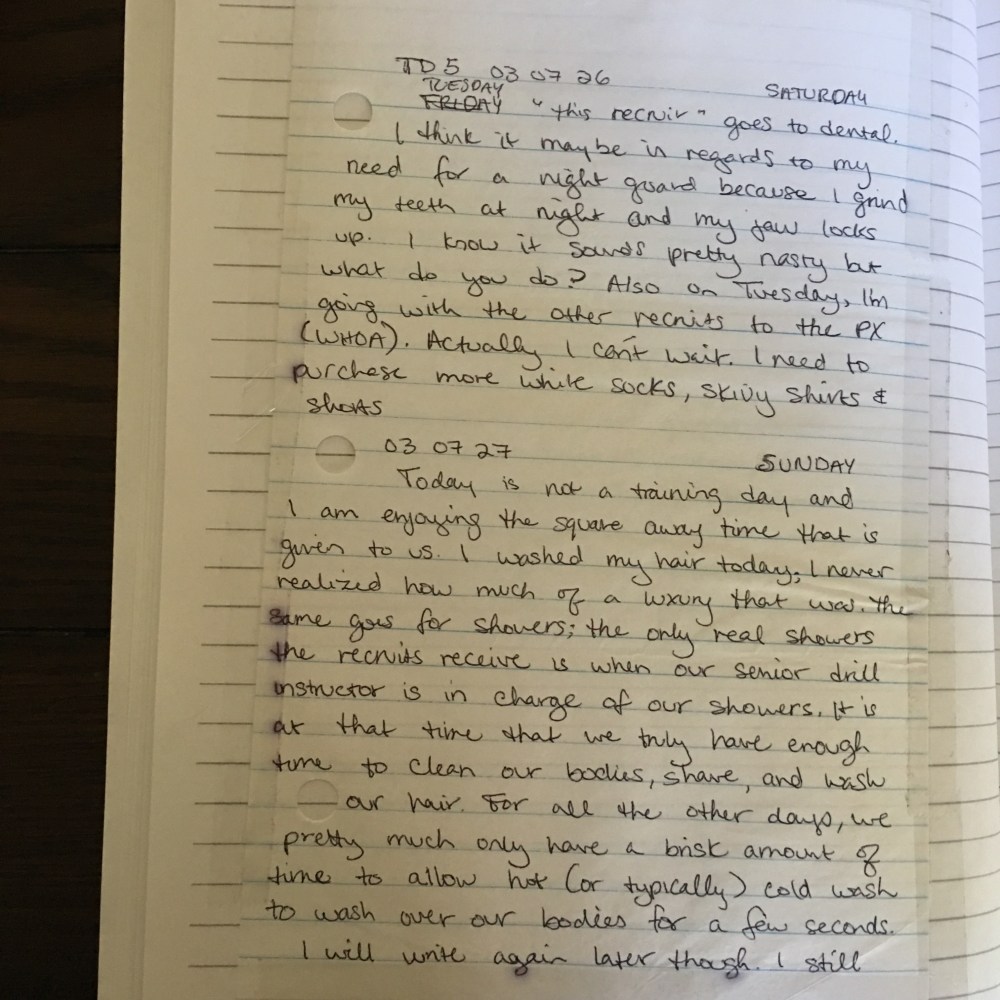
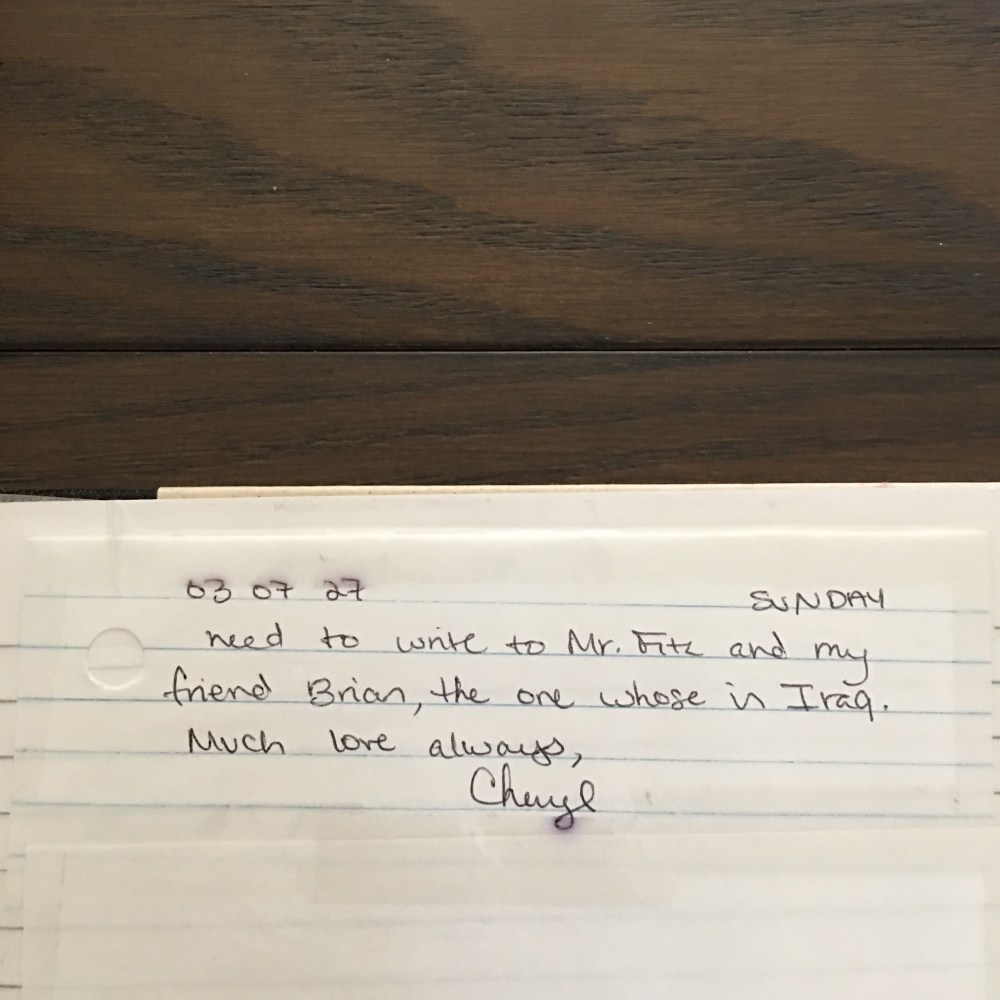
A funny thing happened in September 2003. I didn’t have much to say to my family back home. It’s kind of odd but maybe I wrote more letters to friends and extended family? One of the recruiters sent me the above letter, but in my trove of boot camp things, I didn’t have much to say at this point in my training to my immediate family.
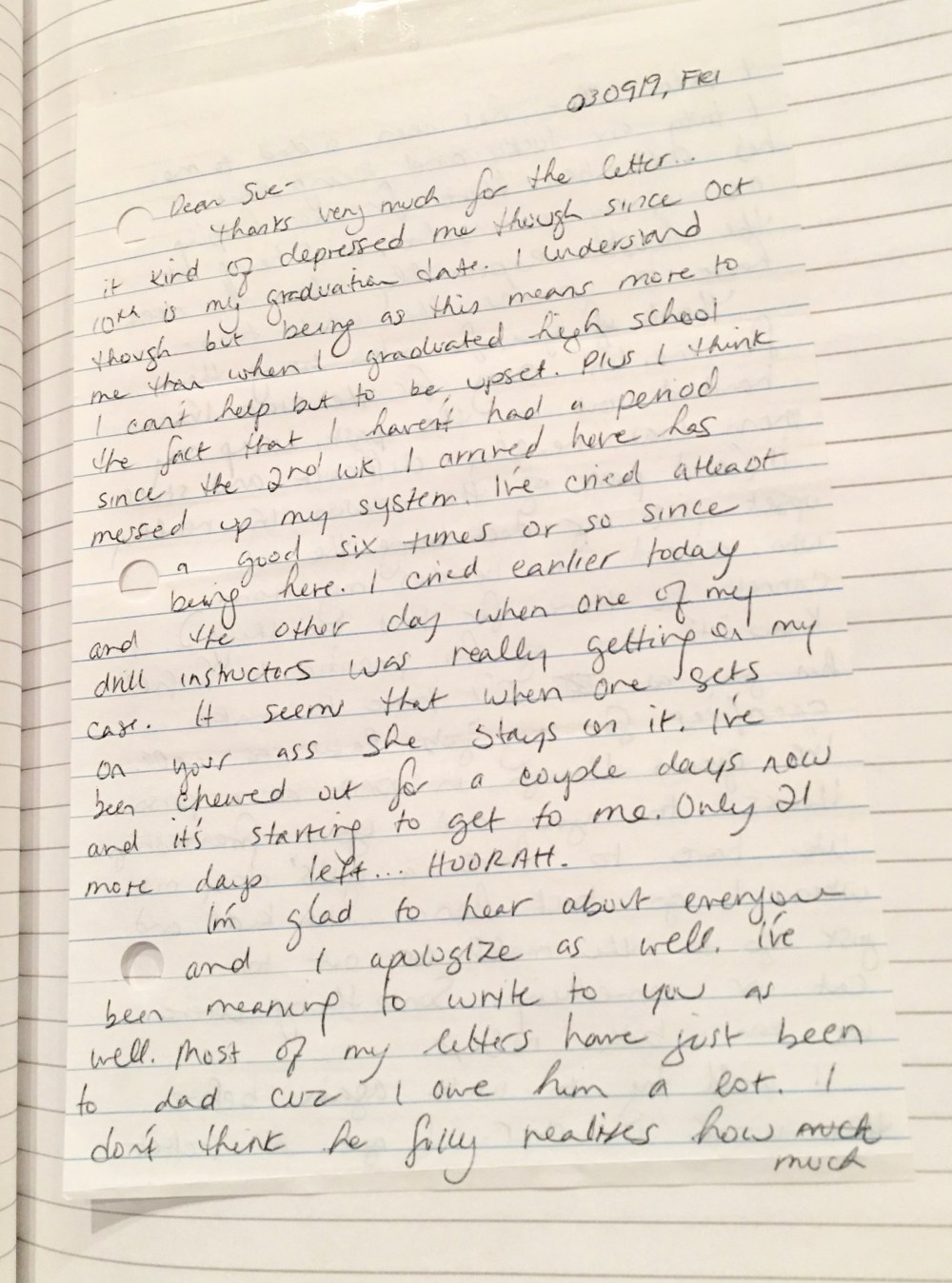
What’s pretty funny is that I basically forgot what I wrote in the first letter and repeated myself in my second square away time. Can you say I was probably pretty sleep deprived?
And that love affair with sweets…it’s never gone away. I had a caramel pecan cookie and a red velvet cookie today from AJ’s Fine Foods. Yep, I like my sweets.
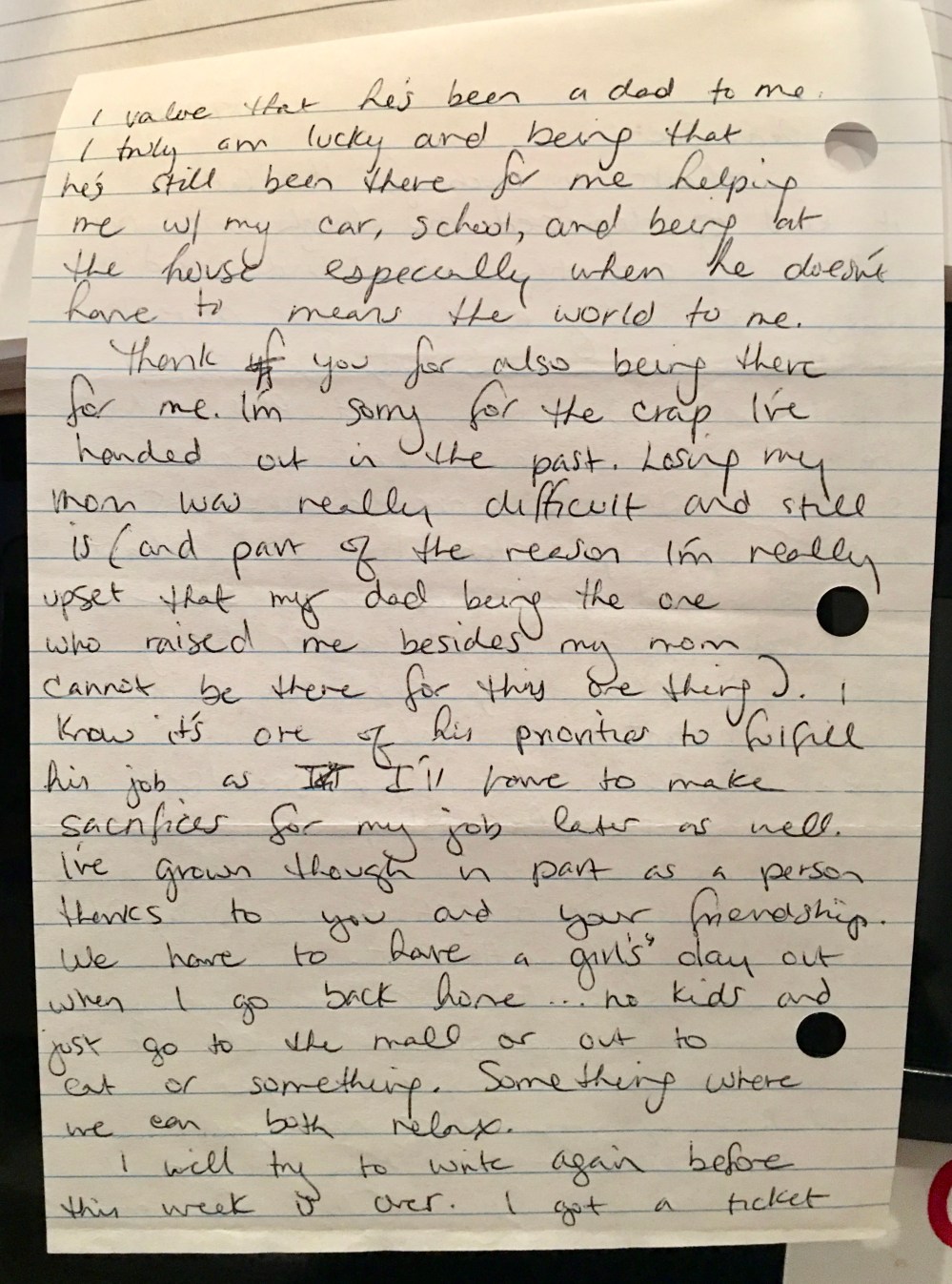
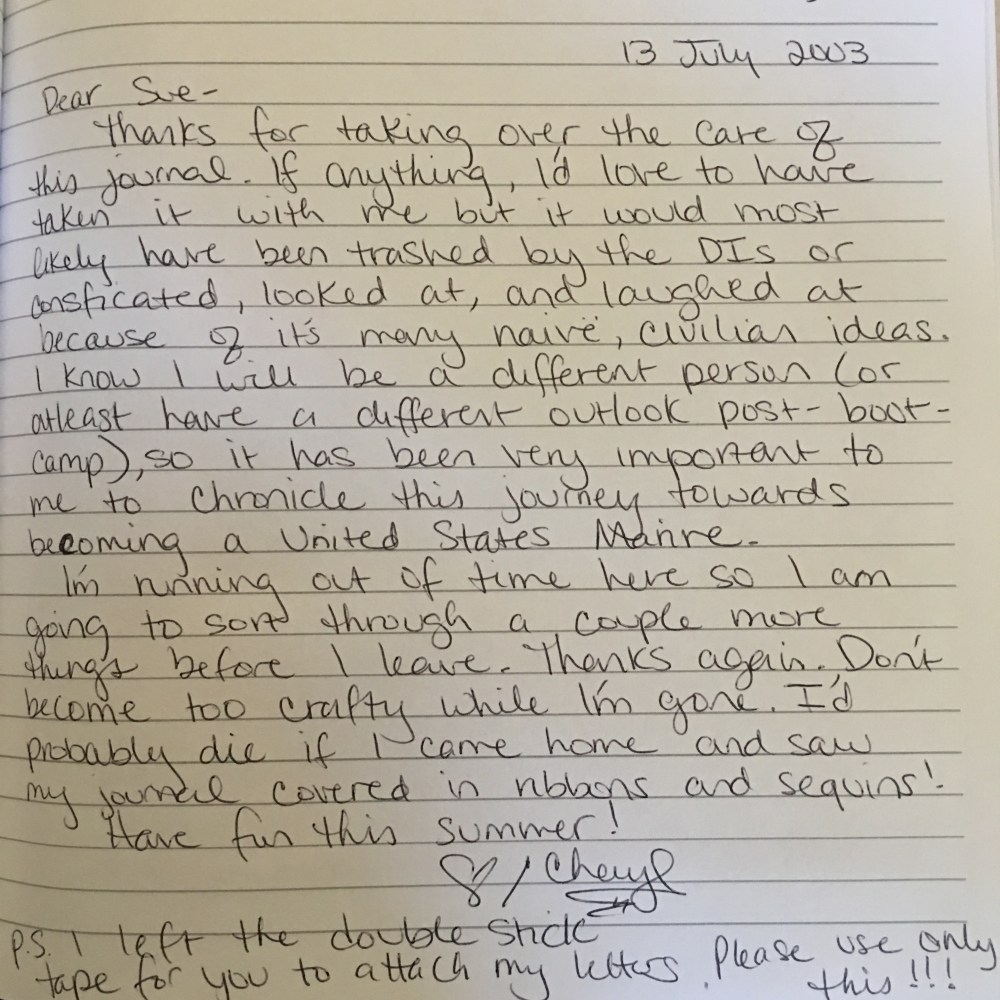
To give you some background on my letter below, my parents tricked me and told me my father would be unable to attend my boot camp graduation. My mom passed away my last day of sophomore year in high school and Sue is my stepmom. This quite personal letter to her is something I was originally on the fence about sharing, but it an important part of our relationship. I also think because I talk about being emotional the letter is something others should see about recruit training.
It’s a significant difference to go from an academic environment that encourages a lot of individual success to a culture that requires others to work together. The individual differences we bring to the table aren’t all great. We must recognize those selfish attributes we carry and be willing to work towards self improvement. It’s humbling, but we find better opportunities and partnerships when we make those conscious decisions.
My little one is spending her evening with my in-laws so I’m free to write earlier than expected this week. More than normal, I am ready for the weekend. I finished my third course for my Master’s in Public Administration. I enjoy the privilege of higher education, but I miss my free time for personal writing and I’m need more physical fitness preparation for my upcoming Huts for Vets trip.
In my boot camp scrapbook I found a few letters from my recruiter. I think these are worth sharing as well, with some censorship.
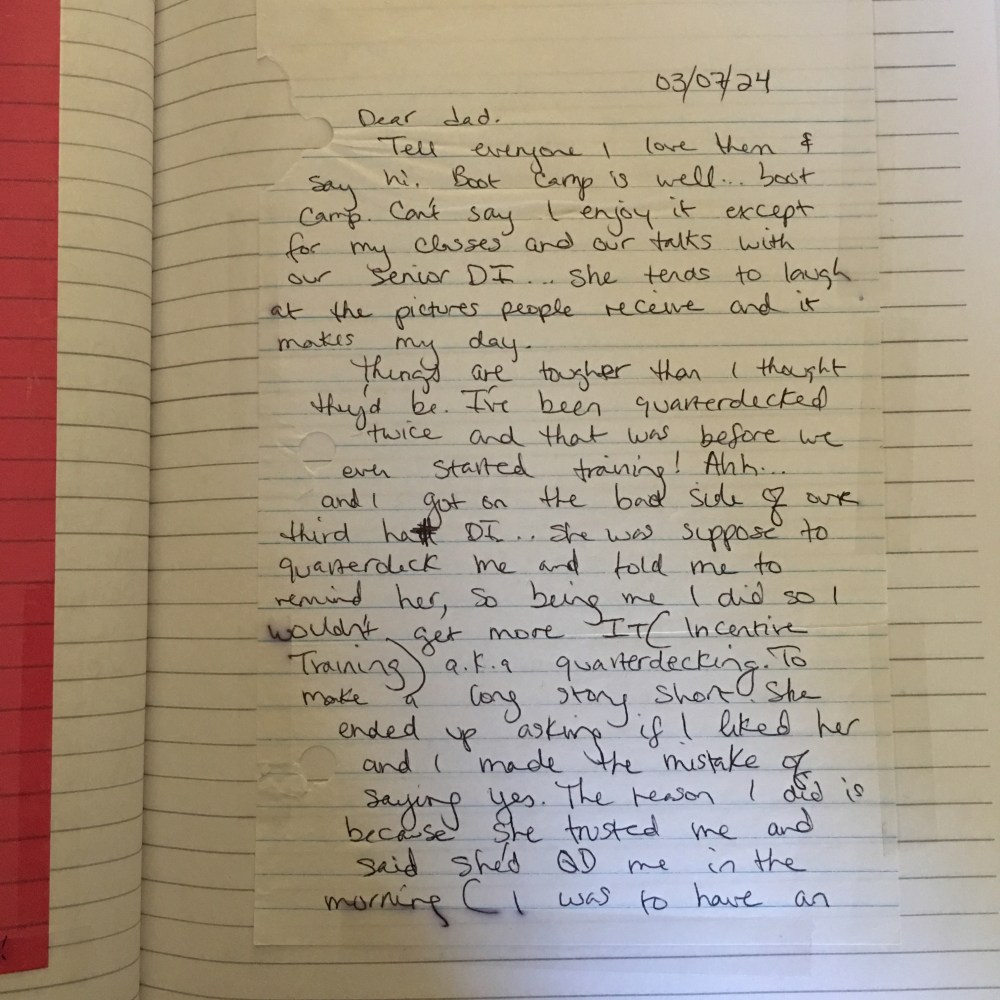
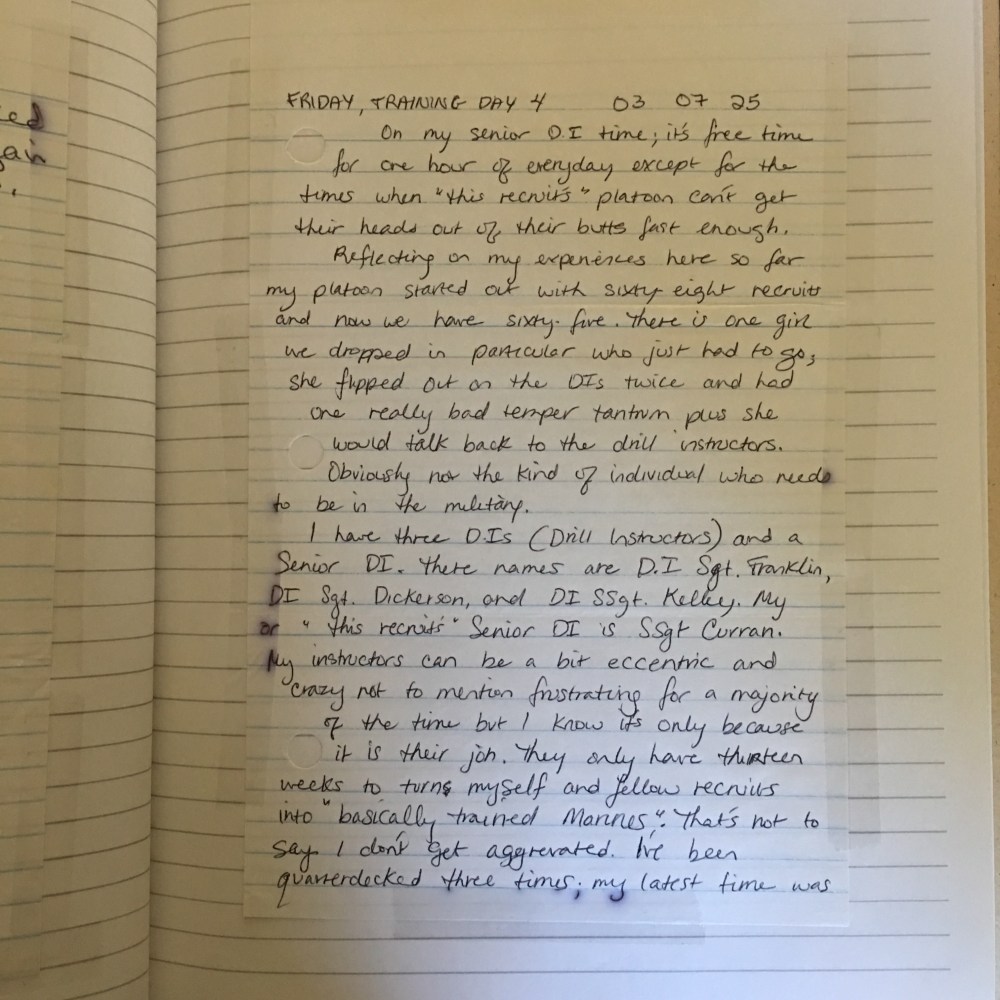
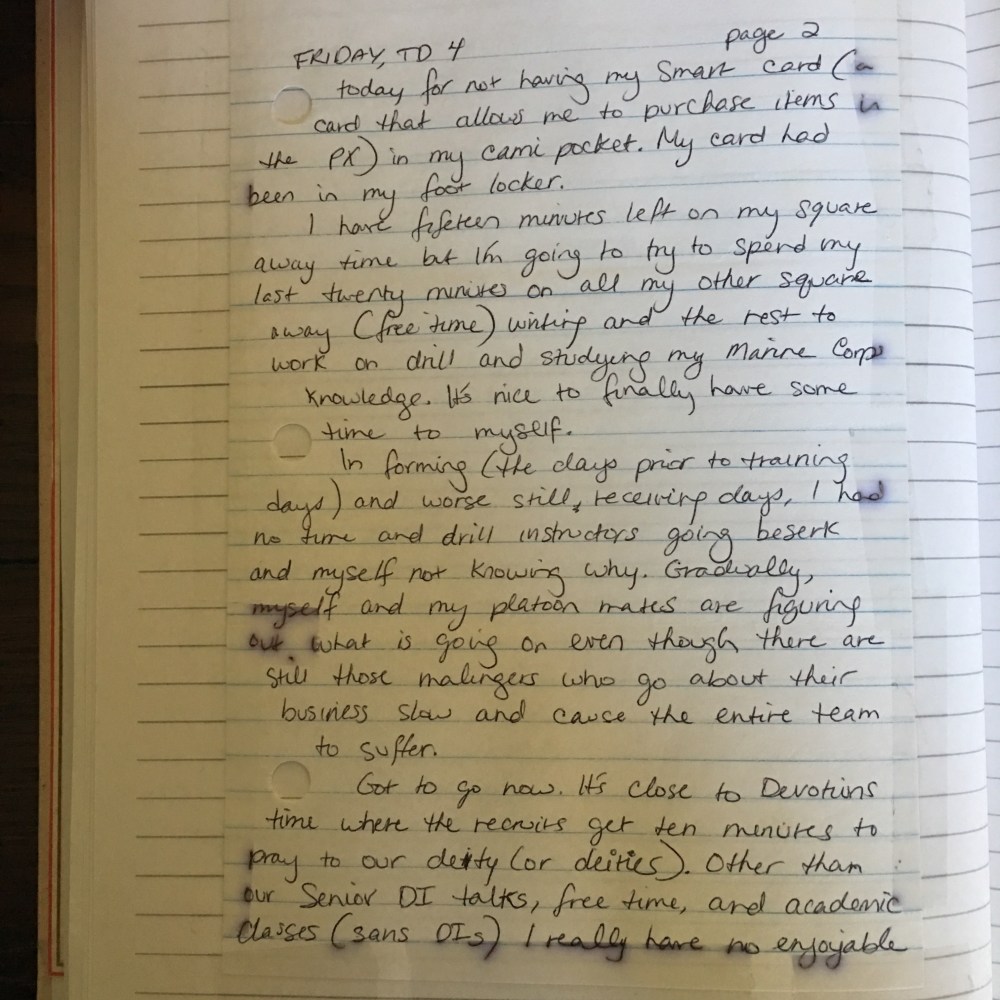
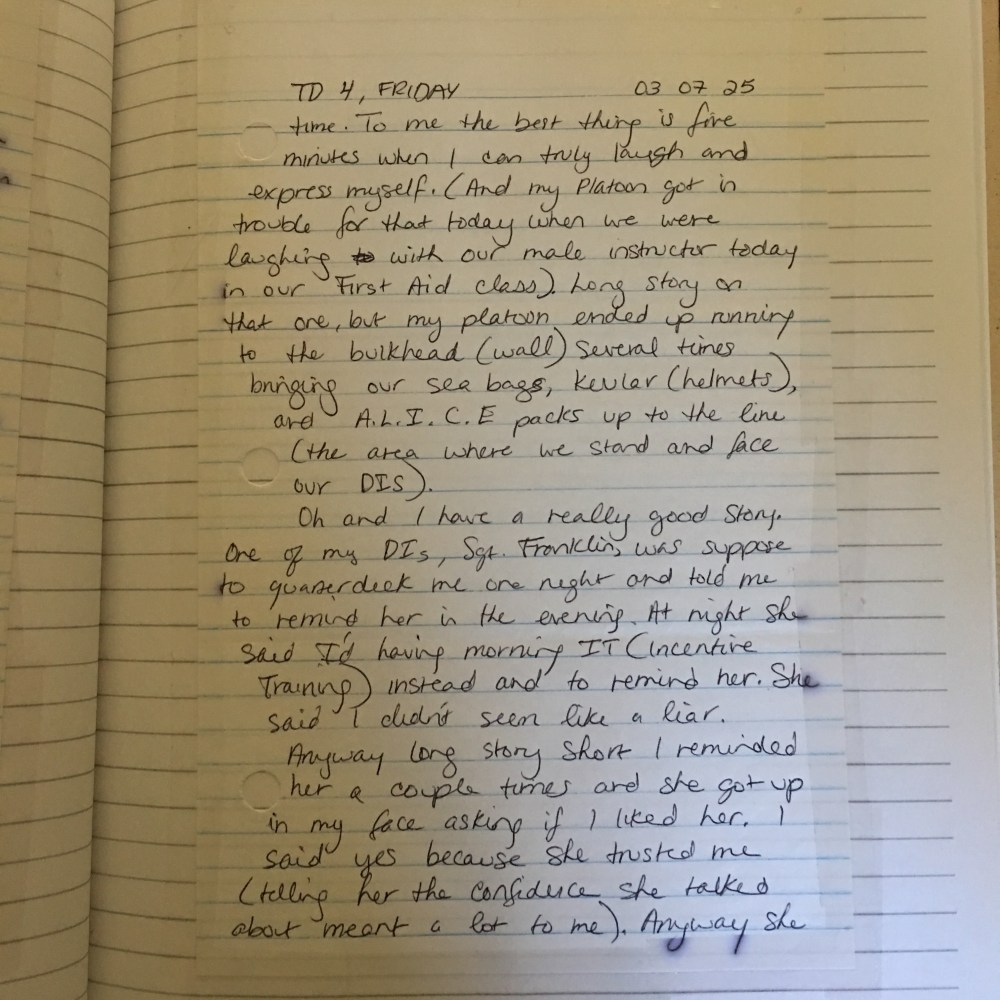
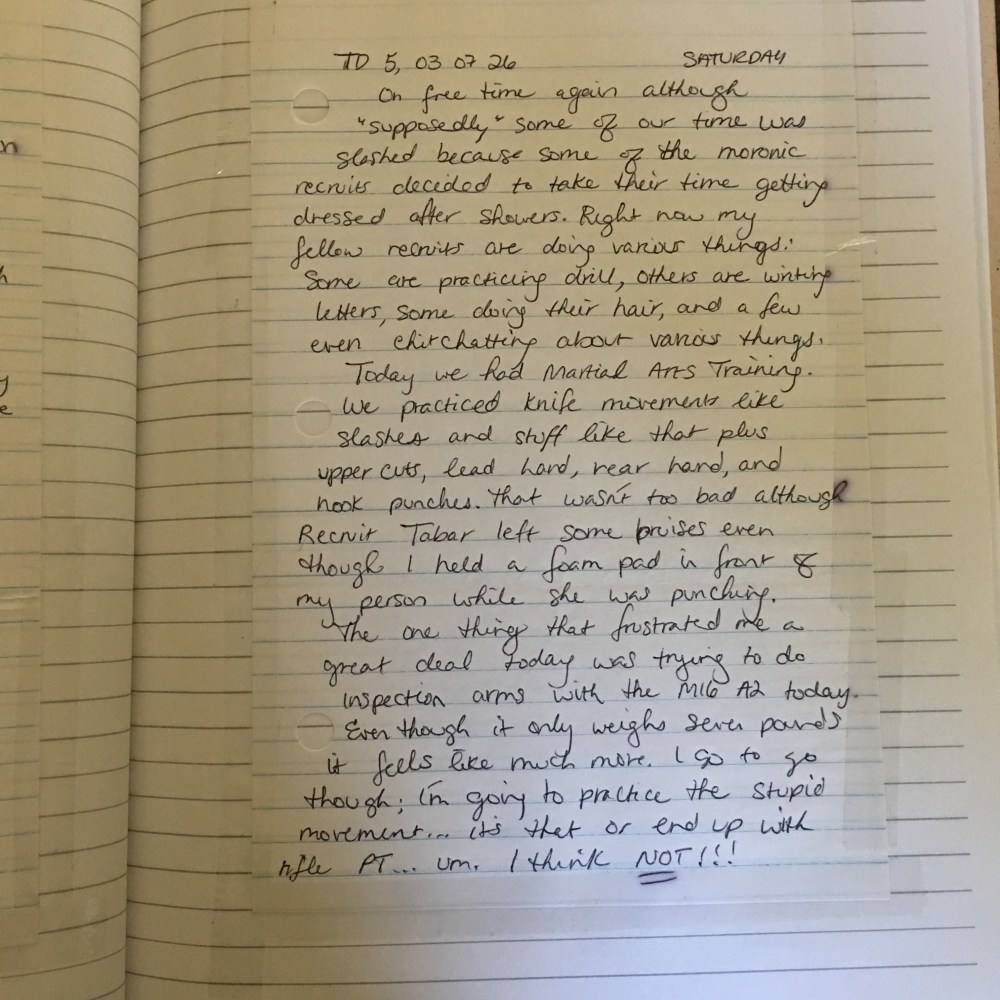
My boot camp letters are a good indicator I was not nearly as dedicated a recruit as I should have been, but no changing that reality now! As a parent now, I think my behavior was much like how a school age child feels at the end of the day. I was not fond of doing yet more training, ever.
It’s funny to see my comments about getting sealants on my teeth. Later after I separated from the Marine Corps, my first civilian dentist was surprised I had them.
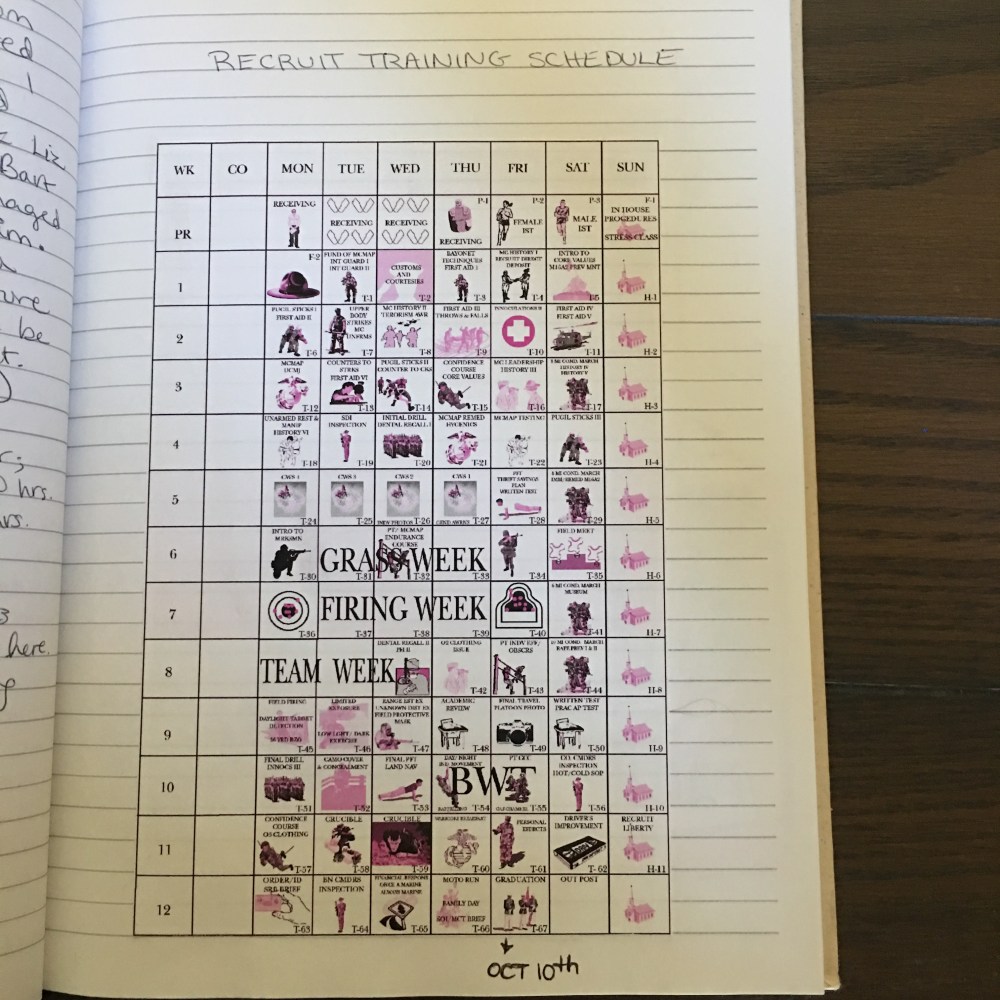
I think, with the exception of my strong running background, I was quite the average recruit. I wasn’t great at a lot of things, and like many, I had to confront a variety of fears during training. Swim week was a challenge. I was terrified to jump off the high dive and I haven’t chosen to jump off a ten foot high tower ever again. (I also was a chicken for the rappel tower later on in boot camp.)
It might sound funny but I remember a lot of every day moments more than specific training requirements. We had a storage closet and as a team were tasked–using our money–with keeping it stocked. We cleaned our floors with liquid laundry detergent. In lieu of using mops we stood on towels, scooting along the squad bay, and scrubbed the floors this way; honestly, I like this method and continue to mop my house this way since it’s easier on my back than using a mop.
At some point, someone can up with the ingenious idea to purchase Ziploc bags and stored their items in multiple bags inside their foot locker. I liked the idea and followed suit but it didn’t seem like much time passed before our drill instructors decided when we had to empty our foot lockers, we had to empty out the bags, too. So much for saving time!
Getting dressed “by the numbers” was annoying and hilarious at the same time. Trust me, it looks rather ridiculous to have sixty odd people struggling to get into their clothes. I had moments of frustration when I was ready before others and moments when I was embarrassed to be among the last to complete the task. More than anything, I felt like quite an idiot at times trying to dress quickly following our drill instructors’ orders, but at the end of the experience, it’s just a small step in our lives. We learned a lot of traditions and developed new skills, we tackled some fears (even if those fears did not not go away), and we improved our physical fitness.
Boot camp was a time away from our normal bad habits. I didn’t have regular access to snack foods and for anyone who smoked before recruit training, there was no smoke breaks. We couldn’t eat any time of day that fancied us; we had breakfast, lunch, and dinner. Our greetings were means to reinforce that we’ve eaten our meals. You don’t say good afternoon until after you’ve had lunch and good evening after eating dinner. This habit is something I stopped doing after boot camp; I just use noon at my delineating measure for starting my “Good afternoon” greeting whether in-person, over the phone, or in my emails. I am less rigid about when I start saying “Good evening” to people. I think I have a tendency to start saying it around 5-6 p.m.
Maybe it’s not too noteworthy, but I kind of like seeing when postage was a bit cheaper.
I have one more Boot Camp Letters entry for you coming up soon and then a separate entry with boot camp photographs. Stay tuned!
I’m procrastinating like any good college student as my class enters its last week today. As such, I figured I’d do something else equally valuable and share some things from boot camp with you all today.
I truly enjoy sharing old stories and photos so that they can serve a purpose to someone else and I think it’s good for people to see some transparency regarding recruit training. My experience is not like the movie “Ears Open, Eyeballs Click” but if you get a chance to watch the movie, please do so. I find it utterly hilarious. It’s a good reminder boot camp has some ridiculous moments and I laughed so hard at some points in the movie I had tears streaming down my face.
Moving on….
The nerd that I am, I kept a journal during my preparation for boot camp and asked my family to hold onto my boot camp letters. My stepmom had the responsibility to keep these in order and she did a great job not decorating my journal, as I feared, in my absence.
I imagine a lot of people are better prepared for boot camp than I was, but some of my high school athleticism worked out in my favor. Running, a constant PT activity in the Marine Corps, is something I was used to but the flexed arm hang was one of my weak areas from the very beginning.
I’ve always been that awkward introverted nerd and I won’t say the Marine Corps beat it out of me. Over time, I just found people I got along with, but I felt like a fish out of water at boot camp. There’s a lot of stepping outside one’s comfort zone. Personal space is not really a thing and for someone as private about their body as I am, it’s awkward to shower in a communal setting.
I don’t mind admitting I’m an average person who decided to become a United States Marine. There are other people who run with the idea and become the best in different areas of Marine Corps life like the person who always rocks a high 1st class PFT (physical fitness test); the person who always shoots expert; the person who always knows everything. I was never one of those. I decided to serve in honor of my late friend, Lance Corporal Barton J. Carroll, and it didn’t take long to figure out, I had no idea what I signed up for but I committed to it and I was going to complete that obligation.
I am not surprised I barely spent any time writing to my family about what boot camp was like, but more so on what I didn’t care for and the things I appreciated. These simple things remind me that I love focusing on relationships rather than achievements. I’ve never enjoyed being the center of attention and it’s kind of comical to see how much I tried to hide in the background of boot camp as well.
I was quite content to try to not be noticed. I wanted to observe and learn, but mostly to pass under the radar.
I don’t remember the process of receiving all that much but bits and pieces. The drill instructors took away a lot of things individuals brought with them like makeup and hair appliances (Why someone thought they could bring that to boot camp is beyond me as is the makeup. Our need for feminine hygiene products didn’t last very long and most of us only had one cycle through the three months of training. Our civilian clothes were placed into brown paper grocery size bags and returned to us at the end of our training. I still remember the fact I wore a short sleeve baby pink color t-shirt and jeans. My recruiter did a good job reminding us to take as little as possible with us and to dress comfortably.
The new clothes we received, and purchased with our own money, required marking. We had stencils and marking tape to mark all sorts of items we wore: sports bras, underwear, socks, shirts, shorts, camouflage tops and bottoms, and boots. I can’t remember my thoughts on clothing issue for our dress uniform items other than being grateful one set of trousers was left a bit loose; it really helped out when I decided to eat a lot of junk food at Marine Corps Combat Training (MCT) although it was a pretty poor decision to undo my mostly healthy eating habits from boot camp. The other uniform items were marked as well once in our possession.
Basically, you need to mark your sh#t. It’s a requirement. Drill instructors will notice it if it’s not marked or that marking tape starts falling off. I got pretty lazy about marking my stuff later in the fleet with the exception of Corporals Course since there was an inspection.
Last thoughts though before I end here for the day. I never shot expert on the rifle at boot camp, or any other part of my Marine Corps career. I was a sad little marksman the whole time, but at least I learned a new skill. One of these days my husband and I need a trip back to the rifle range; I haven’t shot in years, and it would be nice to pick up a rifle and shoot better than I did in the Marine Corps. If anyone will help me get there, it will be my husband. I shoot the rifle left-handed and he’s the only left-handed rifle coach I’ve ever met; it’s a real shame he wasn’t on the rifle range with me in the Marine Corps.
(Sorry for the serious detour towards the end of this entry; can you tell I reallydon’t want to do homework right now?)