

I inadvertently picked up a few books that happen to be good reference materials to share this month: September being Suicide Prevention and Awareness Month. Each pulled my attention for different reasons. Kikuko Tsumura’s There’s No Such Thing As an Easy Job for the protagonist’s quest to find a more meaningful job after being burnt out in another (who hasn’t been there before?!). September Letters by Brittany Snow & Jaspre Guest called to me the way Post Secret did in the past; a lot of us are still learning how to write about our personal struggles and it helps to have a willing audience to break down our fears. The last, Evanna Lynch’s The Opposite of Butterfly Hunting is one I’ve been trying to locate at Barnes & Noble for a bit, but I wasn’t going to hunt down an employee to locate it after the business revamped their store layout. What can I say? I am obstinate. I wanted to find it, unassisted, and instead of finding it in the Social Sciences and Memoir section of the store, it was located under ‘Entertainment.’ I am sure it has squarely to do with the fact she is one of the Harry Potter actors, but if you read the book, it is not designed as entertainment. Her book centers on her recovery from anorexia, and while I originally grabbed it to generally learn about her since Luna Lovegood (her character in the Harry Potter films) is my favorite character in the whole series, I was drawn to how her recovery parallels a lot with managing PTSD for me.
Addressing work burnout is something I think our society sometimes pokes fun at, because older generations like to indicate they’ve “been through worse”, somehow undermining our struggles. One of the most important things I’ve had mentioned to me more than once is not to compare traumas, and I think in the same vein, older generations’ efforts to minimize our work frustrations is just as dangerous. They are creating rifts that don’t need to exist. Work environments change drastically. Some of the older members who scoff at younger workers ignore the fact they entered their careers with less debt, more secure retirement funds in the form of pensions, and generally had larger family networks to take certain burdens off their plates. Think of how many old guys who worked more physical labor jobs you know who don’t manage their own bank accounts, do indoor housework like dishes, grocery shop for their families, or set up medical appointments. How many of those guys have wives who do this stuff for them? They might have been the sole breadwinner for their family, but that reality does not mean they should devalue the emotional or mental struggles others face as they navigate knowledge-based work. Younger workers grew up in an educational system that pushed as many as possible towards higher education and these jobs not only serve knowledge-based work environments and their workers, but they cut across into care for blue collar jobs and those employees. These jobs are essential to providing services to help vulnerable persons, whether they are homeless, live with disabilities, or are preyed on in various ways, such as individuals who have been sexually assaulted.
September Letters is the type of book that reminds me I need to be more forthcoming in my own struggles. In fact, I have shared some of these sentiments more recently with my friend Bart’s dad. Bart is my main reason for becoming a Marine, for those of you who are new here. His time as a United States Marine was cut short when he was killed by a National Guardsman during a trip home to see his family for the Fourth of July. I am not someone who believes everything happens for a reason. Losing him was devastating, not only for me, other friends and loved ones, most importantly his family, but it was an absolute shock to our small community. Having Bart’s dad’s blessing to share some of the things that were written to me from him and his wife as I started my journey as a United States Marine are crucial to the story I want to tell for my memoir (this 7-year project now!). For years, I’ve skirted around how difficult coming home from Iraq was in 2005. I projected a lot of unnecessary anger onto others, I drank excessively, I stopped caring that the Marine Corps wasn’t the place for me, both for the poor quality of medical care I received in ’05 and for the regular intrusions into my personal life that I felt had no bearing on my ability to serve as a Marine. What I’ve been unwilling to say over all these years is that I struggled in 2005 with suicide ideation.
My whole life felt like it was falling apart when I came home from Iraq, and I was unable to identify part of my struggle began shortly after Captain Brock was killed on Feb. 2nd, 2005. I was constantly on edge on guard duty when it was on the backside of our work building facing the portajohns where he was hit by a mortar round. At the time, I didn’t realize the boa constrictor like sensation I felt wearing my flak jacket and the chest pains were symptoms of PTSD developing. In spite of receiving an educational message for our chaplain that “suicide is a permanent solution to a temporary problem” after we lost a Marine to suicide during the deployment, in 2005, I wasn’t taking those words to heart. I was sitting and stewing in my grief and anger that coming home was a shit show. Financially, I was struggling after losing money to repay student loans that went into default; it would have been a bit easier if the debt collector wasn’t as harassing a personality as he had been over the loan situation. A six-month relationship stalled and I ended it because I was tired of feeling like the bottom of his priority list. Come to find out years later, I learned his family never knew I existed as his partner, so I called that one correctly. Getting promoted to Corporal, while better for my bank account, meant I couldn’t be friends with my Marines as I had pre-promotion (social isolation). Friends and family back home were rather off-limits due to the distance that separated us, and reflecting back, I wasn’t my best self when I saw them either so things were strained a bit (maybe months). Once I started drinking more heavily with other Marines in California, I lost track of my ability to manage my problems. Instead of confronting them, I became more depressed that life felt crappy.
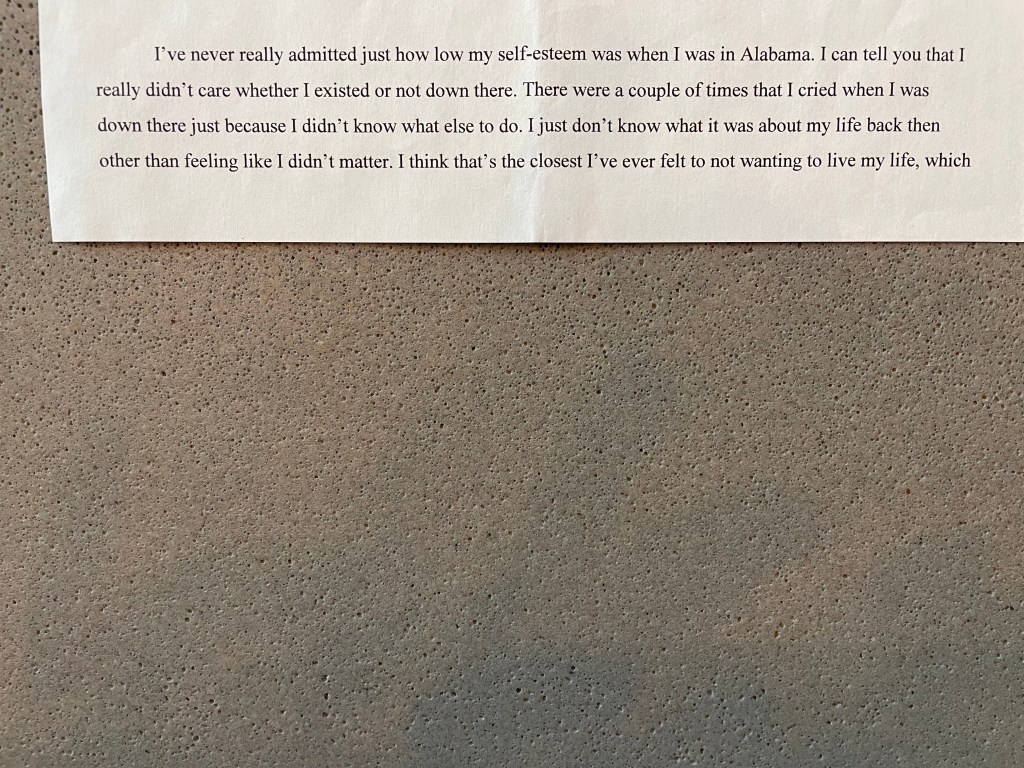
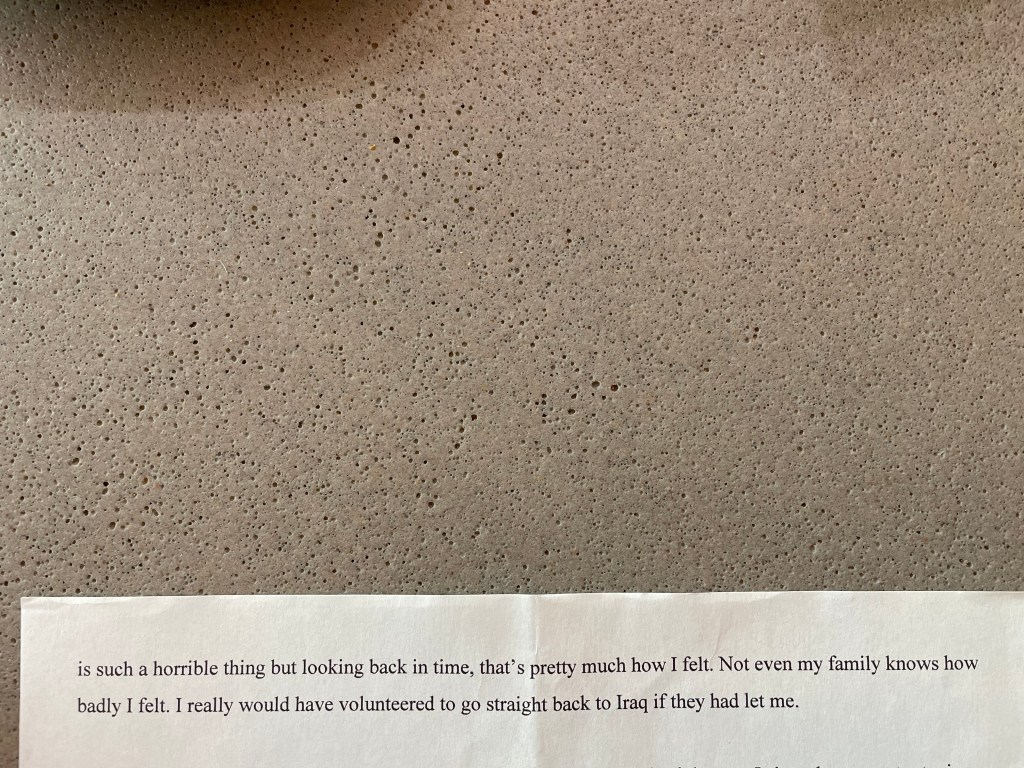
The lowest point didn’t happen right away. Things went on like this for months until I went to Tech Escort school in Huntsville, Alabama. At this point, there was this public self I put on and this private person I was tucked away in my hotel suite. I went to work, the only woman again in a sea of male bodies, and I made time to go to church on the weekend. I want to say the school was only about a month long, but there was something about the isolation there that hit particularly hard. One day I realized I didn’t have to put up with a lackluster life–I could be my own solution and give up. (I’ve thought about sharing this story at least once every year since the second or three year I started this blog.) Part of me is grateful I didn’t write a suicide note or even a journal entry because I don’t want to go back to seeing that part of myself that felt she had nothing to live for. My saving grace was a desire to repair my relationship with my youngest biological sister. Something I was unwilling to admit to her or the rest of my family all these years. In my deepest moment of self-hatred, I felt others would have so many happy memories of us to sustain themselves, and her and I butted heads all throughout our childhood years. Not growing up in the church, I did still have a small conversation with God about my pain and the only thing I made myself do was get through that first night.
To want to play an active role in turning your life around is not easy: Evanna Lynch expresses this reality quite well in The Opposite of Butterfly Hunting. Mental health treatments run the gamut and after all these years, there is still quite a stigma over mental health care versus treatment for ailments of a physical origin. Knowing this personally is part of my reluctance to share my story over the years. I don’t want someone to come out and tell me my pain isn’t real. Even after my lowest point in 2005, I didn’t see mental health treatment in the Marine Corps. This is something that certainly created challenges when I was looking for support through the VA and it’s a decision I wouldn’t want others to replicate. While I wavered between whether I wanted to stay in or not, I felt I couldn’t bring up my issues. That to do so would cause all career opportunities to be taken away from me. I didn’t want someone to be on suicide watch over me or to feel more out of place among my team. The only person I let in was my then-boyfriend, now husband in a letter dated Feb. 4th, 2006, barely a year after Captain Brock’s death.
Being with someone who finally acknowledged me as partner, not a placeholder in their life, was life changing. By no means have things always been easy, often far from it, but I was free from having to feel like I was on this hamster wheel to earn a place in someone’s life and he wasn’t scared by my admissions. These things combined to start a healing journey that continues to this day. Keep in mind I was 21 when I made this admission to him and he was only 19, so if you’re in your 30’s, 40, 50’s, I have faith you can also turn your life around. I think a big part of what we get wrong when we talk about overcoming suicide ideation and coping with mental health is stating, “It gets better” when we should be saying more often and more loudly “You become more capable to face your struggles and if you need help, there are options so you’re not doing this alone.”
I would love to rave for paragraphs on end about the healing power of Evanna Lynch’s book in seeing parallels to my own journey, but here are some ideas to help you or someone you might know struggling today.
People
I am the first to admit I crave longterm committed friendships. I want all my friendships to work out. There are people though who like to use me as bait for other life objectives they have or are completely indifferent to my feelings. I’m not an object. I am a person. The people I’ve removed from my life are gone because of their attitudes, behaviors, and actions towards me. You might need to part ways with people, too, if you find they are trying to derail your recovery and maintenance of healthier habits. None of the people I’ve stopped associating with have apologized for the hurt they’ve caused; if anything, they’ve all, on one occasion or another, insinuated I overreacted or that I’ve tried to rob them of something. I’ve also learned it is dangerous to keep company with people who regularly rely on alcohol as their coping mechanisms.
Things
Not all things are good for you. What is a bad is circumstance-based. In my life, alcohol was adding to my problems, not eliminating them. In 2005, I had moments where I fully understood drinking wasn’t helping and I took breaks from it. My second deployment is still a chapter of my life I could have done without, but it, too, was helpful because it required sobriety. I needed it after drinking heavily the latter half of 2005. I’m not sure what point I realized I could pick more of a path between sobriety and choosing drinking. I did make a conscious decision though to stop drinking kamikaze cocktails, my self-hatred, “I’ll just stew in it” beverage of choice. Years now, I still don’t drink them when we go out and I don’t make them at home in spite of often having the ingredients to make them. Like some people know they cannot trust themselves to own a firearm anymore, I know drinking these would just bring all that pain back to the forefront. I’ve also come to enjoy a lot of alcohol-removed beers and wines. The non-alcoholic Stella Artois is my favorite NA beer; my second choice is Athletic Brewing Co. as they have a variety of flavors. Surely sparkling rose is pretty great so I look forward to trying their other products.
Places
The Marine Corps is a place of employment I realized I couldn’t stay at, and it is a difficult choice I’ve overthought far too many times. I’ve been guilty of being jealous of friends and strangers who succeeded here, but for me, it wasn’t working. Between the invasions of personal privacy while the Marine Corps had no solution for my health problems, being present there at a time where the drinking culture was at a pretty all-time high was not good for my health, and I knew deep down the drive to always improve all combined to make work a place I disliked going to every day. I’ve found the same is true in other jobs, so taking a friend’s words in mind that a place of employment should not exacerbate a disability, I am more mindful of how I spend my working years now.
Positive Replacements (People, Things, and Places)
I cannot find the exact item to share, but there is some information that reads that for each suicide loss about 134 persons are impacted by the death of a loved one or friend. This statistic is important because while your pain can end, it is only transferred. To actually end the pain is to seek help, form healthier attachments and coping mechanisms, and to give yourself grace. For me, I have part of that grace wrapped up in my forearm tattoo. In lieu of the common semi-colon tattoo to mark overcoming my hardships, I have a lot of symbolism wrapped up in the flowers, colors, and placement of this tattoo, my only marker of my Marine Corps service on my body. These all mean something to me. You don’t have to wear your recovery on your person, but for me, it helps me forgive the person I used to be. I also have a large network of friends, family members, and pseudo family members who choose to be here for me. I cannot make up for the people who harmed me, but they can go find less and be short of my expectations. They had their chance to treat me properly and didn’t. Apologies aren’t forthcoming, so expecting closure on those fronts is unrealistic. This includes family members, too, just to be honest. I’m not putting up with bullying, indifference, or emotional abuse from anyone. I have apologized to myself for all I put up with over the years. You can also find me exercising, cooking, baking, and reading to better adapt to my post-deployment self and all the good and bad that comes with this identity. I would encourage anyone still exploring hobbies to cope with mental health challenges, those physical hobbies are a game changer. These things require a type of being physically present that helps smooth over stressful situations, serve as confidence building exercises, and are the types of hobbies you can share with friends or family also on your journey with you.
~Cheryl

 She Wears Dogtags